Evaluating Types of Wood Fireplaces: Lumber Grades & Surrounds
Explore types of wood fireplaces with our grade and quality guide. Learn framing lumber specs, surround wood species, and NFPA clearance rules.

Structural and Finish Lumber for Wood-Burning Systems
When architects and contractors evaluate different types of wood fireplaces, the focus often lands exclusively on the firebox or the fuel. However, the structural integrity and aesthetic longevity of a wood-burning fireplace rely heavily on the grade and quality of the lumber used in the chase framing, mantels, and surrounds. A poorly graded framing stud can warp under the thermal load of the chimney chase, while an improperly dried mantel will crack within months of installation. This guide breaks down the exact lumber grades, species specifications, and clearance requirements necessary for building safe, durable wood fireplace systems in 2026.
Framing Lumber Grades for Fireplace Chase Construction
The chase—the structural enclosure that houses the chimney flue or zero-clearance fireplace pipe—requires lumber that can withstand significant temperature fluctuations without twisting or bowing. Using utility-grade lumber here is a common failure point that leads to drywall cracking and misaligned mantels.
| Lumber Grade | Species Recommendation | Moisture Content (MC) | Application in Fireplace Systems |
|---|---|---|---|
| Select Structural | Douglas Fir-Larch | ≤ 19% (S-DRY) | Load-bearing headers supporting heavy masonry or stone veneer surrounds. |
| #2 Grade | SPF (Spruce-Pine-Fir) | ≤ 19% (S-DRY) | Standard vertical chase framing, king studs, and cripple studs. |
| #3 Grade | Hem-Fir | ≤ 19% | Non-load-bearing backing blocks for securing drywall or cement board. |
| Stud Grade | SPF | ≤ 19% | Short vertical studs directly adjacent to the firebox clearance zones. |
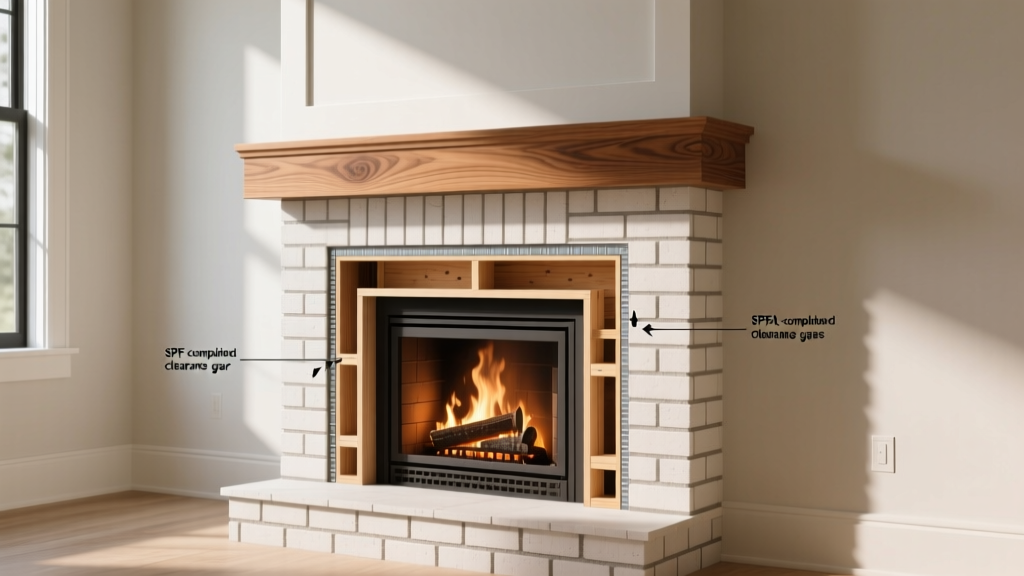
For zero-clearance prefab fireplaces, always specify #2 Grade SPF or better for the chase framing. The heat radiating from the metal firebox can raise ambient chase temperatures to 120°F. Kiln-dried lumber (KD) with a moisture content below 15% is highly recommended to prevent the framing from shrinking and pulling away from the firestop plates after the first heating season.
Warning: NFPA 211 Combustible Clearances
According to the NFPA 211 Standard for Chimneys, Fireplaces, Vents, and Solid Fuel-Burning Appliances, all combustible wood framing must maintain a strict 2-inch air clearance from the exterior of a masonry fireplace or chimney. For wood joists or headers, the required clearance increases to 6 inches. Never pack insulation or wood scraps into these gaps; they are designed for convective air cooling to prevent spontaneous combustion of the framing lumber.
Fireplace Surrounds and Mantels: Selecting the Right Wood Species
The wood used for the mantel and surround is subjected to intense, localized heat and severe humidity drops during the winter. Softwoods like pine or cedar are prone to resin bleeding and checking (splitting) when exposed to these conditions. For premium types of wood fireplaces, hardwoods with high Janka hardness ratings and tight grain structures are mandatory.
Wood Species Comparison Matrix for Mantels
| Wood Species | Janka Hardness (lbf) | Dimensional Stability | Estimated Cost (per linear ft, 2026) | Best Finish Application |
|---|---|---|---|---|
| White Oak (Quarter Sawn) | 1,360 | Excellent (Low radial shrinkage) | $18.00 - $28.00 | Clear polyurethane or penetrating oil |
| Hard Maple | 1,450 | Good (Moderate shrinkage) | $14.00 - $22.00 | Painted finishes or light stains |
| American Black Walnut | 1,010 | Excellent (Very stable) | $35.00 - $55.00 | Natural oil to highlight dark grain |
| Knotty Alder | 590 | Fair (Prone to movement) | $9.00 - $15.00 | Rustic/distressed stain applications |
Pro-Tip for Installers: When ordering a hardwood mantel, specify RF (Rift Sawn) or QS (Quarter Sawn) cuts. Plain-sawn boards will cup upward at the edges when the bottom of the mantel is heated by the fire while the top remains cool. Quarter-sawn White Oak eliminates this cupping due to its vertical grain orientation.
Wood Fuel Grades: Matching the Firebox to the Right Timber
Beyond the construction materials, the operational efficiency of wood-burning fireplaces depends entirely on the grade of the fuel wood. Burning unseasoned or low-grade wood leads to creosote buildup, which is the leading cause of chimney fires. The EPA Burn Wise program strictly outlines the moisture parameters for safe and efficient wood combustion.
Fuel Wood Moisture and BTU Data Highlights
- Green Wood (Unseasoned): Moisture content > 40%. Produces excessive smoke, low heat (approx. 8-10 million BTUs per cord), and rapid creosote accumulation. Never burn in a residential fireplace.
- Air-Seasoned Cordwood: Moisture content 20% - 25%. Requires 6 to 12 months of split, stacked, and covered outdoor drying. Yields 18-22 million BTUs per cord depending on the species (Hickory and Oak yield the highest).
- Kiln-Dried Firewood: Moisture content < 15%. Heated in a kiln to 160°F for 75 minutes to kill invasive pests and eliminate moisture. Yields maximum heat output (24-28 million BTUs per cord) with minimal particulate emissions.
For high-efficiency EPA-certified wood fireplace inserts, always utilize kiln-dried hardwoods. The USDA Forest Products Laboratory notes that wood burned at 20% moisture content yields roughly 30% more usable heat than wood burned at 40% moisture, as the firebox does not waste energy boiling off internal water weight.
Frequently Asked Questions: Wood Fireplace Materials
Can I use shiplap or wood paneling around a wood-burning fireplace?
Yes, but it must be installed outside the required non-combustible clearance zone. For masonry fireplaces, this means maintaining a 12-inch clearance from the top and sides of the firebox opening using brick, stone, or cement board. Beyond that 12-inch boundary, you may install Grade A or B interior pine shiplap, provided it is treated with a Class A fire-retardant coating.
Why did my custom wood mantel crack down the center?
Center-checking in mantels is caused by using 'green' or inadequately kiln-dried lumber (moisture content above 12%). The intense heat from the fireplace rapidly dries the bottom face of the wood, causing it to shrink faster than the top face. Always verify that your mantel supplier uses interior-grade kiln-dried lumber (6-8% MC) specifically milled for fireplace applications.
What is the best structural lumber for supporting a heavy stone veneer surround?
Stone veneer can weigh 10 to 15 pounds per square foot. Standard #2 SPF studs may deflect under this continuous load. Upgrade the framing directly behind the stone surround to Select Structural Douglas Fir-Larch or engineer the wall using 2x6 framing at 12 inches on-center to provide adequate backing for the metal lath and mortar scratch coat.
Written by
James ThorntonJames Thornton is a construction industry veteran with 25 years of hands-on experience in wood framing, lumber grading, and residential building codes. He started as a framing carpenter in rural Oregon, earned his ICC Residential Building Inspector certification, and eventually became a senior plan reviewer for the City of Portland Bureau of Development Services. James holds a B.S. in Wood Science & Technology from Oregon State University and is a certified lumber grader through the West Coast Lumber Inspection Bureau (WCLIB). He has inspected over 3,000 residential construction sites and authored the city's internal guide on advanced framing techniques (2x6 at 24" O.C.). James lives in Bend, OR, where he builds custom timber-frame cabins and competes in lumberjack sports.
More from James Thornton
View all
Insulation
Best Home Insulation Materials: Complete 2026 Guide
Compare top home insulation materials for 2026. Find R-values, installed costs per square foot, and best uses for fiberglass, spray foam, and mineral wool.
Aug 4, 2026

Sustainable Building
Certify Your Green Building Material for LEED and WELL
Step-by-step guide to certifying a green building material for LEED v5 and WELL v2. Master EPDs, HPDs, and VOC limits for 2026 project specifications.
Aug 4, 2026

Stone & Masonry
Veneer Stacked Stone Panels: Interior Design & Style Showcase
Discover how veneer stacked stone panels transform interiors. Explore modern design profiles, material pairings, and technical installation specs.
Aug 4, 2026