Types of Drill Bits Wood Pros Use: A Selection Framework
Master the types of drill bits wood pros use with this selection framework. Match bit geometry, metallurgy, and RPMs to specific wood species and tasks.

The Anatomy of Wood Drill Bit Selection
Selecting the correct tooling is not about finding a universal bit; it is about matching cutting geometry to material density, fiber orientation, and production volume. When categorizing the types of drill bits wood fabricators and carpenters use, the decision must be driven by a strict framework of material hardness (Janka scale), hole diameter, and required edge finish. Using a standard twist bit on highly figured maple will result in catastrophic tear-out, while using a precision brad point bit to bore deep holes through a laminated veneer lumber (LVL) beam will lead to bit binding and motor burnout.
This framework provides a systematic approach to selecting the right bit, calculating optimal feed rates, and understanding the metallurgical requirements for modern engineered and solid wood substrates.
Core Types of Drill Bits for Wood: A Matrix
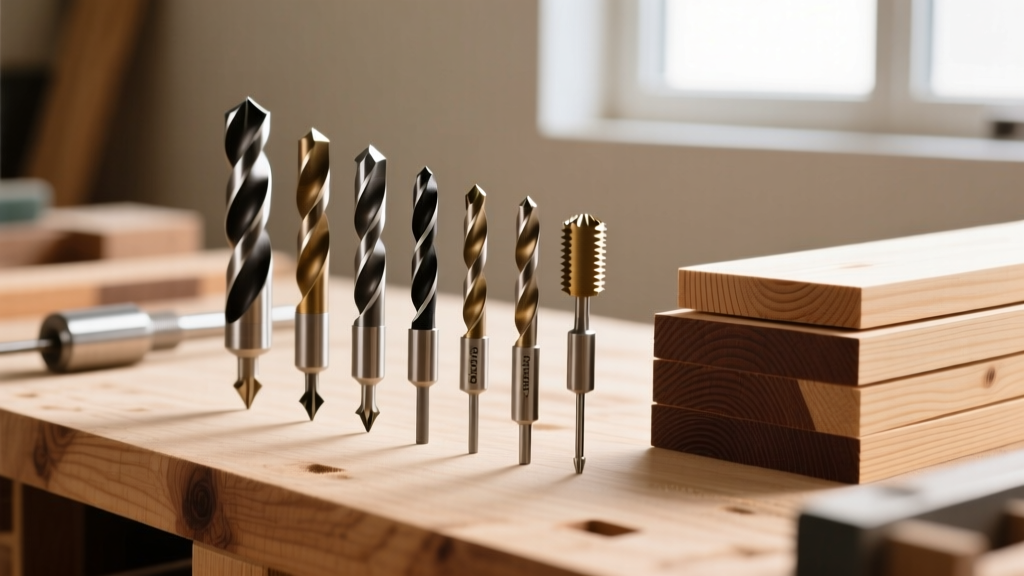
Every bit geometry serves a distinct mechanical purpose. The following matrix breaks down the primary types of drill bits wood professionals deploy across different shop and job-site scenarios.
| Bit Type | Geometry & Features | Primary Use Case | Max Depth-to-Diameter Ratio | Finish Quality |
|---|---|---|---|---|
| Brad Point | Center spur with two outer cutting spurs; 118-degree split point. | Precision pilot holes, doweling, shelf pins. | 5:1 | Excellent (Clean entry/exit) |
| Forstner | Rim-driven cutting edge with center pilot; flat bottom. | Euro hinge cups (35mm), overlapping holes, flat-bottom blind holes. | 2:1 (Standard) / 4:1 (With extension) | Superior (Glass-smooth walls) |
| Spade (Paddle) | Flat blade with center point and side spurs; aggressive rake angle. | Rough plumbing/electrical holes in studs, speed drilling. | 8:1 | Poor (High tear-out risk) |
| Ship Auger | Single or double flute with a threaded pull-screw tip. | Deep boring in heavy timber, LVL, and PSL beams. | 15:1+ | Fair (Clean entry, rough exit) |
| Countersink (Combo) | Pilot drill surrounded by a multi-fluted conical cutter. | Flush-mounting screws, preventing surface splitting. | N/A (Surface/Profile cut) | Excellent (Chamfered edge) |
Decision Tree: Matching the Bit to the Wood Species
Wood density dictates cutting speed, chip clearance, and edge wear. According to data from the US Forest Products Laboratory, the Janka hardness scale is the most reliable metric for determining tooling requirements.
Softwoods (Janka < 900 lbf) & Engineered Panels
Species like Eastern White Pine (380 lbf) and SPF framing lumber, alongside MDF and plywood, are relatively forgiving. However, engineered panels contain abrasive urea-formaldehyde or MDI resins that dull high-speed steel (HSS) rapidly.
- Recommended Tooling: Carbide-tipped brad points or solid carbide down-shear router bits for CNC. Standard HSS twist bits are acceptable for rough framing.
- RPM Guideline: High speed (2,000 - 3,000 RPM for 1/4-inch bits) with a fast feed rate to prevent resin burn in MDF.
Domestic Hardwoods (Janka 900 - 2,000 lbf)
Red Oak (1290 lbf) and Hard Maple (1450 lbf) require sharp outer spurs to sever fibers cleanly before the lifting action of the flute removes the chip. Tear-out is the primary failure mode here.
- Recommended Tooling: Premium HSS or Titanium Nitride (TiN) coated brad points with a 90-degree spur angle. Forstner bits with sawtooth rims for holes over 1/2 inch.
- RPM Guideline: Moderate speed (1,200 - 1,800 RPM for 1/4-inch bits). Peck drilling is mandatory for depths exceeding 2 inches to clear chips and prevent heat buildup.
Application-Specific Frameworks
Beyond material density, the structural intent of the hole dictates the tooling. A cabinetmaker and a timber framer have entirely different priorities regarding the types of drill bits wood structures demand.
Joinery and Cabinetry (Precision over Speed)
In cabinetmaking, tolerance stack-up is the enemy. When drilling 5mm shelf pin holes or 8mm dowel holes, the bit must not wander upon entry. Popular Woodworking emphasizes that bit wander is often caused by dull outer spurs or excessive chuck runout.
- Framework: Use Colt Maxi2 or Festool brad point bits. These feature a precision-ground center point that scores the wood before the main cutting lips engage.
- Edge Case: When drilling through melamine-faced particleboard, standard brad points will blow out the back veneer. Use a Vix bit or a zero-clearance sacrificial backer board clamped to the exit side.
Structural Framing (Speed and Depth)
When running 2-inch PVC drain lines through 2x10 floor joists or boring LVL ridge beams for steel tension rods, speed and chip evacuation are paramount.
- Framework: Use self-feed bits (like the Milwaukee Switchblade) for holes up to 2-9/16 inches in dimensional lumber. For LVL beams, use a heavy-duty single-flute ship auger (e.g., Irwin Speedbor 880 series). The threaded screw tip pulls the bit through the dense laminations, reducing the torque required from the drill.
- Edge Case: Never use a spade bit in LVL or PSL beams. The alternating grain directions and heavy adhesives will catch the spade's side spurs, potentially causing severe wrist injuries from drill kickback.
Metallurgy and Coatings: What Actually Matters
Marketing terms often obscure the actual metallurgical properties of drill bits. Here is the reality of bit materials for woodworking:
- Carbon Steel: Avoid entirely. It loses its temper (softens) at the low heat thresholds generated by wood friction.
- High-Speed Steel (HSS - M2 Grade): The baseline standard. Excellent for softwoods and occasional hardwood use. Can be resharpened easily with a diamond hone.
- Cobalt (M35 / M42): Contains 5-8% cobalt, increasing heat resistance and edge retention. Ideal for abrasive engineered woods and dense exotics.
- Titanium Nitride (TiN) Coating: The gold-colored finish reduces friction by up to 30%, allowing for faster feed rates in resinous softwoods (like Southern Yellow Pine) without pitch buildup.
- Carbide-Tipped vs. Solid Carbide: Carbide-tipped Forstner bits are essential for high-volume MDF and melamine work. Solid carbide brad points are brittle; they will shatter if subjected to lateral deflection in a handheld drill. Reserve solid carbide strictly for CNC routers or drill presses.
Troubleshooting Common Wood Drilling Failures
Cause: Chip packing. The flutes are clogged, creating friction.
Fix: Implement peck drilling (retracting the bit every 1/2 inch of depth). If using a Forstner bit, ensure you are clearing the hole frequently, as Forstner bits lack deep ejection flutes.
Cause: The cutting lips push the unsupported bottom fibers outward before severing them.
Fix: Drill until the center spur just pierces the exit face (approx. 1mm). Flip the workpiece, insert the bit's center spur into the pilot hole, and complete the cut from the opposite side.
Sourcing and Cost Expectations
Professional tooling requires capital investment, but the cost-per-hole drops significantly compared to big-box store alternatives. As of 2026, pricing for professional-grade wood drill bits reflects both material costs and precision grinding.
| Bit Category | Consumer Grade (Big Box) | Professional Grade (Specialty) | Cost-Per-Hole Value |
|---|---|---|---|
| Brad Point Set (1/8' to 1/2') | $25 - $45 (HSS, rolled flutes) | $120 - $220 (M2 HSS, ground flutes, 90-deg spurs) | Professional sets last 10x longer in hardwoods, justifying the premium. |
| 35mm Forstner Bit | $15 - $25 (Carbon steel, wavy rim) | $45 - $85 (Carbide-tipped, sawtooth rim) | Carbide sawtooth bits yield 500+ clean holes in melamine vs. 20 for carbon. |
| Ship Auger (3/4' x 18') | $35 - $50 (Soft steel, painted) | $80 - $130 (Hardened alloy, polished flutes) | Polished flutes prevent binding in deep LVL beams, saving drill motors. |
Ultimately, mastering the selection of drill bits transforms woodworking from a battle against friction and tear-out into a precise, predictable machining process. Align your bit geometry with the wood's Janka hardness, respect the RPM limits of the substrate, and invest in metallurgy that matches your production volume.
Written by
James ThorntonJames Thornton is a construction industry veteran with 25 years of hands-on experience in wood framing, lumber grading, and residential building codes. He started as a framing carpenter in rural Oregon, earned his ICC Residential Building Inspector certification, and eventually became a senior plan reviewer for the City of Portland Bureau of Development Services. James holds a B.S. in Wood Science & Technology from Oregon State University and is a certified lumber grader through the West Coast Lumber Inspection Bureau (WCLIB). He has inspected over 3,000 residential construction sites and authored the city's internal guide on advanced framing techniques (2x6 at 24" O.C.). James lives in Bend, OR, where he builds custom timber-frame cabins and competes in lumberjack sports.
More from James Thornton
View all
Insulation
Best Home Insulation Materials: Complete 2026 Guide
Compare top home insulation materials for 2026. Find R-values, installed costs per square foot, and best uses for fiberglass, spray foam, and mineral wool.
Aug 4, 2026

Sustainable Building
Certify Your Green Building Material for LEED and WELL
Step-by-step guide to certifying a green building material for LEED v5 and WELL v2. Master EPDs, HPDs, and VOC limits for 2026 project specifications.
Aug 4, 2026

Stone & Masonry
Veneer Stacked Stone Panels: Interior Design & Style Showcase
Discover how veneer stacked stone panels transform interiors. Explore modern design profiles, material pairings, and technical installation specs.
Aug 4, 2026