Hardwood Floor Finish Options: A Complete Species Guide
Discover the best hardwood floor finish options for every wood species. Learn how oak, walnut, and maple react to polyurethane, oil, and wax finishes.
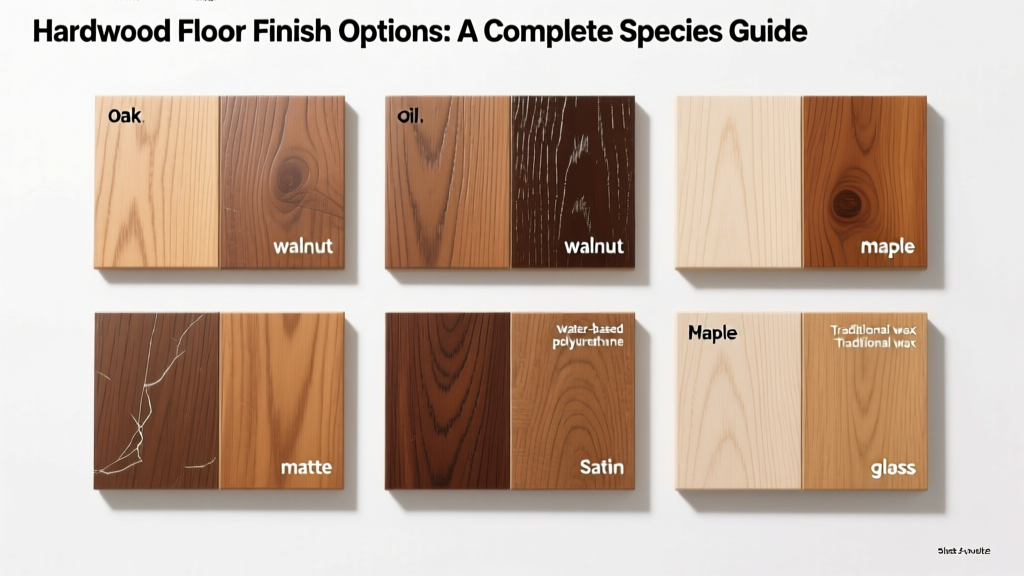
The Chemistry of Wood: Why Species Dictates Finish Selection
Selecting the right hardwood floor finish options requires more than choosing between matte and gloss. The cellular structure, tannin content, and Janka hardness of a specific wood species fundamentally dictate how a finish will bond, cure, and age. According to data from the USDA Forest Products Laboratory, the anatomical differences between ring-porous and diffuse-porous woods alter the mechanical adhesion of film-building finishes and the penetration depth of reactive oils.
Ring-porous species, like oak and ash, feature large earlywood vessels that allow deep penetration of hardwax oils but require grain fillers for a perfectly smooth polyurethane surface. Conversely, diffuse-porous species like maple and cherry have uniform, tightly packed cells that reject heavy oil penetration, making them ideal candidates for surface-level water-based polyurethanes. Ignoring these biological realities leads to finish failure, tannin bleed, and uneven curing.
Domestic Hardwoods: Finish Pairings for Oak, Maple, and Hickory
Red and White Oak (The Industry Standards)
White oak (1360 Janka) and red oak (1290 Janka) dominate the North American flooring market, but their chemical profiles require vastly different approaches to finishing. White oak contains high concentrations of tannic acid and features tyloses—cellular outgrowths that make the wood highly water-resistant but reactive to water-based finishes.
Applying a standard water-based polyurethane directly to raw white oak triggers a chemical reaction that pulls tannins to the surface, resulting in a permanent yellowish-green hue. You must apply a tannin-blocking sealer, such as Bona Prime AmberSeal or a specialized water-white sealer, before applying water-based topcoats.
Red oak lacks tyloses and has highly open pores. It accepts penetrating oils beautifully, making it the premier candidate for hardwax oils like Rubio Monocoat 2C or Osmo Polyx-Oil. The open grain allows the oil to molecularly bond deep within the wood fibers, providing exceptional durability while maintaining a natural, zero-build texture.
Hard Maple (The Dense Challenge)
Hard maple (1450 Janka) is a diffuse-porous wood with an incredibly tight, closed grain. Because it resists deep penetration, applying traditional penetrating oils often results in a blotchy, uneven appearance. The optimal hardwood floor finish options for maple are high-solids, water-based two-component polyurethanes (such as Loba WS 2K Supra or Bona Traffic HD). These finishes build a microscopic protective film on the surface rather than relying on deep absorption. For sanding prep, stop at 120-grit; sanding maple too smoothly (e.g., 150-grit) can burnish the dense fibers and cause adhesion failure.
Hickory (The High-Contrast Grain)
Hickory (1820 Janka) is one of the hardest domestic species and features dramatic color variations between its light sapwood and dark heartwood. To enhance this natural contrast, solvent-based or oil-modified polyurethanes are highly effective, as the ambering effect deepens the heartwood's rich tones. If a modern, muted look is preferred, a hardwax oil in a 'Pure' or 'Cotton White' pigment will soften the contrast while providing excellent scuff resistance.
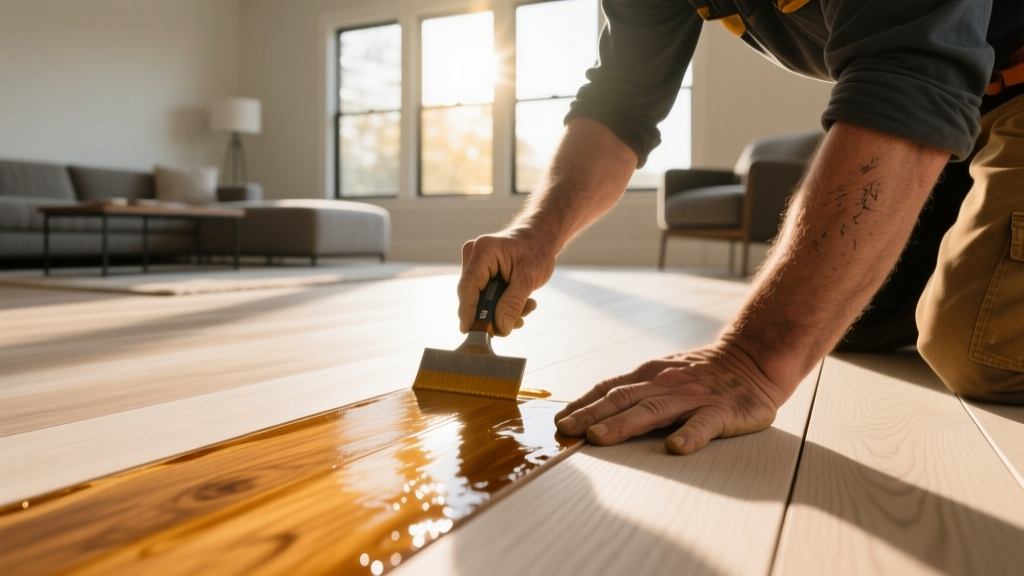
Dark and Exotic Species: Walnut, Cherry, and Jatoba
American Black Walnut
Walnut (1010 Janka) is prized for its deep chocolate hues and chatoyance (the 3D light reflection within the grain). Walnut naturally darkens and warms when exposed to UV light. Oil-modified polyurethanes accelerate this ambering process, which is generally desirable for walnut. However, if the goal is to preserve the exact raw, freshly sanded color of the walnut, a two-component water-based finish with a UV inhibitor is mandatory.
Exotic Oily Woods (Jatoba, Rosewood, Ipe)
Exotic species like Jatoba (Brazilian Cherry, 2350 Janka) and Rosewood contain high levels of natural resins, oils, and extractives. These exudates act as chemical retarders that will prevent oxidative oil finishes and standard polyurethanes from curing, leaving the floor permanently tacky.
Pro Protocol for Exotics: Before sealing any high-resin exotic wood, wipe the raw floor with mineral spirits or a commercial solvent to remove surface oils. Immediately follow with a fast-drying, solvent-based sealer or a dewaxed shellac barrier coat to lock in the remaining extractives before applying your final topcoat.
Comprehensive Finish Matrix by Wood Species
The following matrix provides a technical framework for matching species to finish chemistry, based on guidelines from the National Wood Flooring Association (NWFA).
| Wood Species | Grain Structure | Janka Hardness | Ideal Finish Type | Required Prep / Sealer |
|---|---|---|---|---|
| White Oak | Ring-Porous | 1360 lbf | Hardwax Oil, 2K Water-Based Poly | Tannin-blocking sealer mandatory for water-based |
| Red Oak | Ring-Porous | 1290 lbf | Penetrating Oil, Oil-Modified Poly | Optional grain filler for high-gloss film finishes |
| Hard Maple | Diffuse-Porous | 1450 lbf | 2K Water-Based Poly, Conversion Varnish | Stop sanding at 120-grit to prevent burnishing |
| Hickory | Ring-Porous | 1820 lbf | Oil-Modified Poly, Pigmented Hardwax | Standard 100-grit final sand sequence |
| Black Walnut | Diffuse-Porous | 1010 lbf | Oil-Modified Poly, Hardwax Oil | UV-inhibitor sealer if preventing ambering |
| Jatoba (Brazilian Cherry) | Diffuse-Porous | 2350 lbf | Moisture-Cured Urethane, Solvent-Based Poly | Solvent wipe + shellac barrier coat required |
Deep Dive into Top Hardwood Floor Finish Options
Two-Component Water-Based Polyurethane
Products like Bona Traffic HD and Loba WS 2K Supra represent the pinnacle of modern film-building finishes. By mixing an aliphatic polyisocyanate hardener with a polyurethane resin, these finishes achieve commercial-grade durability (Taber abrasion tests exceeding 4000 cycles) while maintaining ultra-low VOC emissions. They dry in 4 to 6 hours, allowing for two coats in a single day. Material costs range from $1.50 to $2.50 per square foot.
Hardwax Oils (Reactive Molecular Bonding)
Unlike traditional penetrating oils that simply soak in, hardwax oils (Rubio Monocoat 2C, Osmo Polyx-Oil) utilize a molecular bonding process. The oil component penetrates the wood, while the wax component reacts with ambient moisture to form a durable, breathable matrix on the surface. They require only a single coat application, and spot-repairs are seamless. However, they demand strict environmental controls during application (ideal RH: 40-60%) and cost between $2.50 and $4.00 per square foot in materials.
Moisture-Cured Urethane
Moisture-cured urethanes are the most durable finishes available, utilizing atmospheric humidity to trigger cross-linking. They are exceptionally resistant to chemicals and heavy abrasion, making them ideal for commercial spaces or high-traffic exotic wood floors. However, they are highly sensitive to application conditions; if the humidity is too low, they will not cure, and if it is too high, they will blush (turn cloudy). Due to high VOC content and application complexity, they are strictly for certified professionals.
Application Protocols and Edge Cases
Critical Environmental Thresholds
- Relative Humidity (RH): Must be maintained between 35% and 55% during application and curing. Deviations cause micro-checking in film finishes or delayed curing in hardwax oils.
- Wood Moisture Content (MC): Must be within 2% to 4% of the subfloor moisture content and generally between 6% and 9% for interior climate-controlled environments.
- Temperature: Finish chemistry is optimized for 65°F to 80°F (18°C to 27°C). Applying polyurethane below 60°F drastically extends dry times and compromises flow-out, leading to brush marks.
The Silicone Contamination Edge Case
One of the most catastrophic failure modes in floor finishing is silicone contamination, often introduced by previous homeowners using aerosol furniture polishes (e.g., Pledge) or pet care products. Silicone causes 'fisheyes'—small, circular craters where the finish pulls away from the wood. If silicone is suspected, the floor must be thoroughly scrubbed with a specialized silicone remover or mineral spirits, followed by a test application of a shellac-based sealer, which is the only primer capable of bridging silicone residues.
Matching the correct finish chemistry to the specific biological traits of your wood species is the single most critical decision in hardwood flooring. By respecting the tannin content, grain porosity, and natural extractives of the wood, contractors and homeowners can ensure a finish that is not only visually stunning but structurally resilient for decades.
Written by
James ThorntonJames Thornton is a construction industry veteran with 25 years of hands-on experience in wood framing, lumber grading, and residential building codes. He started as a framing carpenter in rural Oregon, earned his ICC Residential Building Inspector certification, and eventually became a senior plan reviewer for the City of Portland Bureau of Development Services. James holds a B.S. in Wood Science & Technology from Oregon State University and is a certified lumber grader through the West Coast Lumber Inspection Bureau (WCLIB). He has inspected over 3,000 residential construction sites and authored the city's internal guide on advanced framing techniques (2x6 at 24" O.C.). James lives in Bend, OR, where he builds custom timber-frame cabins and competes in lumberjack sports.
More from James Thornton
View all
Insulation
Best Home Insulation Materials: Complete 2026 Guide
Compare top home insulation materials for 2026. Find R-values, installed costs per square foot, and best uses for fiberglass, spray foam, and mineral wool.
Aug 4, 2026

Sustainable Building
Certify Your Green Building Material for LEED and WELL
Step-by-step guide to certifying a green building material for LEED v5 and WELL v2. Master EPDs, HPDs, and VOC limits for 2026 project specifications.
Aug 4, 2026

Stone & Masonry
Veneer Stacked Stone Panels: Interior Design & Style Showcase
Discover how veneer stacked stone panels transform interiors. Explore modern design profiles, material pairings, and technical installation specs.
Aug 4, 2026