A Selection Framework for Different Types of Cherry Wood
Compare true American Black Cherry with trade-name alternatives. Use this selection framework to choose the right types of cherry wood for your project.

The "Cherry" Misnomer in Commercial Lumber
When architects, millworkers, and flooring contractors specify "cherry" for a project, they frequently encounter a fragmented market. The commercial lumber industry utilizes the word "cherry" to market a wide spectrum of botanically unrelated hardwoods. True cherry belongs to the genus Prunus, but many imported tropical species are branded with the cherry trade name strictly to capitalize on the domestic prestige and color association of American Black Cherry.
Selecting the correct material requires moving beyond trade names and evaluating botanical properties, Janka hardness ratings, and dimensional stability. This framework decodes the various types of cherry wood available in 2026, providing actionable specifications for cabinetry, heavy-duty flooring, and exterior applications.
True Cherry: American Black Cherry (Prunus serotina)
American Black Cherry is the only true cherry widely harvested for commercial architectural woodworking in North America. Sourced primarily from the Appalachian and Northern hardwood regions, it is the gold standard for high-end interior millwork and cabinetry.
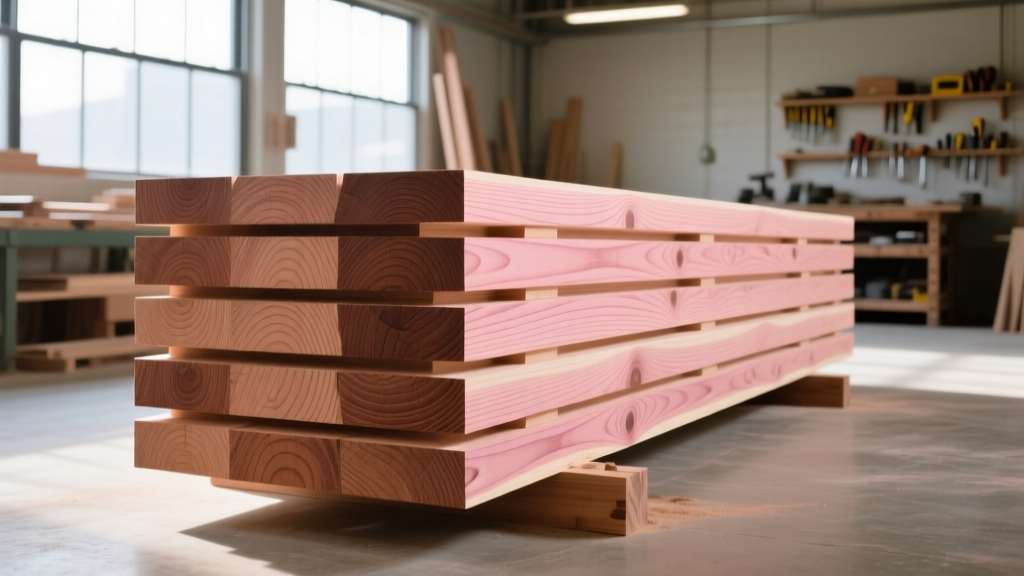
Freshly milled Black Cherry heartwood is a pale, pinkish-brown. Upon exposure to ultraviolet light and oxygen, it undergoes a rapid photochemical reaction, darkening to a rich, translucent reddish-brown within the first six months. If a project requires the wood to maintain its initial pale color, specify a UV-inhibiting topcoat (such as a specialized polyurethane with HALS additives) immediately after finishing.
Workability and Finishing Gotchas
With a Janka hardness of 950 lbf and a specific gravity of 0.50, Black Cherry machines beautifully. It routes cleanly and holds edge profiles sharply. However, it is notorious for stain blotching due to its uneven end-grain and varying density bands. Penetrating oil-based pigment stains will yield a mottled, unprofessional appearance.
- The Fix: Apply a 1-lb cut of dewaxed shellac as a wash coat to seal the grain before applying pigment stains.
- The Alternative: Use aniline dye stains, which penetrate the wood fibers uniformly without relying on pore density, or rely entirely on clear topcoats to let the natural UV patina develop.
The Trade-Name Cherries: Hardness & Durability Matrix
If your project demands higher impact resistance than American Black Cherry can provide, or if you are sourcing materials for commercial flooring, you will encounter several "trade-name" cherries. These species share the reddish hue but possess vastly different mechanical properties. According to comprehensive botanical testing by the Wood Database, the mechanical divergence between true cherry and its tropical namesakes is extreme.
| Trade Name | Botanical Name | Janka Hardness (lbf) | Avg Dried Weight (lbs/ft³) | Primary Architectural Use |
|---|---|---|---|---|
| American Black Cherry | Prunus serotina | 950 | 35 | Cabinetry, Interior Millwork |
| Brazilian Cherry (Jatoba) | Hymenaea courbaril | 2,350 | 53 | Commercial Flooring, Heavy Traffic |
| Patagonian Cherry (Guatambu) | Balfourodendron riedelianum | 1,630 | 46 | Residential Flooring, Turnery |
| Caribbean Cherry (Bucida) | Bucida buceras | 1,180 | 49 | Exterior Trim, Decking |
| Sweet Cherry (European) | Prunus avium | 1,150 | 38 | Fine Furniture (Niche/Import) |
Note: Brazilian Cherry (Jatoba) is exceptionally hard. While it excels in flooring, its high density and interlocked grain cause severe tear-out during routing and rapid dulling of standard HSS tooling. Carbide-tipped tooling is mandatory when milling Jatoba, as detailed in species-specific milling guides.
Application-Specific Selection Decision Tree
Use this framework to match the specific type of cherry wood to your project's physical and environmental demands.
Scenario A: Kitchen Cabinetry and Furniture
Selection: American Black Cherry (FAS Grade).
Rationale: Cabinetry requires extensive routing for door profiles, dovetail joinery, and sanding. Black Cherry's moderate hardness prevents excessive wear on router bits and sandpaper. Its dimensional stability (Tangential shrinkage: 9.2%, Radial shrinkage: 5.4%) ensures that frame-and-panel cabinet doors will not crack or bind during seasonal humidity fluctuations.
Scenario B: High-Traffic Commercial Flooring
Selection: Brazilian Cherry (Jatoba).
Rationale: True Black Cherry (950 lbf) is too soft for commercial corridors or retail spaces; it will dent under rolling loads and high-heel traffic. Brazilian Cherry (2,350 lbf) offers more than double the impact resistance. It also exhibits excellent resistance to wood-boring insects and fungal decay, making it ideal for ground-level commercial installations.
Scenario C: Exterior Millwork and Decking
Selection: Caribbean Cherry (Bucida) or pivot to a non-cherry alternative.
Rationale: American Black Cherry has virtually no natural rot resistance and will decay rapidly when exposed to ground contact or constant moisture. Caribbean Cherry offers moderate decay resistance and high density. However, for high-end exterior applications in 2026, many architects are pivoting away from Caribbean Cherry toward thermally modified hardwoods or highly durable species like Ipe and Cumaru due to better long-term weathering profiles.
Grading Specifications and the Sapwood "Gotcha"
Purchasing American Black Cherry requires strict adherence to National Hardwood Lumber Association (NHLA) grading specifications. The most common and costly mistake made by procurement teams involves sapwood.
Industry Standard Warning: Under standard NHLA rules, sapwood (the pale, yellowish-white outer layer of the log) is not considered a defect in Black Cherry unless explicitly excluded on the purchase order. A standard FAS (First and Seconds) grade board can legally contain up to 83.3% clear cuttings, but those cuttings may be entirely sapwood.
To ensure you receive the rich, dark heartwood required for premium interior finishes, you must alter your purchase order specifications:
- Specify "All Heartwood" or "90/50": This dictates that the board must be 90% heartwood on the face and 50% on the back.
- Specify "Sap-Free": This commands a premium (often 15-20% above standard FAS pricing) but guarantees uniform color oxidation.
- Mineral Streaks: Black Cherry is prone to black and green mineral streaks caused by soil nutrients. If your design requires a pristine, uniform grain, specify "No Mineral Streaks" or "1-Face Clear" to ensure at least one show-face is free of discoloration.
2026 Cost Analysis and Yield Expectations
Budgeting for cherry wood requires accounting for both the base board-foot (BF) cost and the waste factor inherent in the selected grade.
| Species / Grade | Avg. 2026 Price (per BF) | NHLA Clear Yield | Best Use Case |
|---|---|---|---|
| Black Cherry - FAS (Heartwood specified) | $12.50 - $16.00 | 83.3% - 100% | Cabinet doors, wide panels, premium furniture |
| Black Cherry - #1 Common | $7.00 - $9.50 | 66.6% | Drawer boxes, internal structural framing, short runs |
| Brazilian Cherry (Jatoba) - FAS | $7.50 - $10.50 | 83.3% - 100% | Flooring, stair treads, heavy-duty workbenches |
Yield Calculation Tip: When estimating material for a kitchen cabinet run using #1 Common Black Cherry, multiply your net square footage by 1.5 to account for the 33.4% waste factor (knots, sapwood, and mineral defects that must be cut around). For FAS grade with a heartwood specification, a 1.15 multiplier is generally sufficient to account for end-trimming and minor edge defects.
Summary: Finalizing Your Specification
The term "cherry" is a color and marketing descriptor, not a singular botanical guarantee. For interior architectural woodwork where machinability and traditional aesthetics are paramount, specify Prunus serotina (American Black Cherry) with strict heartwood and mineral-streak limitations on the PO. For high-impact flooring applications, pivot to Hymenaea courbaril (Brazilian Cherry/Jatoba), ensuring your milling contractor is equipped with carbide tooling to handle its 2,350 lbf density. By aligning the botanical reality of the wood with the mechanical demands of the application, you eliminate material failure and ensure long-term architectural integrity.
Written by
Priya KapoorPriya Kapoor is a real estate market analyst and construction economics researcher with expertise in housing affordability, development feasibility, and infrastructure investment. She holds a Master of Regional Planning from Cornell University and previously worked as a senior analyst at CBRE's Investment Properties group, where she modeled returns for $4B in mixed-use development pipelines. Priya now runs an independent research practice advising developers, municipalities, and REITs on construction cost forecasting and market timing. She publishes the quarterly "BuildMat Market Pulse" report tracking material price indices across 12 commodity categories. Based in Austin, TX, Priya serves on the board of Habitat for Humanity Austin and is a marathon runner.
More from Priya Kapoor
View all
Construction Cost
Cost to Build a 1600 Sq Ft Home in 2026: Full Breakdown
Accurate 2026 cost to build a 1600 sq ft home—material, labor, and regional pricing breakdowns included. Plan your budget with real-time estimates.
Aug 11, 2026

Wood & Lumber
Name the Types of Wood for Pressure Treatment and Preservation
Learn how to name the types of wood best suited for pressure treatment. Compare species treatability, chemical retention levels, and 2026 preservation costs.
Aug 4, 2026

Stone & Masonry
Stone Veneer Suppliers Lindenhurst: 2026 Cost Analysis
Analyze 2026 stone veneer costs in Lindenhurst, NY. Compare local supplier pricing, delivery fees, and Suffolk County installation labor rates.
Aug 4, 2026