How to Tell the Type of Wood: A Builder's Identification Guide
Learn how to tell the type of wood using end-grain pores, Janka hardness, and sensory tests. A practical identification framework for builders.

The End-Grain Examination Framework
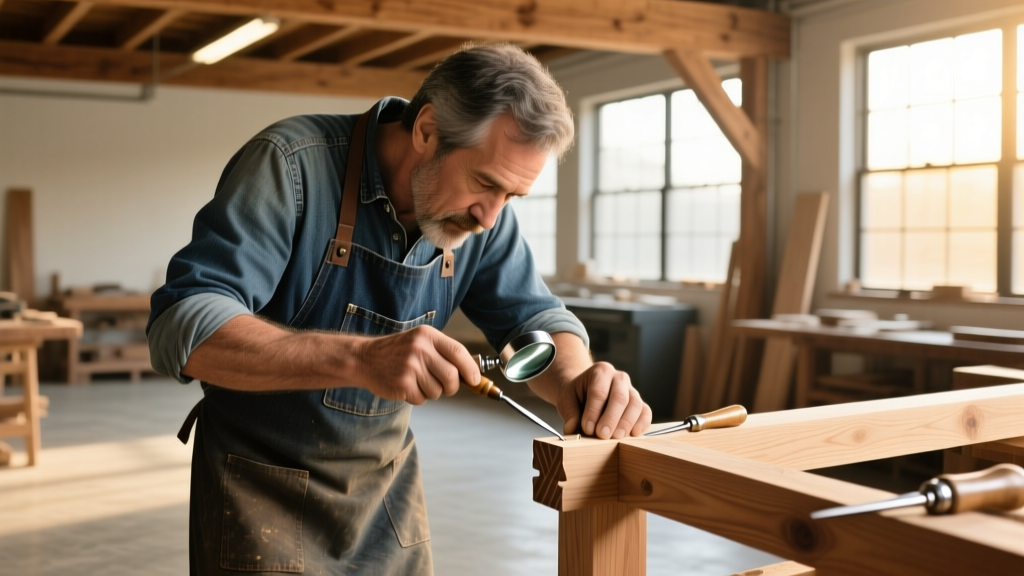
Identifying lumber species from a face-grain glance is unreliable due to staining, aging, and superficial similarities. The definitive method for determining wood species—especially when evaluating reclaimed timber or unmarked yard stock—is end-grain analysis. Using a 10x to 20x triplet jeweler’s loupe (such as a Belomo or Hastings), you can classify the cellular structure into distinct botanical categories.
Hardwood Pore Structures
Hardwoods (angiosperms) contain vessel elements, or pores, which transport water. The arrangement of these pores on the end grain dictates the wood's workability, finishing characteristics, and structural behavior.
- Ring-Porous: Earlywood pores are massively larger than latewood pores, forming distinct concentric rings. Species: White Oak, Red Oak, Ash, Elm, Hickory. These woods typically have bold, prominent face-grain patterns and require grain fillers for a glass-smooth finish.
- Diffuse-Porous: Pores are uniform in size and evenly distributed across the growth ring. Species: Hard Maple, Birch, Yellow Poplar, Basswood. These yield incredibly smooth surfaces straight from the planer and are ideal for painted cabinetry or precision millwork.
- Semi-Ring-Porous: A transitional category where earlywood pores are slightly larger, but the transition is gradual. Species: Black Walnut, Black Cherry. These offer a balance of prominent grain and excellent machinability.
Softwood Diagnostics: Resin Canals and Transition
Softwoods (gymnosperms) lack pores, relying on tracheids for water transport. Identification hinges on the presence of resin canals and the transition between earlywood and latewood.
- With Resin Canals: Visible under 10x magnification as small, distinct dots (often filled with white or amber pitch). Species: Pine, Spruce, Larch, Douglas Fir. (Note: Douglas Fir has very small, sporadic canals, while Pines have large, obvious ones).
- Without Resin Canals: The end grain appears uniform without pitch dots. Species: Cedar, Hemlock, True Firs (e.g., Balsam, Noble). Western Red Cedar is further identified by its distinct arborvitae odor and sharp earlywood-to-latewood transition.
Sensory Diagnostics: Oxidation, Odor, and Weight
When end-grain analysis yields a shortlist of candidates, sensory inputs provide the final confirmation. Wood is a reactive biological material; its chemical composition alters its color and scent over time.
The Oxidation Factor
Freshly milled wood rarely reflects its final installed color. Ultraviolet light and oxygen trigger chemical reactions in the extractives.
- Black Cherry: Mills as a pale, pinkish-tan. Oxidizes within 6 to 12 months to a deep, rich reddish-brown. If a board labeled "Cherry" is already dark red at the lumberyard, it is likely stained Alder or Poplar.
- Purpleheart: Cut surfaces appear dull brown. Within hours of exposure to air and UV light, the extractives oxidize into a vibrant, unmistakable purple.
- Teak: Freshly planed Teak shows wild color variations (blacks, yellows, whites). It homogenizes into a uniform golden-brown after sun exposure.
Olfactory Identification
Scent is highly diagnostic, particularly for softwoods and tropical hardwoods. Lightly sanding the wood or applying a drop of water reactivates volatile organic compounds (VOCs).
- Eastern Red Cedar: Sharp, camphor-like "pencil shavings" scent (due to thujopsene).
- Black Walnut: Rich, earthy, faintly chocolate-like odor when wet.
- Douglas Fir: Sharp, resinous, almost citrus-like piney scent.
- Spanish Cedar: Sweet, spicy, cigar-box aroma (distinct from the pencil scent of Eastern Red Cedar).
The Janka Hardness & Density Matrix
Identifying the species is only the first step; understanding its mechanical limits dictates its application. The Janka hardness test measures the force (in pounds-force, lbf) required to embed a 0.444-inch steel ball halfway into the wood. This metric directly correlates to dent resistance in flooring and fastener-holding capacity in structural framing.
| Wood Species | Janka Hardness (lbf) | Average Dried Weight (lbs/ft³) | Primary Construction Application |
|---|---|---|---|
| Hickory (Pecan) | 1,820 | 47 | High-traffic flooring, tool handles |
| Hard Maple (Sugar) | 1,450 | 44 | Bowling alleys, butcher blocks, stair treads |
| White Oak | 1,360 | 47 | Exterior millwork, flooring, boatbuilding |
| Douglas Fir | 660 | 32 | Structural framing, glulam beams |
| Western Red Cedar | 350 | 23 | Exterior siding, decking, saunas |
| Eastern White Pine | 380 | 25 | Interior trim, pattern-making, carving |
For comprehensive cellular anatomy data and species-specific extractive profiles, the Wood Database identification guide remains the industry standard reference for builders and woodworkers.
Edge Case: The White Oak vs. Red Oak Litmus Test
Distinguishing White Oak (Quercus alba) from Red Oak (Quercus rubra) is a critical failure point in construction. Red Oak is highly porous and will rot rapidly if used in exterior or wet applications. White Oak is water-resistant. Face-grain color is a poor indicator, as both can be milled to look nearly identical.
The Tyloses Test: White Oak vessels are plugged with cellular outgrowths called tyloses, which block water flow (this is why White Oak is used for whiskey barrels). Red Oak vessels are open tubes.
- Cut a small, 2-inch sample of the wood end-grain.
- Submerge one end in water and attempt to blow air through the other end like a straw.
- Result: If you can blow bubbles through the wood, it is Red Oak. If the airway is completely blocked, it is White Oak.
Alternatively, under a 10x loupe, White Oak end-grain pores will appear filled with a frothy, white membrane (tyloses), while Red Oak pores will look like deep, empty, dark holes.
Builder’s Selection Decision Tree
Once you have successfully identified the wood type, use this framework to determine its viability for your specific project scope.
1. Is the application exterior or ground-contact?
- Yes: You must select woods with high natural decay resistance (extractive-rich). Approved: White Oak, Western Red Cedar, Redwood, Teak, Ipe. Rejected: Red Oak, Maple, Pine, Ash.
- No: Proceed to structural load evaluation.
2. Is the application structural (framing, beams, joists)?
- Yes: Prioritize high strength-to-weight ratios and predictable fastener withdrawal values. Look for stamped SPF (Spruce-Pine-Fir) or Douglas Fir. Consult the American Wood Council design standards for specific span tables and engineering values.
- No: Proceed to finish and wear evaluation.
3. Is the application high-wear flooring or cabinetry?
- Flooring: Require a Janka rating above 1,000 lbf to resist denting from foot traffic and dropped objects. Select: White Oak, Hard Maple, Hickory, Ash.
- Painted Cabinetry: Require diffuse-porous woods with tight, uniform grain to prevent telegraphing through paint. Select: Hard Maple, Yellow Poplar, Birch.
- Stained Cabinetry: Require ring-porous or semi-ring-porous woods for visual depth. Select: Walnut, Cherry, Rift-sawn White Oak.
Mastering wood identification eliminates the risk of catastrophic material failure. By relying on end-grain cellular analysis, Janka metrics, and sensory diagnostics rather than superficial visual cues, builders ensure that every board selected is chemically and mechanically optimized for its intended environment.
Written by
Marcus ChenMarcus Chen is a licensed structural engineer (PE) and building materials analyst with over 12 years of experience across residential, commercial, and industrial construction. He holds a Master of Science in Civil Engineering from UC Berkeley and spent six years at Thornton Tomasetti before transitioning to independent consulting and technical writing. Marcus specializes in material selection for seismic-prone regions, concrete reinforcement strategies, and lifecycle cost analysis. His work has been cited by the American Concrete Institute (ACI) and the Structural Engineers Association of California (SEAOC). When he is not on a job site or at his desk, you will find him hiking the Sierra Nevada or restoring a 1920s craftsman bungalow in Oakland, CA.
More from Marcus Chen
View all
Construction Cost
How Much Did the Eiffel Tower Cost to Build?
How much did the Eiffel Tower cost to build in 1889? We adjust for inflation and compare its budget to modern skyscraper construction.
Aug 4, 2026

Fire Resistance
What Is a Fire Resistant Material? Testing & Certification Guide
Discover what is a fire resistant material through ASTM and UL testing. Learn how fire ratings, certifications, and assemblies work in construction.
Aug 4, 2026

Construction Cost
How Much Did the Burj Khalifa Cost to Build?
How much did the Burj Khalifa cost to build? We break down the $1.5B project and extract 5 money-saving strategies for your next build.
Jul 30, 2026