What is MDF Board? Cost Estimation, Grades & Sheet Quantity Calculator
Learn what is MDF board, compare 2026 pricing across grades, and use our sheet quantity calculator to estimate material costs for cabinetry and millwork.
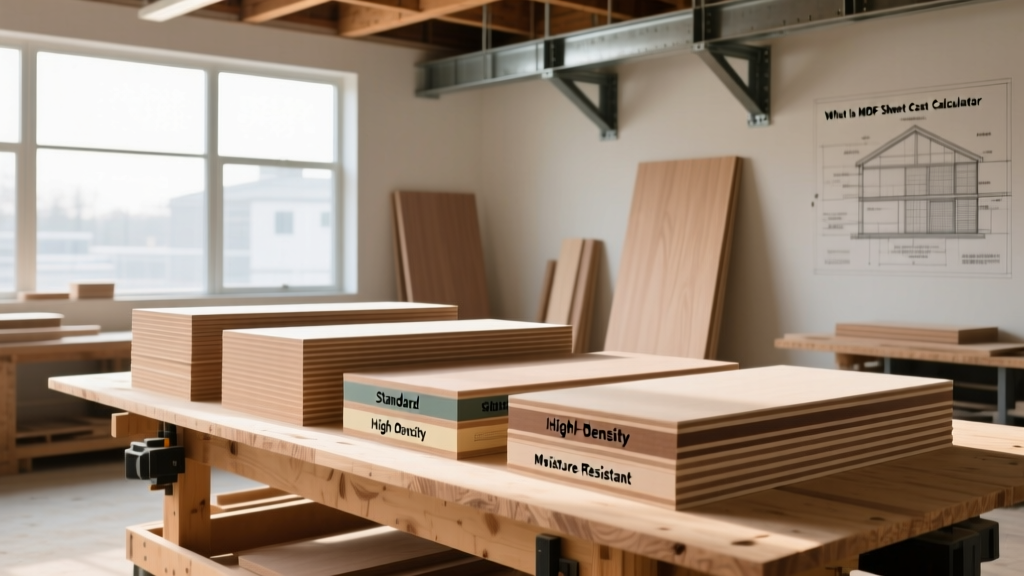
Defining MDF: Composition and Manufacturing Standards
Medium-Density Fiberboard (MDF) is an engineered wood composite manufactured by breaking down hardwood or softwood residuals into individual wood fibers, combining them with a synthetic resin binder (typically urea-formaldehyde or pMDI), and applying high temperature and pressure to form dense panels. Standard MDF operates within a density range of 37 to 50 lbs/ft³ (600 to 800 kg/m³), yielding a homogeneous, grain-free surface ideal for precision machining, veneering, and painting.
From a regulatory and compliance standpoint, all MDF sold for interior use in the United States must comply with ANSI A208.2 standards for physical properties and the EPA TSCA Title VI formaldehyde emission limits. For projects in California or those requiring strict indoor air quality (IAQ) certifications like LEED, specifying CARB Phase 2 compliant boards is mandatory. According to the California Air Resources Board (CARB), CARB2 limits formaldehyde emissions to 0.11 ppm for MDF, a threshold that virtually all major North American mills now meet as a baseline standard.
MDF Grade Matrix: Cost and Application Breakdown
Estimating project costs requires selecting the correct MDF grade. Standard MDF will fail catastrophically in high-humidity environments, while specifying Fire Retardant (FR) MDF for a dry residential built-in wastes budget. Below is the 2026 pricing matrix for standard 4x8 foot, 3/4-inch (18mm) nominal thickness panels.
| MDF Grade | Density (lbs/ft³) | Avg. Cost per 4x8 Sheet | Resin / Additive | Best Application |
|---|---|---|---|---|
| Standard (Interior) | 44 - 48 | $45.00 - $55.00 | Urea-Formaldehyde (UF) | Painted cabinet doors, baseboards, furniture |
| Moisture Resistant (MR) | 46 - 50 | $65.00 - $80.00 | pMDI / Melamine-UF | Bathroom vanities, kitchen sink bases, laundry rooms |
| Fire Retardant (FR) | 48 - 52 | $95.00 - $120.00 | UF + Fire Retardant Salts | Commercial millwork, egress corridors, elevator cabs |
| Ultralight | 30 - 35 | $50.00 - $65.00 | UF (Lower Compression) | Exhibition booths, RV interiors, tall closet doors |
The MDF Sheet Quantity Calculator: Step-by-Step Estimation
Calculating the exact number of 4x8 sheets (32 square feet each) required for a project is complicated by the "kerf" (blade width) and offcut waste. Use this framework to calculate your baseline material requirements.
- Calculate Net Square Footage: Multiply the height by the width of every individual part in your cut list. Sum these values to get your Net Area.
- Apply the Machining Waste Factor:
- Manual Table Saw Cuts (Straight lines): Add 12% to 15% for kerf and minor miscuts.
- CNC Router Nesting (Complex shapes): Add 18% to 22%. CNC software optimizes nesting, but the 3/8" router bit kerf and required tabbing create higher micro-waste than a 1/8" table saw blade.
- Determine Gross Square Footage: Net Area + (Net Area × Waste Factor).
- Calculate Sheet Count: Divide Gross Square Footage by 32. Always round UP to the nearest whole sheet.
If your cut list includes many narrow parts (e.g., 3-inch wide face frames or drawer fronts), standard percentage-based waste factors will underestimate your needs. Narrow rips leave behind 10x24 inch offcuts that are too small for structural parts but too large to count as "dust." For heavily ripped projects, increase your waste factor to 25% or use dedicated panel optimization software like CutList Plus.
Hidden Costs: Machining, Edge Banding, and Finishing
Raw sheet cost is only 40% of a finished MDF project's budget. MDF's high silica content and dense resin matrix introduce specific secondary costs that estimators frequently overlook.
Tooling and Machining Wear
MDF acts as an abrasive. High-Speed Steel (HSS) router bits will dull within 2 to 4 hours of continuous MDF routing, resulting in burned edges that require costly sanding to fix.
- Solution: Specify Solid Carbide or Polycrystalline Diamond (PCD) tooling. While a PCD raised-panel router bit costs $350–$500 upfront (compared to $80 for carbide), it will maintain a razor edge for 30+ times longer, reducing labor costs associated to sanding and bit changes.
Edge Banding and Moisture Sealing
The exposed edges of MDF are highly porous. If left untreated, they will absorb ambient moisture and swell, ruining the finish.
- EVA Hot Melt Edgebanding: Standard approach. Costs approx. $0.05 to $0.08 per linear foot (material only). Susceptible to heat and moisture failure over time.
- PUR (Polyurethane Reactive) Edgebanding: Creates an impermeable, chemical cross-link bond. Adds $0.12 to $0.18 per linear foot but is mandatory for MR-MDF in wet environments to prevent edge delamination.
Primer and Paint Adhesion
Never apply water-based latex primer directly to raw MDF edges; the water content will cause the fibers to swell and "fuzz." Estimators must include the cost of a solvent-based sealer (such as Zinsser B-I-N shellac primer or a dedicated vinyl edge-sizer) for all exposed edges before applying topcoats. Budget an additional $0.45 per square foot of exposed edge area for this sealing step.
Real-World Cost Estimate: 10-Unit Kitchen Cabinet Run
To illustrate how these costs compound, here is a detailed material estimate for a 10-unit kitchen cabinet run (base and uppers) utilizing 3/4-inch MR-MDF for boxes and standard MDF for painted shaker doors.
| Material / Component | Quantity | Unit Cost | Total Cost |
|---|---|---|---|
| 3/4" MR-MDF (Cabinet Boxes) | 14 Sheets | $72.00 | $1,008.00 |
| 3/4" Standard MDF (Doors/Drawers) | 8 Sheets | $48.00 | $384.00 |
| 1/4" Standard MDF (Backing Panels) | 6 Sheets | $28.00 | $168.00 |
| PVC Edgebanding (PUR Applied) | 450 Lin. Ft. | $0.15 | $67.50 |
| Solvent-Based Edge Sealer & Primer | 3 Gallons | $85.00 | $255.00 |
| Hardware (Hinges, Drawer Slides) | Lot | $320.00 | $320.00 |
| Estimated Raw Material Total | $2,202.50 |
Note: This estimate excludes CNC machine time, assembly labor, finishing booth time, and installation.
MDF vs. Plywood vs. Particleboard: Structural Trade-offs
When deciding if MDF is the correct material for your budget, compare its structural limitations against alternatives. The USDA Forest Products Laboratory outlines distinct mechanical differences between these engineered panels.
- Screw Holding Strength: MDF performs poorly in shear and withdrawal strength compared to plywood. Standard wood screws will strip out of MDF under load. Estimator Fix: Budget for specialized hardware like Confirmat screws, threaded inserts, or mechanical dowel joinery when designing MDF cabinetry.
- Weight and Handling: A 3/4" 4x8 sheet of standard MDF weighs roughly 90 lbs, compared to 60 lbs for hardwood plywood. This increases freight costs and requires two-person handling or vacuum lifters on the shop floor, marginally increasing labor overhead.
- Surface Finish: MDF wins decisively for painted finishes. Plywood requires extensive grain-filling and sanding to achieve a glass-smooth painted surface, whereas MDF requires only a quick scuff-sand and primer, saving 15-20% in finishing labor costs.
By accurately calculating sheet yields, specifying the correct moisture or fire-rated grade, and budgeting for the necessary edge-sealing and specialized tooling, estimators can leverage MDF to deliver high-end, dimensionally stable millwork at a highly competitive price point.