US Lumber Durability: Expected Lifespan by Wood Species
Analyze the durability and expected lifespan of major US lumber species. Compare decay resistance, structural creep, and AWPA treatment standards.
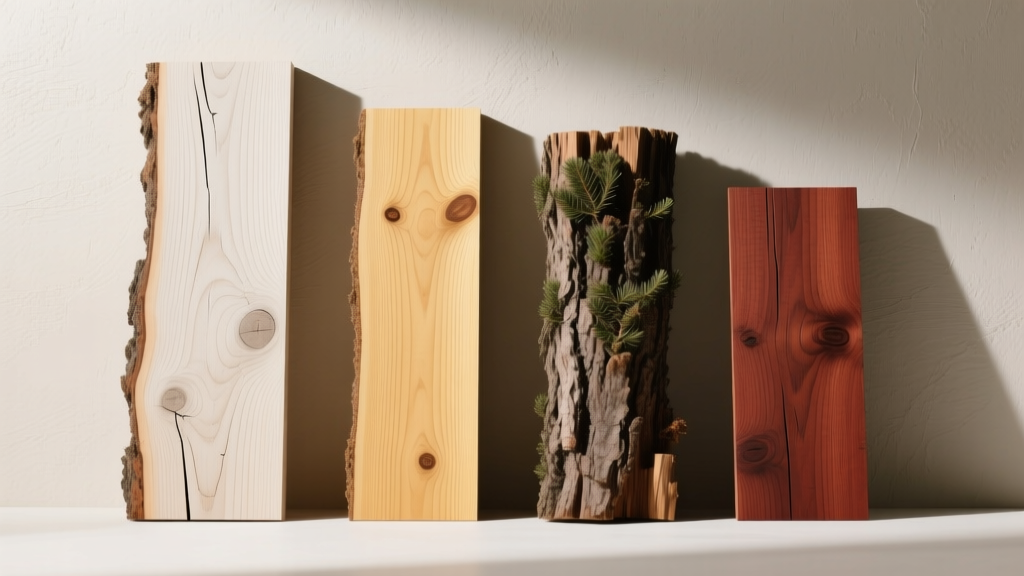
The Decay Resistance Matrix of Domestic US Lumber
When specifying US lumber for structural or exterior applications, predicting the service life requires analyzing two distinct degradation vectors: biological decay and mechanical creep. The natural durability of untreated domestic timber is dictated almost entirely by the extractive content in the heartwood, which acts as a natural fungicide and insect deterrent. Sapwood, regardless of the species, possesses virtually no natural decay resistance and will rapidly degrade if exposed to moisture and fungal spores.
The USDA Forest Products Laboratory categorizes the heartwood decay resistance of major US lumber species into four distinct classes. Understanding this matrix is the first step in calculating the baseline lifespan of untreated wood in exterior or high-moisture environments.
| US Lumber Species | Heartwood Decay Resistance | Termite Resistance | Expected Untreated Exterior Lifespan (Above Ground) |
|---|---|---|---|
| Western Red Cedar | Resistant to Very Resistant | Resistant | 15 - 25+ years |
| Redwood (All Heart) | Resistant to Very Resistant | Resistant | 15 - 25+ years |
| Douglas Fir | Moderately Resistant | Slightly Resistant | 7 - 12 years |
| Southern Yellow Pine | Slightly to Moderately Resistant | Slightly Resistant | 5 - 10 years |
| Spruce-Pine-Fir (SPF) | Not Resistant | Not Resistant | 2 - 5 years |
Structural Load Lifespan: Creep and Fatigue in US Softwoods
Biological decay is only half of the lifespan equation. For interior and protected structural framing, the limiting factor for US lumber is long-term deflection, technically known as "creep." Creep is the time-dependent deformation of wood under a sustained load. Over a 50-year building lifecycle, a floor joist will continue to deflect long after the initial elastic deformation has occurred.
Modulus of Elasticity (MOE) and Long-Term Deflection
The rate of creep is inversely proportional to the wood's Modulus of Elasticity (MOE). When comparing standard US framing lumber, the species stamp dictates the long-term structural lifespan before serviceability limits (e.g., bouncy floors, drywall cracking) are breached.
- Douglas Fir-Larch (DF-L): With an MOE of approximately 1.9 million psi, DF-L exhibits the lowest creep rate among standard US softwoods. It is the preferred species for long-span floor joists and heavy timber beams where 50-year deflection limits are critical.
- Southern Yellow Pine (SYP): Boasting an MOE around 1.8 million psi and superior bending stress ($F_b$) values, SYP offers exceptional load-bearing lifespan, though its higher density makes it slightly more prone to checking and splitting if moisture content fluctuates.
- Spruce-Pine-Fir (SPF): With an MOE ranging from 1.3 to 1.5 million psi, SPF is highly susceptible to long-term creep. When using SPF for floor systems, engineers must apply a higher creep factor (often multiplying the immediate deflection by 2.0 or more) to ensure the lumber does not exceed L/360 deflection limits over its lifespan.
Moisture Content Thresholds and Fungal Degradation
The biological lifespan of US lumber is governed by a strict moisture threshold. Wood-decaying fungi cannot survive in wood with a moisture content (MC) below 19%. Therefore, the primary mechanism for extending the lifespan of untreated US lumber is moisture management.
In enclosed building assemblies, vapor retarders and adequate ventilation keep framing lumber at an equilibrium moisture content (EMC) of 8% to 12%, effectively granting the wood an indefinite biological lifespan. However, in high-risk zones—such as rim joists, sill plates, and areas surrounding plumbing penetrations—transient moisture spikes can push the MC above 20%, initiating fungal colonization.
Borate Pre-Treatments for Extended Lifespan
For interior or protected exterior US lumber where standard pressure-treated wood (which uses copper-based chemicals) is unnecessary or too corrosive to fasteners, disodium octaborate tetrahydrate (DOT) treatments are the industry standard. Products like Bora-Care or Tim-bor penetrate the wood to create a toxic environment for termites, carpenter ants, and decay fungi. Borate-treated US lumber maintains its structural integrity indefinitely as long as it is protected from liquid water leaching, which can wash the water-soluble borates out of the wood matrix.
Pressure Treatment Standards: AWPA Use Categories
When natural durability and moisture control are insufficient, US lumber is pressure-treated with preservatives like Alkaline Copper Quaternary (ACQ) or Copper Azole (CA-C). The expected lifespan of pressure-treated lumber is strictly tied to the American Wood Protection Association (AWPA) Use Categories and the specific chemical retention levels mandated for each.
Specifying the wrong retention level is the most common cause of premature failure in exterior US lumber structures.
| AWPA Use Category | Exposure Condition | Minimum Retention (pcf) for CA-C | Expected Treated Lifespan |
|---|---|---|---|
| UC2 | Interior, damp areas (sill plates, bathrooms) | 0.10 | 50+ years (protected) |
| UC3B | Exterior, above ground, coated/painted | 0.15 | 20 - 30 years |
| UC4A | Exterior, ground contact, general use (posts, retaining walls) | 0.25 | 30 - 40 years |
| UC4B | Heavy duty ground contact (freshwater pilings, critical structural posts) | 0.40 | 40 - 60+ years |
A frequent failure mode in residential construction is the use of UC3B (above ground) treated US lumber for deck posts that are embedded in concrete or direct soil contact. Because the retention level of 0.15 pcf is insufficient to resist the constant fungal and insect pressure of soil contact, the base of the post will typically rot through within 7 to 10 years, compromising the entire deck structure. Always verify the end-tag on treated lumber to ensure it meets UC4A or higher for ground contact.
Decision Framework: Selecting US Lumber for 50+ Year Lifespans
To ensure a 50-year or greater service life for structural and exterior wood assemblies, builders and architects should apply the following decision matrix based on the specific environmental exposure of the US lumber:
- Interior, Climate-Controlled Framing: Standard SPF or Douglas Fir (KD-19). Biological lifespan is indefinite; mechanical lifespan relies on proper span tables to limit creep. No chemical treatment required.
- Interior, High-Moisture Risk (Sill plates, subfloors over crawlspaces): Specify borate-treated (DOT) US lumber. This provides a 50+ year biological defense against termites and transient moisture spikes without the corrosion issues associated with copper-based treatments.
- Exterior, Above-Ground, Protected (Soffits, fascia, covered porch beams): Use naturally durable "All Heart" Western Red Cedar/Redwood, OR specify UC3B pressure-treated Southern Yellow Pine. Ensure all end-cuts are field-treated with a copper naphthenate preservative to seal the exposed sapwood.
- Exterior, Ground Contact or Unprotected (Deck posts, retaining walls, dock pilings): Must use UC4A or UC4B pressure-treated Southern Yellow Pine. Verify the end-tag retention levels (0.25 pcf or 0.40 pcf). Do not use naturally durable cedar or redwood in direct ground contact, as their heartwood extractives will leach out in soil environments, leading to failure within 5 to 8 years.
By aligning the biological decay resistance, mechanical stiffness, and AWPA preservative retention levels with the specific micro-environment of the building assembly, specifiers can accurately predict and guarantee the multi-decade lifespan of US lumber products.