Choosing the Right Type of Fence Wood for Structural Stability
Discover which type of fence wood offers the best structural integrity for high wind loads, post longevity, and framing stability in residential builds.

The Structural Demands of Modern Fencing
A 6-foot solid privacy fence acts as a continuous sail. Under ASCE 7-22 wind load provisions, a 90 mph basic wind speed in an urban or suburban exposure generates approximately 18 to 22 pounds per square foot (psf) of lateral pressure. For a standard 8-foot fence section, this translates to over 1,050 pounds of lateral shear force concentrated at the post base. The resulting bending moment at the ground line exceeds 3,600 foot-pounds. Consequently, selecting the correct type of fence wood is not merely an aesthetic choice; it is a critical structural engineering decision that dictates the lifespan and safety of the perimeter.
Industry data indicates that over 85% of structural fence failures occur at the ground-line interface due to moisture intrusion and fungal decay, not from wind sheer snapping the wood above grade. The type of fence wood you choose must be evaluated primarily on its ground-contact durability and its ability to resist cantilever deflection.
Evaluating the Best Type of Fence Wood for Load-Bearing Posts
The fence post functions as a cantilever beam anchored in the soil. It must resist both lateral wind loads and vertical dead loads from the framing and pickets. According to the USDA Forest Products Laboratory Wood Handbook, the Modulus of Rupture (MOR) is the primary metric for determining a wood species' bending strength before failure.
Comparative Structural Analysis of Post Species
| Wood Species | Modulus of Rupture (psi) | Janka Hardness (lbf) | Ground Contact Rating |
|---|---|---|---|
| Pressure-Treated Southern Yellow Pine (SYP) | 10,100 - 10,900 | 870 | UC4A / UC4B (AWPA Standard) |
| Western Red Cedar (Heartwood) | 7,500 | 350 | Naturally Resistant (Untreated) |
| Douglas Fir-Larch (Coast) | 8,500 | 660 | Requires UC4B Treatment |
| Black Locust | 19,400 | 1,700 | Exceptional Natural Resistance |
For high-wind zones (110+ mph), Pressure-Treated Southern Yellow Pine is the optimal type of fence wood for posts. Its high density and superior MOR allow a 4x4 profile to withstand severe cantilever stress without snapping. While Western Red Cedar is highly desirable for its natural tannins and rot resistance, its lower MOR and softer Janka rating make 4x4 cedar posts susceptible to long-term deflection and bowing under continuous wind load.
Horizontal Rails: Managing Lateral Shear and Deflection
While posts handle the primary bending moment, horizontal 2x4 rails span the 8-foot gaps between posts and must resist sagging (dead load deflection) and transfer lateral wind loads from the pickets to the posts. The choice of framing lumber directly impacts the structural rigidity of the fence plane.
Spruce-Pine-Fir (SPF) #2 Grade
- Pros: High stiffness (Modulus of Elasticity ~1,900,000 psi); excellent fastener withdrawal resistance; cost-effective for long linear runs.
- Cons: Must be pressure-treated for exterior use; prone to twisting and checking if installed with high moisture content.
- Best For: Structural framing in high-shear environments where rigidity is prioritized over natural decay resistance.
Western Red Cedar (Select Structural)
- Pros: Dimensionally stable; low shrinkage; natural preservatives eliminate the need for chemical treatment; lightweight.
- Cons: Lower Modulus of Elasticity (~1,110,000 psi) leads to higher mid-span deflection; expensive.
- Best For: Premium privacy fences in moderate wind zones where aesthetics and natural rot resistance are paramount.
The Hidden Threat: Fastener Corrosion and Tannin Reaction
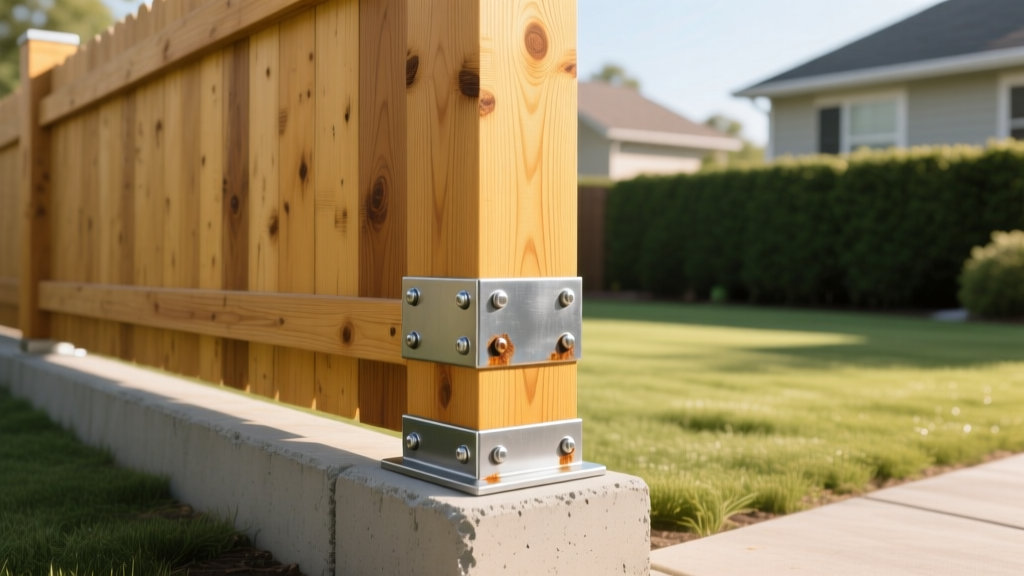
When selecting the type of fence wood, you must simultaneously specify the fastener metallurgy. Modern pressure-treated SYP utilizes Alkaline Copper Quaternary (ACQ) or Micronized Copper Quaternary (MCQ) preservatives. The American Wood Council design guidelines mandate that ACQ-treated wood requires hot-dipped galvanized fasteners meeting ASTM A153 Class D, or Type 304/316 stainless steel. Using standard zinc-plated or electro-galvanized nails will result in rapid galvanic corrosion, leading to catastrophic structural failure at the rail-to-post joints within 3 to 5 years.
Conversely, if you choose Western Red Cedar, the high concentration of tannic acid will react with zinc and copper, causing severe black streaking and accelerating the degradation of galvanized fasteners. For cedar, Type 304 stainless steel ring-shank nails or structural screws (e.g., Simpson Strong-Drive SDWS) are mandatory to maintain structural integrity and visual appeal.
Engineering the Post-to-Soil Interface
The strongest type of fence wood will fail prematurely if the post-to-soil interface is improperly engineered. The traditional method of dropping a post into a bell-shaped hole and filling it entirely with concrete creates a "boat effect," where the wide concrete collar catches frost heave and pushes the post upward, ruining the fence's plumb alignment.
Step-by-Step Structural Post Setting
- Excavation: Dig a cylindrical hole to a depth 6 inches below the local frost line. For a 36-inch frost line, dig to 42 inches.
- Drainage Base: Add 6 inches of crushed 3/4-inch angular gravel to the base and tamp it solid. This prevents water from pooling under the post end-grain.
- Moisture Barrier: Apply a bituminous post sleeve (e.g., PostSaver) to the bottom 24 inches of the SYP post. This creates an impermeable barrier against soil-borne fungi and moisture.
- Backfilling: Set the post and backfill with crushed gravel in 4-inch lifts, tamping heavily. Alternatively, use a structural post anchor embedded in a cylindrical concrete pier poured to grade level, keeping the wood entirely above the soil.
"Frost heave exerts thousands of pounds of uplift pressure on fence footings. A cylindrical gravel backfill or a properly sloped concrete collar that sheds water away from the wood grain is essential for maintaining the structural plumbness of the fence over a 20-year lifecycle."
Cost vs. Structural Lifespan Analysis (2026 Market Data)
Budgeting for a structural fence requires analyzing the cost per linear foot against the expected lifespan before major structural intervention is required. The following data reflects 2026 material costs for a standard 6-foot privacy fence.
| Material Configuration | Material Cost (per LF) | Expected Structural Lifespan | Primary Failure Mode |
|---|---|---|---|
| PT SYP Posts + SPF Rails + PT Pickets | $28 - $36 | 20 - 25 Years | Fastener corrosion; picket warping |
| Cedar Posts + Cedar Rails + Cedar Pickets | $55 - $75 | 15 - 20 Years | Post deflection; ground-line rot |
| PT SYP Posts + Cedar Rails + Cedar Pickets | $42 - $52 | 25 - 30 Years | Galvanic corrosion if fasteners mismatched |
Summary Decision Framework
Use the following engineering framework to finalize your selection based on your specific regional and structural requirements:
- IF your build is in a High-Velocity Hurricane Zone (HVHZ) or basic wind speed exceeds 110 mph: THEN mandate 4x6 Pressure-Treated SYP posts (UC4B rated), SPF #2 structural rails, and 3-inch hot-dipped galvanized structural screws. The high MOR of SYP is non-negotiable here.
- IF your build is in a moderate wind zone (< 90 mph) with high soil moisture or clay content: THEN utilize PT SYP posts wrapped in bituminous sleeves, paired with Western Red Cedar rails and pickets. Use Type 304 stainless steel fasteners exclusively at the cedar-to-steel connections to prevent tannin reactions.
- IF budget is the primary constraint but structural longevity is required: THEN select an all-PT SYP system, but upgrade the fasteners to ASTM A153 hot-dipped galvanized ring-shank nails and apply a penetrating oil-based sealer to the end-grains of all field-cut posts prior to setting.
Ultimately, the ideal type of fence wood for structural applications prioritizes the Modulus of Rupture in the posts and dimensional stability in the rails. By matching the wood species to the specific mechanical demands of the fence plane and specifying compatible, corrosion-resistant metallurgy, you ensure a perimeter that withstands both environmental decay and severe lateral wind loads.
Written by
David NakamuraDavid Nakamura is a licensed architect (AIA) and construction technology writer focused on sustainable building methods, mass timber engineering, and high-performance building envelopes. He holds a Master of Architecture from the University of Washington and is a certified Passive House Consultant (CPHC). David spent eight years at the Seattle firm Mithun, where he led the design of three LEED Platinum projects, before founding his own practice specializing in net-zero residential design. He serves on the editorial advisory board of GreenBuilder Magazine and has authored peer-reviewed papers on cross-laminated timber (CLT) connections for the Journal of Structural Engineering. In his spare time, David teaches woodworking at Pratt Fine Arts Center and kayaks the Puget Sound.
More from David Nakamura
View all
Construction Cost
Labor Cost to Build a Deck Per Sq Ft: 2026 Installation Guide
Discover the exact labor cost to build a deck per sq ft in 2026. This installation guide breaks down contractor rates, complexity factors, and hidden fees.
Aug 4, 2026

Construction Cost
How Much Does It Cost to Build a 3 Bedroom House? Financing Guide
Learn exactly how much it costs to build a 3 bedroom house and explore 2026 financing options, construction loan types, and budget frameworks for your build.
Aug 4, 2026

Construction Cost
Cost to Build a Tennis Court: 2026 Guide
How much does it cost to build a tennis court in 2026? Breakdowns for asphalt, concrete, and synthetic surfaces plus fencing and lighting.
Jul 30, 2026