What Type of Wood to Use for Raised Beds: 2026 Cost Analysis
Discover what type of wood to use for raised beds with our 2026 cost analysis. Compare cedar, treated pine, and redwood lifespan versus price.

The True Cost of Raised Bed Lumber: Beyond the Sticker Price
When determining what type of wood to use for raised beds, most gardeners and landscapers focus exclusively on the initial price per board. However, the lumber market in 2026 has stabilized in unique ways, making the true cost of a raised bed a calculation of initial capital, hardware requirements, maintenance, and ultimate lifespan. A cheap board that rots in three years and requires complete teardown and soil replacement is vastly more expensive than a premium board that lasts two decades. This analysis breaks down the actual financial and practical value of the most common structural timbers used in garden bed construction, evaluating them through the lens of long-term cost-per-year metrics.
• Lowest Upfront Cost: Untreated SPF (Spruce-Pine-Fir) — Best for temporary setups or renters.
• Best Overall Value (Cost-to-Lifespan): Pressure-Treated MCA-C Pine — Unbeatable annualized cost for permanent installations.
• Best Premium Organic Option: Western Red Cedar (Heartwood only) — Ideal for strict organic growers willing to pay a premium.
• Luxury/Heritage Build: Coastal Redwood — Maximum aesthetic and lifespan, but diminishing returns on investment.
Wood Species Breakdown: Initial Cost vs. Expected Lifespan
To accurately compare materials, we must look at the 2026 average retail pricing for standard 2x8 or 2x10 dimensional lumber (the most common sizes for raised beds) and map it against realistic ground-contact lifespans. Ground contact is the most punishing environment for timber, exposing the wood to constant moisture, soil microbes, and fungal hyphae.
| Wood Species | 2026 Avg. Cost (per linear ft) | Ground-Contact Lifespan | Annualized Cost (per linear ft) |
|---|---|---|---|
| Untreated SPF | $1.50 - $2.20 | 3 - 5 Years | $0.44 - $0.55 / year |
| Pressure-Treated Pine (MCA-C) | $2.80 - $3.75 | 15 - 20 Years | $0.15 - $0.18 / year |
| Western Red Cedar | $5.50 - $8.00 | 10 - 15 Years | $0.45 - $0.53 / year |
| Coastal Redwood | $9.00 - $14.00 | 15 - 25 Years | $0.45 - $0.60 / year |
Untreated Whitewood (SPF: Spruce-Pine-Fir)
Often sold as "whitewood" or standard construction framing lumber, untreated SPF is the cheapest option at the lumber yard. However, its cellular structure lacks natural rot-resistant extractives. When in direct contact with damp soil, untreated SPF will typically succumb to brown rot fungi within 36 to 60 months. While the upfront cost for a 4x8 foot bed might only be $35, the labor cost of dismantling a collapsed bed, salvaging the soil, and rebuilding it every four years makes this the most expensive option on an annualized basis. Use SPF only if you are lining the interior with a heavy-duty HDPE plastic barrier that completely isolates the wood from soil moisture.
Pressure-Treated Southern Yellow Pine (MCA-C)
Modern pressure-treated lumber is the undisputed champion of pure financial value. According to the American Wood Protection Association (AWPA), the current standard for residential ground-contact lumber utilizes MCA-C (Micronized Copper Azole) or CA-C (Copper Azole) preservatives. The outdated CCA (Chromated Copper Arsenate) treatment, which contained arsenic, was voluntarily phased out of residential use in 2003. Today's MCA-C treatments use finely ground copper particles and organic biocides that are highly effective against decay and termites while posing minimal risk to soil chemistry. At roughly $3.25 per linear foot and a lifespan approaching two decades, the annualized cost drops to pennies. The primary drawback is aesthetic; treated pine has a greenish tint that weathers to a dull gray, and it is prone to warping and checking as it dries in the sun.
Western Red Cedar
Cedar is the traditional favorite for garden beds due to its rich color, pleasant aroma, and natural resistance to decay. However, a critical detail often missed by retailers is the distinction between heartwood and sapwood. Only the dark heartwood contains the thujaplicins and water-soluble extractives that repel fungi and insects. The lighter sapwood on the outer edges of the log has virtually no rot resistance and will decay as quickly as untreated pine. When purchasing cedar for raised beds, you must inspect the boards and ensure you are buying clear or tight-knot heartwood. Furthermore, as noted by Oregon State University Extension, cedar's natural oils can temporarily inhibit seed germination if fresh wood shavings are mixed directly into the soil, though this is rarely an issue with intact milled boards.
Coastal Redwood
Redwood offers superior dimensional stability and a stunning, deep reddish-brown hue that weathers to a distinguished silver-gray. It contains high levels of tannins that naturally deter rot. However, the 2026 lumber market heavily restricts old-growth redwood harvesting. Most available dimensional redwood is second-growth, which has wider growth rings, less dense tannin concentration, and a noticeably shorter lifespan in ground-contact scenarios compared to historical old-growth timber. Unless you are sourcing reclaimed old-growth redwood or paying a massive premium for specialized heartwood grades, redwood currently offers a lower return on investment than high-grade cedar or treated pine.
Hidden Costs: Fasteners, Liners, and Soil Interaction
The cost of the wood itself is only part of the equation. The chemical composition of your chosen lumber dictates the hardware you must use, which can drastically alter your final budget.
- Fastener Corrosion: The copper in modern MCA-C pressure-treated wood acts as a galvanic catalyst that will rapidly corrode standard zinc-plated screws and electro-galvanized nails. You must use hot-dipped galvanized (G185 coating minimum) or stainless steel fasteners. A box of 3-inch stainless steel deck screws can cost $45, compared to $12 for standard exterior screws, adding a hidden 15% to your total project cost.
- Interior Liners: If you opt for untreated wood or want to protect premium cedar from constant moisture wicking, you will need an interior liner. Avoid cheap woven landscape fabric, which allows water and soil acids to penetrate the wood. Instead, use 6-mil HDPE (High-Density Polyethylene) plastic sheeting or specialized dimpled drainage mats. A dimpled mat costs roughly $1.50 per square foot but allows the wood to breathe and dry out between waterings, potentially doubling the lifespan of a cedar bed.
- Corner Bracing: As soil settles and expands with freeze-thaw cycles, the outward hydrostatic pressure on a raised bed is immense. Beds longer than 6 feet require internal cross-bracing or heavy-duty steel corner brackets (approx. $18-$25 per set) to prevent the boards from bowing and pulling the fasteners out of the end-grain.
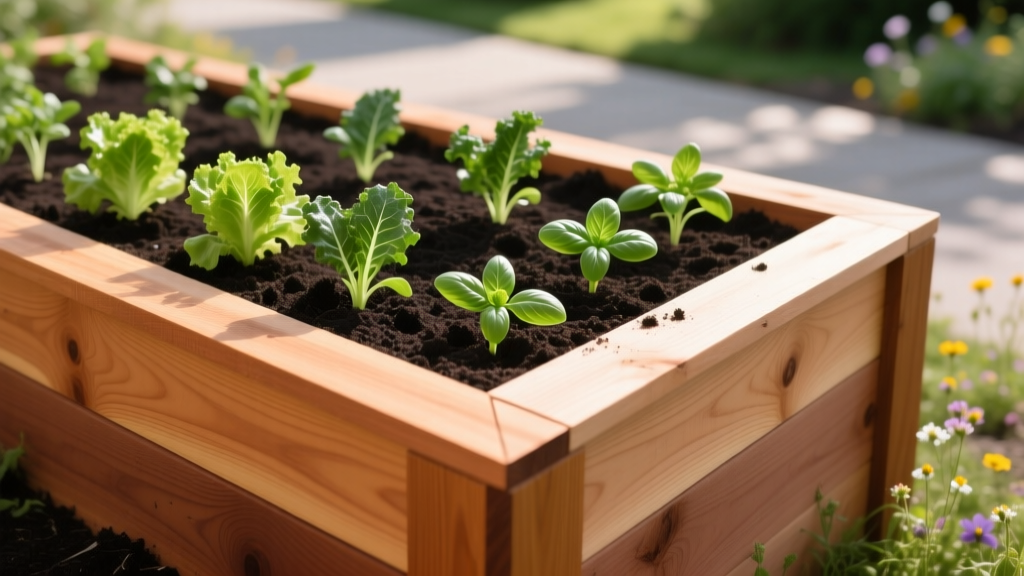
The "Cost-Per-Year" Value Framework
To make an objective purchasing decision, apply the Annualized Cost Formula: (Total Lumber + Hardware Cost) / Expected Lifespan in Years.
Consider a standard 4x8 foot raised bed (requiring 24 linear feet of 2x10 lumber and 8 corner brackets):
Scenario A (Untreated Pine): $45 (wood) + $12 (standard screws) = $57. Divided by a 4-year lifespan = $14.25 per year.
Scenario B (MCA-C Treated Pine): $84 (wood) + $35 (stainless screws) = $119. Divided by an 18-year lifespan = $6.61 per year.
Scenario C (Western Red Cedar): $168 (wood) + $35 (stainless screws) = $203. Divided by a 12-year lifespan = $16.91 per year.
As the math demonstrates, pressure-treated pine is not just cheaper upfront; it is mathematically cheaper over time. Cedar and Redwood are luxury purchases bought for aesthetics, organic certification requirements, or specific environmental preferences, not for financial efficiency.
Environmental and Safety Considerations for Edible Gardens
A common hesitation regarding pressure-treated wood in vegetable gardens is the fear of chemical leaching into root crops like carrots and potatoes. Extensive research reviewed by Penn State Extension confirms that modern copper-based preservatives (MCA and CA) bind tightly to the wood fibers and do not leach into the soil in quantities that pose a risk to human health or plant toxicity. Copper is, in fact, an essential micronutrient for plants and is a common ingredient in organic agricultural fungicides. However, if you are maintaining strict USDA Organic certification for a commercial growing operation, certified organic standards generally prohibit the use of any synthetically treated lumber in direct contact with soil. In those specific commercial cases, untreated Black Locust (which can last 50+ years in ground contact) or thick, unlined Cedar are the only compliant choices.
Final Verdict: Matching Wood to Your Budget and Timeline
Determining what type of wood to use for raised beds ultimately depends on your specific constraints. If your priority is maximizing financial ROI and minimizing future labor, MCA-C pressure-treated Southern Yellow Pine paired with hot-dipped galvanized hardware is the superior choice. If you are building a front-yard edible landscape where aesthetics are paramount and budget is secondary, clear-heart Western Red Cedar provides the best balance of natural beauty and decent longevity. Avoid untreated SPF entirely unless it is part of a temporary, heavily lined setup, as the recurring labor of rebuilding rotted beds will quickly eclipse any initial lumber savings.
Written by
James ThorntonJames Thornton is a construction industry veteran with 25 years of hands-on experience in wood framing, lumber grading, and residential building codes. He started as a framing carpenter in rural Oregon, earned his ICC Residential Building Inspector certification, and eventually became a senior plan reviewer for the City of Portland Bureau of Development Services. James holds a B.S. in Wood Science & Technology from Oregon State University and is a certified lumber grader through the West Coast Lumber Inspection Bureau (WCLIB). He has inspected over 3,000 residential construction sites and authored the city's internal guide on advanced framing techniques (2x6 at 24" O.C.). James lives in Bend, OR, where he builds custom timber-frame cabins and competes in lumberjack sports.
More from James Thornton
View all
Insulation
Best Home Insulation Materials: Complete 2026 Guide
Compare top home insulation materials for 2026. Find R-values, installed costs per square foot, and best uses for fiberglass, spray foam, and mineral wool.
Aug 4, 2026

Sustainable Building
Certify Your Green Building Material for LEED and WELL
Step-by-step guide to certifying a green building material for LEED v5 and WELL v2. Master EPDs, HPDs, and VOC limits for 2026 project specifications.
Aug 4, 2026

Stone & Masonry
Veneer Stacked Stone Panels: Interior Design & Style Showcase
Discover how veneer stacked stone panels transform interiors. Explore modern design profiles, material pairings, and technical installation specs.
Aug 4, 2026