Structural Framing: Comparing Every Different Type of Wood Joints
Compare the structural integrity, cost, and application of every different type of wood joints used in modern timber framing and cabinetry.

The Physics of Wood Joinery: Glue Surface vs. Mechanical Interlock
When evaluating any different type of wood joints, structural integrity relies on two distinct physical mechanisms: long-grain glue surface area and mechanical interlock. End-grain to end-grain connections (like a basic butt joint) offer nearly zero glue adhesion because the wood's capillary tubes absorb the adhesive, starving the joint. Therefore, professional woodworking and structural framing mandate joints that maximize long-grain contact or utilize physical interlocking geometry. Understanding the failure modes of these joints under shear, tensile, and racking forces is critical for selecting the right method for your specific load requirements.
1. Is the joint bearing vertical structural loads? Use Mortise & Tenon or Scarf joints with drawbore pinning.
2. Is the joint subject to lateral racking (e.g., drawer fronts)? Use Dovetail or Dominos.
3. Is speed prioritized over visible aesthetics (e.g., face frames)? Use Pocket Hole joinery with coarse-thread screws.
Heavy Timber and Structural Framing Joints
In heavy timber construction, metal fasteners are often avoided due to differential thermal expansion and the risk of trapping moisture, which accelerates localized rot. Traditional timber framing relies on complex geometric cuts.
The Mortise and Tenon Joint
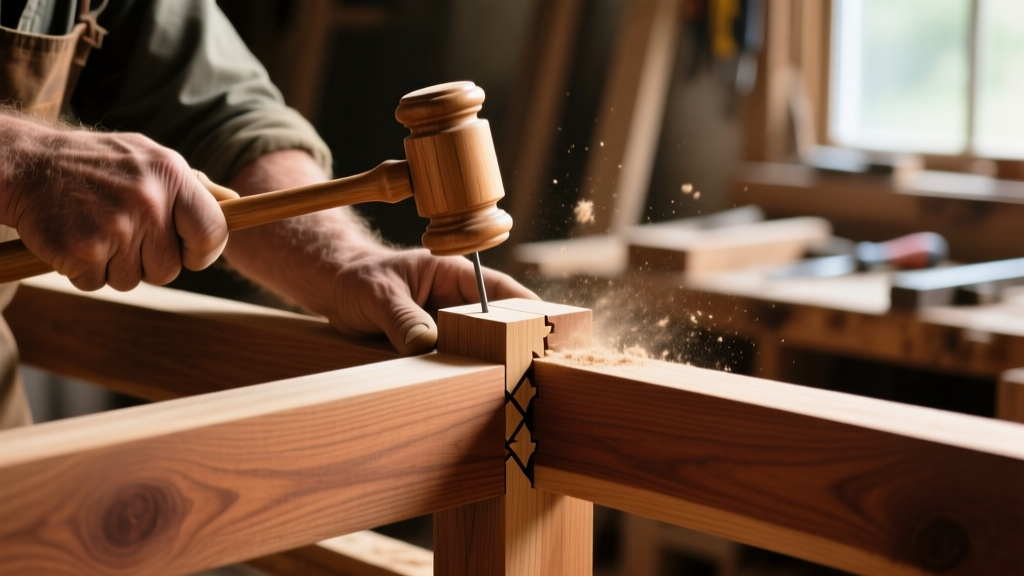
The cornerstone of timber framing. A projecting tenon fits into a corresponding mortise cavity. For optimal structural integrity, the tenon thickness should be exactly one-third of the total stock thickness. If the tenon is too thick, the mortise walls become fragile and prone to splitting; if too thin, the tenon itself becomes the shear failure point.
- Drawbore Pinning: To prevent the joint from pulling apart under tension, the peg hole in the tenon is offset by 1/16 inch toward the shoulder from the holes in the mortise walls. Driving a tapered oak or locust peg through this offset forces the tenon tightly against the mortise shoulder, creating a permanent mechanical lock even if the timber shrinks.
- Failure Mode: In green (unseasoned) timber, mortise walls can compress and deform as the wood dries and shrinks radially. Always use kiln-dried or air-dried timber pegs to ensure the peg does not shrink inside the hole.
The Scarf Joint
Used to splice two timbers end-to-end to create longer continuous beams. A simple 45-degree miter scarf is structurally inadequate for load-bearing beams because it lacks long-grain glue surface and relies entirely on adhesive shear strength. Structural scarf joints require a minimum 1:12 slope ratio and should incorporate a nib or hook (a stepped shoulder) at the apex of the splice to resist vertical shear forces and prevent the joint from folding under heavy top-down loads.
'The secret to a lasting timber frame isn't the precision of the saw cut, but the understanding of how the wood will move tangentially and radially as its moisture content equilibrates with the building's interior environment.' — Traditional Timber Framing Guild Guidelines.
Precision Cabinetry and Panel Joints
Cabinetry requires joints that resist lateral racking and accommodate the seasonal expansion and contraction of solid wood panels.
Dovetail Joints: Hand-Cut vs. CNC
Dovetails provide exceptional tensile strength in one direction, making them the undisputed standard for drawer boxes. The geometry must be matched to the wood species:
- Hardwoods (Walnut, Maple, Oak): Use a 1:8 angle (approx. 7 degrees). Hardwoods have high compressive strength, allowing for narrower, more elegant pins without crushing.
- Softwoods (Pine, Cedar): Use a 1:6 angle (approx. 9.5 degrees). Softwoods require wider tails and a steeper angle to prevent the end-grain corners from crushing and shearing off under load.
Dado and Rabbet Joints
Used for shelving and cabinet carcase construction. A dado is a trench cut across the grain, while a rabbet is cut along the edge. Critical Rule: The depth of a dado should never exceed one-third the thickness of the host panel. Cutting a 3/8-inch deep dado into a 3/4-inch plywood side panel leaves only 3/8-inch of material behind the trench, creating a severe weak point that will snap under the sheer weight of loaded shelves.
Modern Fastener-Assisted Joinery: Domino vs. Pocket Hole
Modern production woodworking bridges the gap between traditional strength and CNC-era speed using specialized fastener systems.
Festool Domino (Floating Tenon)
Cost: ~$1,100 (DF 500 Tool) + $60 (Beech Tenons)
Mechanism: Uses an oscillating router bit to cut a rounded, elongated mortise. A factory-compressed beech tenon is glued into both mating pieces.
Pros: Matches traditional mortise/tenon strength; perfect for mitered panels and frame-and-rail doors.
Cons: High barrier to entry cost; requires precise plunge depth and height calibration.
Pocket Hole Joinery
Cost: ~$150 (Kreg 720PRO Jig) + $15 (Screws)
Mechanism: Drives a specialized self-tapping screw at a 15-degree angle through a pre-drilled pocket into the mating piece.
Pros: Extreme speed; built-in clamping action during glue-up; no waiting for glue cure to proceed with assembly.
Cons: Poor resistance to racking forces without glue; visible holes require plugging or hidden placement.
Comparative Shear Strength and Cost Matrix
The following matrix synthesizes data from structural testing and current market pricing for professional-grade tooling, providing a clear baseline for project budgeting and engineering specifications.
| Joint Type | Avg Shear Strength (PSI) | Setup / Cut Time | Equipment Cost | Best Application |
|---|---|---|---|---|
| Mortise & Tenon (Traditional) | 2,500 - 3,200 | 15-25 mins | $300 (Hollow Chisel Mortiser) | Heavy timber, chair legs |
| Floating Tenon (Domino) | 1,800 - 2,400 | 30-60 seconds | $1,100 (Festool DF 500) | Cabinet frames, miters |
| Through Dovetail (Hand) | 1,500 - 2,000 | 20-40 mins | $150 (Hand saws & chisels) | Heirloom drawer boxes |
| Pocket Hole (15-degree) | 600 - 900 (w/o glue) | 15-30 seconds | $150 (Kreg 720PRO) | Face frames, jigs |
| Biscuit (Plate Joiner) | 400 - 600 | 10-20 seconds | $200 (Makita PJ7000) | Edge-gluing panel alignment |
Moisture Dynamics and Adhesive Selection
No evaluation of a different type of wood joints is complete without addressing the chemical bond and environmental movement. Wood is hygroscopic; it expands when absorbing ambient humidity and shrinks when releasing it. Crucially, wood moves significantly more tangentially (parallel to the growth rings) than radially (perpendicular to the rings). If a joint restricts this natural movement, the wood will split.
Never apply continuous glue across perpendicular grain directions (e.g., gluing a solid wood breadboard end directly to a panel). The panel will expand and contract seasonally while the breadboard end remains static, resulting in catastrophic panel splitting. Use elongated mortise slots and pin only the center to allow lateral movement.
For structural and high-moisture applications, adhesive selection is paramount. Standard PVA (polyvinyl acetate) wood glues are insufficient for exterior timber framing. According to the USDA Forest Products Laboratory Wood Handbook, exterior joints require adhesives that meet ANSI/HPVA Type I waterproof specifications. Products like Titebond III Ultimate utilize a cross-linking PVA chemistry that cures into a rigid, waterproof polymer, maintaining joint integrity even when the timber experiences prolonged moisture exposure.
When utilizing modern fastener-assisted joints like the Festool Domino system, always pair the compressed beech tenons with a Type I or Type II waterproof adhesive. The factory compression of the beech tenon is designed to expand upon contact with the water in the glue, locking the tenon tightly into the mortise walls and creating a joint that is frequently stronger than the surrounding timber itself.
Written by
David NakamuraDavid Nakamura is a licensed architect (AIA) and construction technology writer focused on sustainable building methods, mass timber engineering, and high-performance building envelopes. He holds a Master of Architecture from the University of Washington and is a certified Passive House Consultant (CPHC). David spent eight years at the Seattle firm Mithun, where he led the design of three LEED Platinum projects, before founding his own practice specializing in net-zero residential design. He serves on the editorial advisory board of GreenBuilder Magazine and has authored peer-reviewed papers on cross-laminated timber (CLT) connections for the Journal of Structural Engineering. In his spare time, David teaches woodworking at Pratt Fine Arts Center and kayaks the Puget Sound.
More from David Nakamura
View all
Construction Cost
Labor Cost to Build a Deck Per Sq Ft: 2026 Installation Guide
Discover the exact labor cost to build a deck per sq ft in 2026. This installation guide breaks down contractor rates, complexity factors, and hidden fees.
Aug 4, 2026

Construction Cost
How Much Does It Cost to Build a 3 Bedroom House? Financing Guide
Learn exactly how much it costs to build a 3 bedroom house and explore 2026 financing options, construction loan types, and budget frameworks for your build.
Aug 4, 2026

Construction Cost
Cost to Build a Tennis Court: 2026 Guide
How much does it cost to build a tennis court in 2026? Breakdowns for asphalt, concrete, and synthetic surfaces plus fencing and lighting.
Jul 30, 2026