Selecting the Best Type of Fire Extinguisher for Wood Workspaces
Learn the best type of fire extinguisher for wood shops and framing sites. Includes NFPA mounting heights, Class A comparisons, and installation steps.
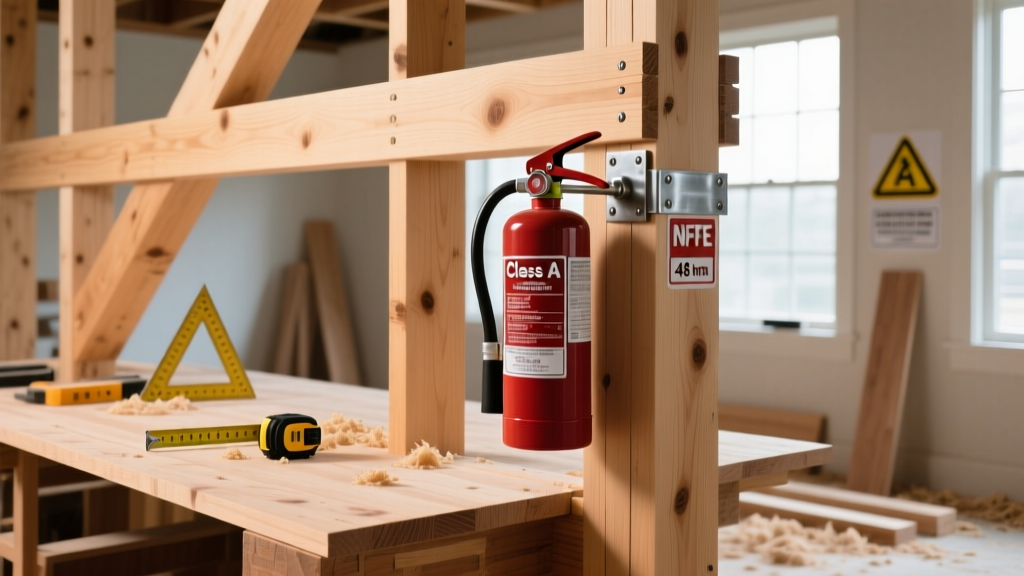
The Hazard Profile: Why Wood Requires Specific Suppression
Wood and lumber present a unique fire hazard classified under Class A (ordinary combustibles). Unlike flammable liquids that flash and dissipate, structural timber, engineered wood products (like LVL and PSL), and fine sawdust create deep-seated fires. The surface may appear extinguished while the core continues to pyrolyze, eventually reigniting. Selecting the correct type of fire extinguisher for wood environments is not merely about putting out visible flames; it is about penetrating the wood grain and cooling the embers to prevent secondary ignition.
In professional woodworking shops, timber framing sites, and lumber yards, the suppression agent must also account for secondary hazards. Modern woodshops are filled with 220V CNC routers, heavy-duty dust collection systems, and solvent-based finishes. Therefore, the installation strategy must balance Class A cooling capabilities with electrical safety and the preservation of expensive machinery and finished timber.
Matrix: Extinguishing Agents for Wood and Lumber Environments
Choosing the right chemical agent dictates both fire survival and post-fire cleanup costs. Below is a comparison of the primary extinguisher types used in wood-heavy construction and fabrication environments, reflecting 2026 market pricing and formulations.
| Agent Type | Classification | Best Application | Pros | Cons | Avg. Cost (10 lb/2.5 gal) |
|---|---|---|---|---|---|
| ABC Dry Chemical (Monoammonium Phosphate) | Class A, B, C | General framing sites, rough lumber yards | Highly effective at knocking down flames; coats fuel to prevent reignition; cost-effective. | Highly corrosive residue; destroys finished wood grain; ruins CNC machine bearings and electronics. | $65 - $85 |
| Water Mist (Deionized Water) | Class A, C | Custom cabinet shops, CNC rooms, finished timber | Superior cooling for deep wood embers; non-corrosive; safe for live electronics up to 100kV; zero residue. | Shorter discharge range; requires specialized nozzle; higher upfront cost. | $220 - $280 |
| Clean Agent (Halotron / FE-36) | Class B, C | Electrical panels in woodshops | Evaporates cleanly; safe for delicate electronics. | Ineffective on deep-seated Class A wood fires; will not cool embers. | $150 - $200 |
| Class A Foam (Wet Water) | Class A | Large-scale timber storage, outdoor lumber yards | Reduces surface tension of water, allowing deep penetration into stacked lumber. | Messes up indoor finishes; requires proportioning equipment or specialized pre-mixed cylinders. | $120 - $160 |
NFPA 10 Installation Best Practices for Wood Facilities
Proper installation is governed by the NFPA 10 Standard for Portable Fire Extinguishers and enforced locally by the Authority Having Jurisdiction (AHJ). For facilities handling wood, strict adherence to travel distance and mounting height is critical due to the rapid spread rate of sawdust and shavings fires.
- Travel Distance: For Class A hazards, the maximum travel distance from any point in the shop to the nearest extinguisher must not exceed 75 feet. In high-piled lumber storage areas, this distance is often reduced to 50 feet by local fire marshals.
- Mounting Height: Extinguishers weighing 40 pounds or less must be installed so the top of the handle is no more than 5 feet above the floor. This ensures accessibility for all operators.
- Bottom Clearance: To prevent moisture accumulation and corrosion from floor washing, the bottom of the extinguisher must be at least 4 inches off the ground.
- Visibility and Signage: Extinguishers must be visible from the primary aisles. If obscured by tall stacks of dimensional lumber or sheet goods, a 3D photoluminescent sign or a floor-projecting arrow must be installed pointing to the unit.
Warning: Dry Chemical Residue on Timber
Monoammonium phosphate (ABC Dry Chem) is mildly acidic. If discharged in a custom woodshop, the airborne powder will settle into the open pores of raw lumber and unfinished cabinetry. When ambient humidity rises, the powder absorbs moisture and creates phosphoric acid, which will permanently stain oak and walnut with black streaks and corrode metal fasteners in timber frames. Always install Water Mist units near finishing and CNC areas.
Step-by-Step Mounting Guide on Wood Studs and Timber
Mounting a heavy, pressurized steel cylinder to wood framing requires specific fastening techniques to prevent pull-out during an emergency grab. Drywall anchors are strictly prohibited by OSHA guidelines for heavy equipment mounting.
1. Locate and Verify the Structural Wood
Use a stud finder to locate the center of a 2x4 or 2x6 wood stud, or identify a solid timber post. If mounting to engineered lumber like Laminated Veneer Lumber (LVL), ensure you are not drilling into the edge-glue lines where splitting is most likely.
2. Select the Correct Bracket and Fasteners
Use the manufacturer's designated wall hook (e.g., the Amerex 810 Wall Hook or Badger equivalent). Do not use generic straps. Secure the bracket using two #12 or #14 wood screws, minimum 2.5 inches in length. For timber framing or dense hardwoods, pre-drill a 3/16-inch pilot hole to prevent the wood from splitting and to ensure the screw threads bite deeply into the core grain.
3. Torque and Test
Drive the screws until the bracket is flush and immobile. Apply 50 pounds of downward pull force on the bracket to simulate the dynamic load of an operator aggressively yanking the extinguisher during a panic scenario. If the wood fibers strip, move the bracket to a new stud and fill the old holes with wood epoxy.
Dealing with Outdoor Lumber Yards and Weather Exposure
Outdoor lumber storage presents environmental challenges that degrade fire suppression equipment. Standard extinguishers exposed to UV radiation and temperature cycling will experience hose dry-rot and valve corrosion. Furthermore, water-based extinguishers will freeze and rupture in winter climates.
For outdoor lumber yards, install extinguishers inside heavy-duty polyethylene or steel weather cabinets (such as the Kidde or Buckeye outdoor enclosures). These cabinets must be mounted on treated 4x4 timber posts or steel bollards to protect them from forklift impacts. If operating in climates where temperatures drop below 40°F (4°C), you must use ABC Dry Chemical or Class A Foam with an anti-freeze additive; standard pressurized water units will become useless ice blocks.
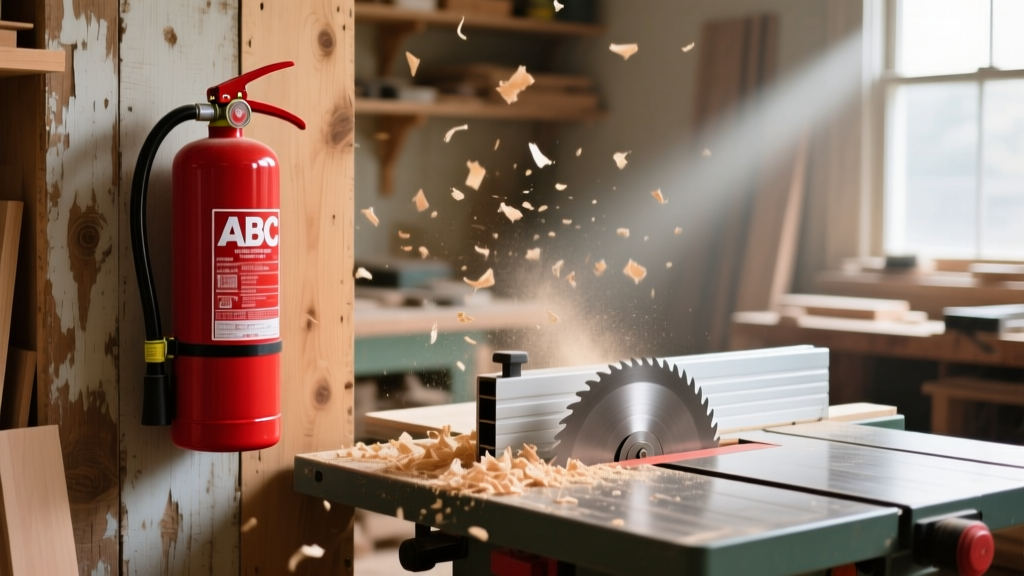
Inspection and Maintenance Realities
Wood dust is pervasive. It infiltrates mechanical parts and clogs pressure gauges. According to the US Fire Administration, portable extinguishers require monthly visual inspections and annual professional maintenance.
- The Dust Factor: In active woodshops, the pull-pin and safety seal must be checked monthly to ensure fine sawdust has not caked around the valve mechanism, which can seize the discharge lever.
- Hose Inspection: Squeeze the rubber discharge hose. Wood dust mixed with ambient shop oils can accelerate rubber degradation. If the hose cracks or feels excessively rigid, replace the hose assembly immediately.
- Hydrostatic Testing: Steel cylinders require hydrostatic testing every 12 years to ensure the internal lining has not corroded, which is especially critical in humid lumber drying kilns or green-timber storage areas.
Frequently Asked Questions
Can I use a CO2 extinguisher on a wood fire?
No. Carbon dioxide (CO2) extinguishers are rated only for Class B (flammable liquids) and Class C (electrical) fires. CO2 works by displacing oxygen, but it lacks the cooling properties required to extinguish deep-seated wood embers. Once the CO2 gas dissipates, the hot wood will immediately pull oxygen from the air and reignite.
How do I protect expensive CNC routers from fire damage without ruining the electronics?
Install a 2.5-gallon Water Mist extinguisher (using deionized water) directly adjacent to the CNC station. Deionized water is non-conductive and safe for electrical equipment up to 100,000 volts. It provides the necessary Class A cooling to stop wood dust fires without leaving the corrosive, abrasive residue associated with dry chemicals, saving tens of thousands of dollars in machine cleanup and recalibration.
Is a fire blanket sufficient for a small woodworking shop?
Fire blankets are only effective for small, contained pan fires or clothing fires. They cannot smother a structural timber fire or a large pile of ignited wood shavings due to the high oxygen demand and thermal mass of burning wood. Portable extinguishers remain the mandatory first line of defense.
Written by
Elena RodriguezElena Rodriguez is a civil engineer and technical writer specializing in concrete technology, masonry systems, and ASTM/ACI compliance. She earned her B.S. in Civil Engineering from Texas A&M University and spent a decade at a materials testing laboratory, performing over 2,000 concrete compressive strength tests and masonry prism evaluations. Elena is an ACI-certified Field Testing Technician (Grade I) and a member of ASTM Committee C12 on Natural Building Stone. She currently consults on forensic engineering cases involving concrete failures and moisture intrusion. Based in San Antonio, TX, Elena is a proud member of the Society of Women Engineers (SWE) and coaches her daughter's FIRST Robotics team.
More from Elena Rodriguez
View all
Walls & Panels
Cost Analysis: Light Gauge Steel Framing Advantages and Disadvantages
Evaluate light gauge steel framing advantages and disadvantages through a strict cost analysis lens, comparing material, labor, and lifecycle expenses.
Aug 4, 2026

Walls & Panels
Gypsum Board Types: Exact Specifications, Thickness & Dimensions
Compare standard, Type X, and moisture-resistant gypsum board types. Get exact specifications, thicknesses, dimensions, and ASTM standards for your project.
Aug 4, 2026

Fire Resistance
Best Fire-Resistant Outdoor Decking Materials: 2026 Buyer Guide
Discover the best fire-resistant outdoor decking materials for 2026. Compare Class A PVC, aluminum, and hardwood options for WUI compliance and safety.
Aug 4, 2026