How Wood Grain Differences Impact Lumber Durability and Lifespan
Analyze how wood grain differences affect lumber durability, moisture resistance, and structural lifespan. Learn to specify the right cut for longevity.
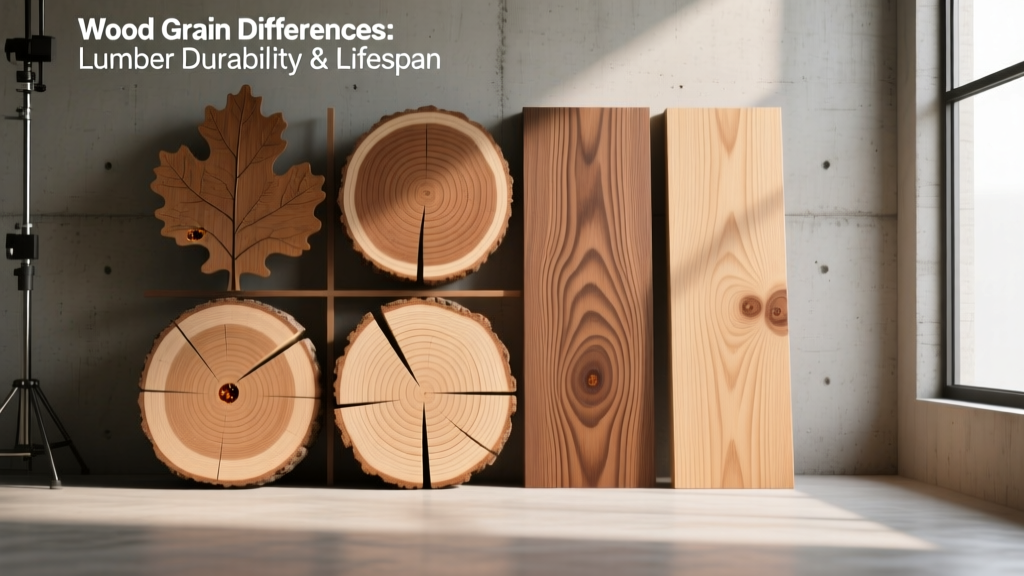
The Hidden Metric of Lumber Longevity: Grain Orientation
When architects and builders evaluate lumber for structural or exterior applications, species selection and preservative treatments often dominate the conversation. However, wood grain differences—specifically the orientation of the growth rings relative to the board's face—dictate dimensional stability, moisture uptake rates, and ultimate structural lifespan. A highly durable species like Western Red Cedar can fail prematurely if milled and installed with the wrong grain orientation, while a modest species can outlast expectations when grain geometry is optimized for the specific environmental load.
Understanding the anatomical reality of wood as an anisotropic material is the first step in predicting how a timber element will perform over a 20-, 50-, or 100-year lifecycle.
Radial vs. Tangential Shrinkage: The Root of Premature Failure
Wood shrinks and swells at different rates depending on the axis of measurement. According to comprehensive data compiled by The Wood Database, tangential shrinkage (parallel to the growth rings) is typically twice as severe as radial shrinkage (perpendicular to the growth rings). This discrepancy is expressed as the Tangential-to-Radial (T/R) ratio.
For example, Red Oak has a tangential shrinkage of roughly 8.6% and a radial shrinkage of 4.0%, yielding a T/R ratio of 2.15. When a flat-sawn (plain-sawn) board dries or absorbs moisture, the tangential face experiences massive dimensional stress compared to the radial edges. This unequal movement is the primary catalyst for cupping, checking, and surface splitting.
When flat-sawn lumber is installed with the bark-side facing outward in exterior siding or decking, tangential shrinkage forces the board edges to curl upward away from the joist or stud. This "cupping" creates horizontal water traps. In high-moisture climates, these trapped puddles accelerate fungal decay, effectively reducing the expected lifespan of a 25-year durable wood species to under 12 years. Always install flat-sawn exterior boards with the heart-side (pith-side) facing up to allow gravity to shed water off the crowned surface.
Sawing Methods and Dimensional Stability Matrix
The method used to mill the log determines the grain orientation on the final board's face. Specifying the correct sawing method is a direct investment in the material's lifespan, particularly for high-moisture or high-wear applications.
| Sawing Method | Grain Angle to Face | Dimensional Stability | Best Lifespan Application |
|---|---|---|---|
| Plain-Sawn (Flat) | 0° to 30° | Low (Prone to cupping) | Interior framing, protected sheathing |
| Quarter-Sawn | 60° to 90° | High (Resists cupping) | Exterior trim, flooring, marine decking |
| Rift-Sawn | 30° to 60° | Very High (Uniform shrinkage) | High-end architectural millwork, stair treads |
| Live-Sawn | Mixed (0° to 90°) | Variable (Stress points at transition) | Heavy timber beams, rustic aesthetic cladding |
The Quarter-Sawn Advantage in White Oak
In species like White Oak, quarter-sawing does more than just align the growth rings vertically; it exposes the medullary rays (the ribbon-like structures that transport nutrients radially). These rays act as internal structural reinforcements, drastically reducing lateral movement. For exterior timber framing or marine applications, quarter-sawn White Oak exhibits up to 40% less volumetric swelling than plain-sawn equivalents, directly translating to tighter joinery and a significantly extended structural lifespan.
End Grain Exposure: The Moisture Superhighway
Wood functions like a bundle of microscopic straws. The longitudinal cells (tracheids in softwoods, vessels in ring-porous hardwoods) are designed by nature to draw water from the roots to the canopy. Consequently, end grain absorbs liquid water and water vapor 10 to 15 times faster than face or edge grain.
In durability analysis, unsealed end grain is the most common point of failure in timber structures. When a beam rests on a masonry pier or a deck post sits on a concrete footing, capillary action wicks ground moisture deep into the timber core. This internal moisture bypasses surface-applied water repellents and creates an ideal environment for internal brown rot.
"To maximize the lifespan of structural timber connections, specify commercial-grade end-grain sealers (such as those containing wax emulsions or polyurethane) on all field cuts. A standard brush-applied oil-based stain will not penetrate or seal end grain sufficiently to halt capillary moisture uptake."
Slope of Grain: Structural Lifespan and Load Degradation
When evaluating structural timber, wood grain differences are not just about surface aesthetics or moisture; they dictate mechanical strength. The "slope of grain" refers to the angle at which the wood fibers deviate from the longitudinal axis of the board. According to the USDA Forest Products Laboratory Wood Handbook, even minor deviations in grain slope severely compromise load-bearing capacity over time.
A slope of grain of 1 in 8 (meaning the grain deviates 1 inch laterally over 8 inches of length) can reduce the bending strength (Modulus of Rupture) of a timber beam by up to 50% compared to perfectly straight-grained wood. Under cyclic loading (such as wind or seismic events), timber with a high slope of grain is highly susceptible to shear failure along the grain lines. When specifying structural glulam or solid-sawn beams for critical load paths, mandate a maximum slope of grain of 1:12 or better in the grading specifications to ensure a 50+ year structural lifespan.
Fastener Placement and Grain Splitting
The interaction between metal fasteners and wood grain is a frequent catalyst for localized decay. Driving a nail or screw parallel to the grain, or too close to the end grain, acts as a wedge, forcing the longitudinal fibers apart. These micro-splits may be invisible to the naked eye but serve as direct conduits for moisture and fungal spores to bypass the wood's natural extractive defenses.
- Edge Distance Rule: Always maintain a minimum edge distance of 1.5 times the fastener diameter when driving parallel to the grain to prevent lateral splitting.
- Pre-drilling for Hardwoods: For dense species like Ipe or Cumaru (Janka hardness > 3,000 lbf), pre-drill clearance holes to 105% of the fastener shank diameter. The sheer radial pressure exerted by a driven screw in flat-sawn Ipe will cause internal checking within 2 to 3 years of installation.
- Fastener Corrosion: The tannins and acids in woods like Western Red Cedar and Oak react aggressively with standard zinc coatings. Use hot-dip galvanized (HDG) or stainless steel (Type 304 or 316) fasteners to prevent galvanic corrosion, which stains the grain and compromises the fastener's withdrawal resistance.
Decision Framework: Specifying Grain for Maximum Lifespan
Use this practical framework when reviewing material submittals or drafting specifications to ensure wood grain differences are leveraged for longevity rather than ignored:
- Exterior Decking & Boardwalks: Reject plain-sawn boards wider than 6 inches. Specify quarter-sawn or vertical-grain lumber (like Alaskan Yellow Cedar or quarter-sawn Douglas Fir) to eliminate cupping and ensure uniform weathering.
- Timber Frame Joinery: Require free-of-heart-center (FOHC) timbers. Timbers containing the pith (the center of the tree) will inevitably develop massive radial checks as the core dries, compromising the structural integrity of mortise-and-tenon joints.
- Interior Flooring over Radiant Heat: Specify engineered wood with a quarter-sawn or rift-sawn wear layer. The vertical grain orientation minimizes tangential shrinkage, preventing the face-veneer from splitting when subjected to the extreme seasonal humidity fluctuations caused by radiant heating systems.