Types of Wood Burning Fireplaces: Technical Comparison and Cost Guide
Compare the main types of wood burning fireplaces, including masonry, zero-clearance, inserts, and freestanding stoves, with pricing and EPA data.

The Efficiency Gap: Why Fireplace Type Dictates Heat Output
When evaluating the different types of wood burning fireplaces for a residential build or renovation, the primary divergence lies in thermal efficiency and particulate emissions. A traditional open-hearth design operates on a fundamentally different thermodynamic principle than a modern EPA-certified combustion chamber. While the former relies on radiant heat and massive structural thermal mass, the latter utilizes secondary burn tubes or catalytic combustors to extract maximum BTU output from the fuel source while minimizing creosote buildup.
According to the U.S. Department of Energy, conventional masonry fireplaces can actually result in a net heat loss for the home, drawing heated indoor air up the chimney while pulling cold infiltration air through the building envelope. Conversely, modern sealed-combustion and EPA-certified units operate at 70% to 85% efficiency, functioning as genuine primary or secondary heat sources rather than mere aesthetic features.
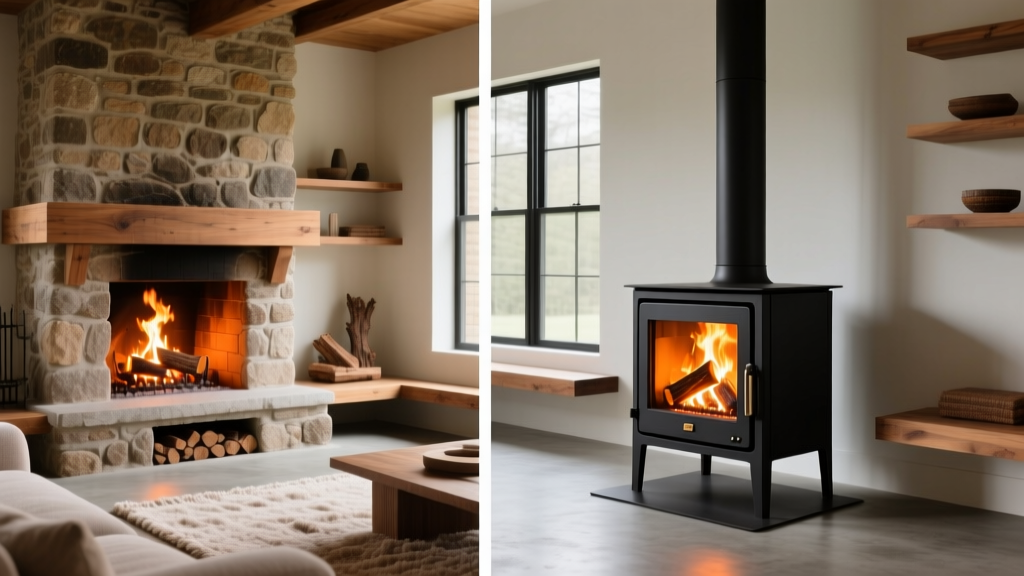
Core Specifications: Comparison Matrix
| Fireplace Type | Thermal Efficiency | Avg. BTU Output | Installed Cost Range | EPA Certification Status |
|---|---|---|---|---|
| Traditional Masonry | -10% to 15% | 10,000 - 20,000 (Radiant) | $8,000 - $25,000+ | Exempt (Not Certified) |
| Zero-Clearance (Prefab) | 70% - 80% | 30,000 - 50,000 | $3,500 - $7,500 | EPA 2020 Certified |
| Freestanding Wood Stove | 75% - 85% | 40,000 - 75,000 | $2,500 - $6,500 | EPA 2020 Certified |
| Wood Burning Insert | 75% - 83% | 35,000 - 60,000 | $3,000 - $5,500 | EPA 2020 Certified |
Traditional Masonry Fireplaces: Ambiance Over Efficiency
Site-built masonry fireplaces consist of a firebox constructed from high-alumina refractory brick, a smoke chamber, a damper, and a masonry chimney lined with terra cotta or cast-in-place flue tiles. The structural footprint requires a dedicated concrete footing capable of supporting 15,000 to 30,000 pounds of masonry load, depending on the height and chimney stack dimensions.
The Net Heat Loss Phenomenon
The defining characteristic of an open masonry fireplace is its high air consumption. To sustain combustion, an open firebox draws 300 to 600 cubic feet per minute (CFM) of room air. This air must be replaced by outside air infiltrating through doors, windows, and structural gaps. If the home's primary heating system is set to 70°F, the fireplace is actively venting that heated air up the flue while the HVAC system works overtime to condition the replacement air.
Builders attempting to improve masonry efficiency often specify a Rumford design—a shallow, angled firebox geometry developed in the 18th century that maximizes radiant heat reflection into the room. While a Rumford configuration improves radiant transfer, it does not solve the infiltration and draft issues inherent to open-combustion systems.
Zero-Clearance (Prefabricated) Wood Fireplaces
Zero-clearance (ZC) fireplaces are factory-built, heavily insulated steel units designed to be framed directly into wood-stud walls with minimal clearance to combustible materials (often as little as 1/2 inch to the side framing). These units have largely replaced masonry in new construction due to lower structural requirements, faster installation, and superior efficiency.
Framing and Venting Requirements
A standard 36-inch ZC wood fireplace requires a rough opening of approximately 38" W x 36" H, depending on the manufacturer (e.g., Astria or Majestic). Unlike masonry, ZC units rely on proprietary Class A air-cooled or insulated chimney pipe systems, such as Simpson DuraTech or Security S2100+. These pipes are significantly lighter than masonry stacks and can be routed through interior framing, offset around structural trusses, and terminated above the roofline using standard flashing kits.
Modern EPA-certified ZC units utilize secondary burn tubes—stainless steel pipes positioned at the roof of the firebox that inject pre-heated oxygen into the smoke, igniting unburned gases before they enter the flue. This technology pushes thermal efficiency past 70% while keeping particulate emissions well below the EPA's strict 2.0 grams per hour (g/hr) limit for cordwood.
Freestanding Wood Stoves: The Heavyweight Heating Champions
When the primary objective is whole-home heating rather than architectural integration, freestanding wood stoves offer the highest BTU output and thermal efficiency. These units are categorized by their construction material and their combustion technology.
Material Dynamics: Steel vs. Cast Iron vs. Soapstone
- Welded Steel (e.g., Lopi, Drolet): Heats up rapidly (within 20 minutes of loading) and transfers convective heat quickly. Ideal for spaces that need fast temperature recovery, such as a weekend cabin. However, steel stoves cool down almost immediately once the fire dies.
- Cast Iron (e.g., Jøtul, Hearthstone): Takes longer to heat (45-60 minutes) but offers superior thermal retention and a classic aesthetic. Cast iron is prone to cracking if over-fired or subjected to rapid thermal shock from cold water.
- Soapstone (e.g., Hearthstone Craftsbury): The ultimate thermal battery. Soapstone absorbs heat slowly over 2 to 3 hours but will continue to radiate steady, even heat for up to 12 hours after the fire has extinguished. It is the most expensive material option but provides the most comfortable, consistent heat profile.
Catalytic vs. Non-Catalytic Combustion
High-end freestanding stoves often feature catalytic combustors—a ceramic honeycomb grid coated in platinum or palladium. The catalyst lowers the ignition temperature of smoke from 1,100°F to 500°F, resulting in exceptionally long burn times (up to 30 hours on a low load in models like the Blaze King King 40) and ultra-low emissions. The trade-off is maintenance; the catalyst degrades over 5 to 10 years and costs $300 to $500 to replace. Non-catalytic stoves rely solely on secondary burn tubes and firebox geometry, requiring less maintenance but offering shorter maximum burn times (8 to 12 hours).
Wood Burning Fireplace Inserts: Retrofitting for Performance
An insert is essentially a freestanding wood stove engineered to slide directly into an existing masonry or ZC firebox. Inserts are the standard solution for upgrading an inefficient open fireplace into a high-performance heating appliance without demolishing the existing hearth and chimney structure.
The Critical Chimney Liner Requirement
The most common installation failure with wood inserts is "slamming" the unit into the firebox and allowing the exhaust to vent into the oversized, unlined masonry chimney. This causes rapid creosote condensation in the upper flue, creating a severe chimney fire hazard.
According to the Chimney Safety Institute of America (CSIA), every wood insert must be connected to a continuous, insulated stainless steel chimney liner (typically 6-inch diameter, 316Ti alloy) that runs from the insert's flue collar all the way to the top of the chimney crown. A positive connection plate must be sealed at the smoke shelf to prevent cold air from washing down into the living space around the insert's surround panels.
Decision Framework: Matching the Fireplace to Your Build
Selecting the correct unit requires balancing structural constraints, heating requirements, and budget. Use the following framework to specify the right system for your project:
- Choose Traditional Masonry if: The project is a luxury custom build where architectural authenticity, monumental scale, and visual ambiance are prioritized over heating efficiency, and the foundation engineering can support the massive dead load.
- Choose Zero-Clearance if: You are framing a new construction home or addition and want the aesthetic of a built-in fireplace without the cost, timeline, and structural requirements of a masonry stack. Ideal for primary living rooms and master bedrooms.
- Choose a Freestanding Stove if: The home is in a cold climate zone (IECC Zones 5-8), wood is the primary or secondary heat source, and the floor plan allows for a central, 360-degree radiant heat distribution point. Requires a non-combustible hearth pad (R-value of 1.5 or higher).
- Choose an Insert if: The property already has an existing masonry fireplace that is drafting poorly or failing to heat the space, and the homeowner wants to retain the existing chimney structure while achieving modern EPA efficiency standards.
"The transition from open-hearth masonry to EPA-certified combustion chambers represents the most significant leap in residential wood heating technology in a century. Specifying the correct unit type based on the home's thermal envelope is no longer optional; it is a matter of basic building science and indoor air quality."
Written by
Marcus ChenMarcus Chen is a licensed structural engineer (PE) and building materials analyst with over 12 years of experience across residential, commercial, and industrial construction. He holds a Master of Science in Civil Engineering from UC Berkeley and spent six years at Thornton Tomasetti before transitioning to independent consulting and technical writing. Marcus specializes in material selection for seismic-prone regions, concrete reinforcement strategies, and lifecycle cost analysis. His work has been cited by the American Concrete Institute (ACI) and the Structural Engineers Association of California (SEAOC). When he is not on a job site or at his desk, you will find him hiking the Sierra Nevada or restoring a 1920s craftsman bungalow in Oakland, CA.
More from Marcus Chen
View all
Construction Cost
How Much Did the Eiffel Tower Cost to Build?
How much did the Eiffel Tower cost to build in 1889? We adjust for inflation and compare its budget to modern skyscraper construction.
Aug 4, 2026

Fire Resistance
What Is a Fire Resistant Material? Testing & Certification Guide
Discover what is a fire resistant material through ASTM and UL testing. Learn how fire ratings, certifications, and assemblies work in construction.
Aug 4, 2026

Construction Cost
How Much Did the Burj Khalifa Cost to Build?
How much did the Burj Khalifa cost to build? We break down the $1.5B project and extract 5 money-saving strategies for your next build.
Jul 30, 2026