Choosing the Best Types of Wood for Fences: A Pro's Framework
Use our pro selection framework to compare types of wood for fences. Analyze lifespan, rot resistance, and 2026 costs for cedar, redwood, and pine.

The 4-Pillar Fence Wood Selection Framework
Selecting the right lumber for a fence is rarely as simple as picking the cheapest option at the local yard. A fence is a structural assembly subjected to extreme micro-climates: the top rails bake in UV radiation, while the posts sit in a perpetual moisture-and-microbe trap at the soil line. To engineer a fence that lasts decades rather than years, professional contractors evaluate lumber through a strict four-pillar framework: Decay Resistance, Dimensional Stability, Fastener Compatibility, and Lifecycle Cost.
This guide bypasses generic advice and provides a technical selection matrix for the most common types of wood for fences, integrating 2026 material pricing, American Wood Protection Association (AWPA) use categories, and metallurgical fastener requirements.
Species Deep-Dive: Grading and Chemical Retention
Western Red Cedar: The Heartwood Imperative
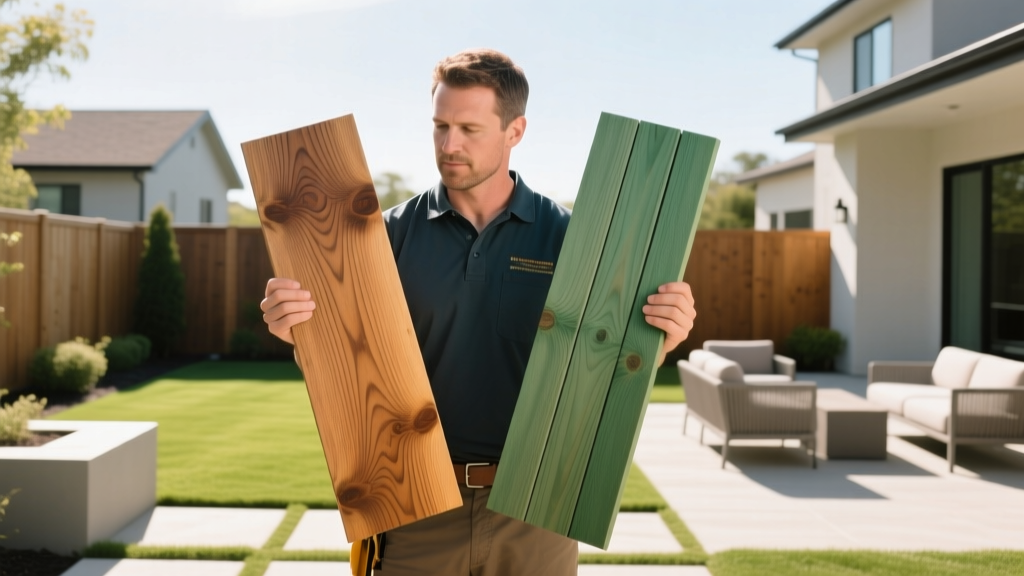
Western Red Cedar is prized for its low tangential shrinkage (4.2%), which minimizes warping and checking compared to pine. However, its natural decay resistance comes exclusively from thujaplicins—water-soluble fungicides present only in the heartwood. If you purchase "Select Tight Knot" (STK) cedar and the boards contain wide bands of light-colored sapwood, those sapwood sections will succumb to rot within 3 to 5 years. For maximum longevity, specify Clear All Heart or Better grades, ensuring 100% heartwood content on all exposed faces.
Pressure-Treated Southern Yellow Pine: Decoding Use Categories
Southern Yellow Pine (SYP) is the workhorse of residential fencing, but its lifespan is entirely dictated by chemical retention levels. The AWPA categorizes treated wood by its intended exposure. The most critical mistake DIYers and novice builders make is using the wrong retention level for fence posts.
- UC4A (Above Ground, 0.25 pcf): Suitable for pickets, rails, and top caps. Must be at least 6 inches above the soil.
- UC4B (Ground Contact, 0.40 pcf): Mandatory for all fence posts and any kick-boards touching the soil. The higher copper concentration prevents subterranean termite and fungal degradation.
Always check the end-tags on SYP lumber. If your supplier only stocks UC4A, you must special-order UC4B for the posts or switch to a structural steel post system (like PostMaster) to avoid premature foundation failure.
Redwood: Construction Heart vs. Architectural Clear
Redwood offers superior dimensional stability and a rich aesthetic, but pricing has pushed it into the luxury tier. Construction Heart grade allows knots but guarantees the decay-resistant heartwood, making it the most cost-effective choice for structural rails and posts. Architectural Clear is reserved for high-end horizontal privacy screens where a flawless, modern aesthetic is required.
Climate-to-Species Compatibility Matrix
Not all types of wood for fences perform equally across different USDA Hardiness Zones and moisture regimes. Use this matrix to align your local climate with the correct material specification.
| Climate Profile | Primary Threat | Recommended Species | Required Grade / Treatment |
|---|---|---|---|
| Pacific Northwest / Coastal | High moisture, fungal rot | Western Red Cedar | 100% Heartwood (Clear or STK) |
| Southeast / Humid Subtropical | Subterranean termites, heavy rain | Southern Yellow Pine | UC4B (0.40 pcf) for all posts |
| Southwest / Arid Desert | UV degradation, extreme dry/wet cycling | Redwood or Composite | Construction Heart (sealed ends) |
| Northeast / Freeze-Thaw | Ice heave, moisture absorption | SYP or Cedar | UC4B posts set below frost line |
2026 Material Cost and Lifecycle Analysis
When budgeting, evaluate the lifecycle cost rather than just the initial material outlay. The following data reflects 2026 national averages for material-only costs per linear foot (based on a standard 6-foot tall board-on-board or stockade configuration).
| Material | Grade / Spec | Cost per Linear Foot | Expected Lifespan | Maintenance Cycle |
|---|---|---|---|---|
| Pressure-Treated SYP | UC4A Pickets / UC4B Posts | $14.00 - $19.00 | 15 - 20 Years | Seal every 2-3 years |
| Western Red Cedar | Select Tight Knot (STK) | $28.00 - $36.00 | 20 - 25 Years | Stain every 3-5 years |
| Western Red Cedar | Clear All Heart | $45.00 - $60.00 | 25 - 30+ Years | Stain every 5-7 years |
| Redwood | Construction Heart | $38.00 - $52.00 | 25 - 30 Years | Seal every 3-5 years |
| Ipe (Tropical Hardwood) | Clear / FAS Grade | $85.00 - $110.00 | 40 - 50+ Years | Optional UV oil annually |
Fastener Chemistry: The Hidden Failure Point
The most common cause of premature fence failure is not the wood itself, but the galvanic corrosion caused by mismatching fasteners to the wood's chemical profile. According to data from the USDA Forest Products Laboratory, using the wrong nail or screw can compromise structural integrity in under five years.
Modern SYP is treated with Micronized Copper Azole (MCA) or Alkaline Copper Quaternary (ACQ). These copper-based preservatives are highly corrosive to aluminum and standard electro-galvanized steel. You must use G185 hot-dipped galvanized (ASTM A153) or 304/316 stainless steel fasteners. Standard zinc-plated screws will snap under wind load within a few seasons.
Cedar and Redwood are rich in tannic acid. When exposed to moisture, tannins react with the zinc in galvanized fasteners, creating unsightly black streaks down the face of the fence boards. Always use 304 stainless steel ring-shank nails or polymer-coated structural screws (e.g., Simpson Strong-Tie SD) for cedar and redwood to prevent tannin bleed.
Step-by-Step Decision Flowchart
Use this logic tree to finalize your selection based on your specific project constraints:
- Assess the Soil and Climate: Is the fence line in a high-termite zone or subject to standing water? If Yes: You must use UC4B Pressure-Treated SYP for posts, or upgrade to steel posts. If No: Proceed to step 2.
- Determine the Maintenance Tolerance: Are you willing to apply penetrating alkyd-wood stains (like TWP or Armstrong Clark) every 3 to 5 years? If Yes: Cedar or Redwood are viable. If No: Choose Pressure-Treated Pine and let it weather to silver-gray, or upgrade to a tropical hardwood like Ipe which requires zero structural maintenance.
- Calculate the Budget Threshold: Is your material budget under $20 per linear foot? If Yes: Pressure-Treated SYP is your only viable structural option. If No: Evaluate Western Red Cedar STK for the best balance of aesthetics, dimensional stability, and lifespan.
- Verify Local HOA and Zoning Codes: Many municipalities require the "finished" side of the fence to face the street. If building a shadowbox or board-on-board fence to satisfy this, Cedar is highly recommended over SYP, as SYP tends to warp and twist when exposed to uneven sun exposure on complex rail systems.
Final Sourcing and Storage Directives
When procuring types of wood for fences, never accept delivery and immediately begin building. Lumber yards store SYP and Cedar in different environments. SYP is often heavily saturated with preservative chemicals and water upon delivery. If you build a privacy fence with wet SYP pickets, the boards will shrink by up to 1/4 inch in width as they dry, transforming a private fence into one with massive gaps.
Always unband the pickets, stack them with 1/2-inch sticker spacers in a shaded, dry area, and allow them to acclimate and dry for 7 to 14 days before installation. For Cedar, consult resources from the Western Red Cedar Lumber Association regarding proper ground-clearance staging to prevent the bottom edges from wicking moisture before the fence is even erected. By aligning your material choice with this technical framework, you ensure a structurally sound, aesthetically pleasing boundary that withstands the elements for decades.
Written by
Priya KapoorPriya Kapoor is a real estate market analyst and construction economics researcher with expertise in housing affordability, development feasibility, and infrastructure investment. She holds a Master of Regional Planning from Cornell University and previously worked as a senior analyst at CBRE's Investment Properties group, where she modeled returns for $4B in mixed-use development pipelines. Priya now runs an independent research practice advising developers, municipalities, and REITs on construction cost forecasting and market timing. She publishes the quarterly "BuildMat Market Pulse" report tracking material price indices across 12 commodity categories. Based in Austin, TX, Priya serves on the board of Habitat for Humanity Austin and is a marathon runner.
More from Priya Kapoor
View all
Construction Cost
Cost to Build a 1600 Sq Ft Home in 2026: Full Breakdown
Accurate 2026 cost to build a 1600 sq ft home—material, labor, and regional pricing breakdowns included. Plan your budget with real-time estimates.
Aug 11, 2026

Wood & Lumber
Name the Types of Wood for Pressure Treatment and Preservation
Learn how to name the types of wood best suited for pressure treatment. Compare species treatability, chemical retention levels, and 2026 preservation costs.
Aug 4, 2026

Stone & Masonry
Stone Veneer Suppliers Lindenhurst: 2026 Cost Analysis
Analyze 2026 stone veneer costs in Lindenhurst, NY. Compare local supplier pricing, delivery fees, and Suffolk County installation labor rates.
Aug 4, 2026