Identification Types of Wood Grain Patterns in Structural Timber
Learn how identification types of wood grain patterns impact structural timber strength, slope of grain limits, and framing safety in building codes.
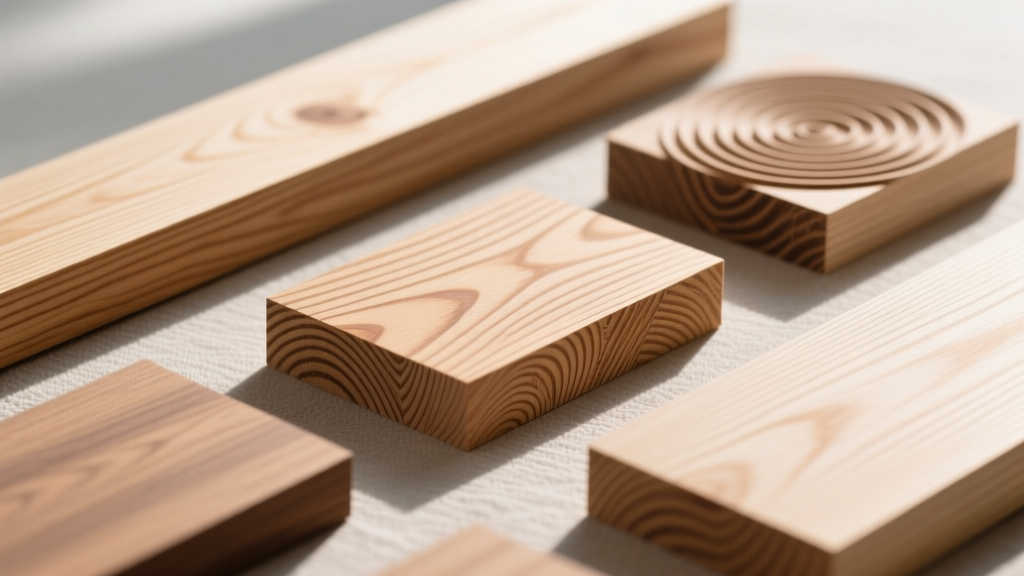
The Physics of Anisotropy: Why Grain Direction Matters
Wood is an anisotropic material, meaning its physical properties change depending on the direction of the applied load relative to its cellular structure. In structural framing, the longitudinal alignment of wood fibers—commonly referred to as the grain—dictates the timber's load-bearing capacity, stiffness, and shear resistance. While architects and finish carpenters evaluate grain for aesthetic appeal, structural engineers and framers must perform rigorous identification types of wood grain patterns to prevent catastrophic deflection, twisting, or shear failure under dead and live loads.
According to the USDA Forest Products Laboratory Wood Handbook, wood is strongest when loaded parallel to the grain and weakest when loaded perpendicular to it. A deviation in grain alignment as small as 5 degrees can reduce the bending strength (Modulus of Rupture) of a structural joist by up to 20%. Understanding how to identify and grade these patterns is not merely a theoretical exercise; it is a code-mandated requirement for ensuring structural safety in both light-frame and heavy timber construction.
Core Grain Patterns and Structural Derating
Natural growth conditions, sawing techniques, and the presence of defects create distinct grain patterns. Each pattern interacts with structural forces differently.
Straight Grain (The Baseline)
Straight grain occurs when wood fibers run parallel to the longitudinal axis of the board. This is the structural ideal. Lumber with straight grain exhibits the highest Modulus of Elasticity (MOE) and maximum allowable bending stress (Fb). In visual grading, Select Structural and No. 1 grades of Douglas Fir-Larch or Southern Pine require strict limits on grain deviation to ensure this parallel alignment is maintained across the length of the member.
Spiral Grain (The Torsion Threat)
Spiral grain develops when fibers twist around the tree's central axis during growth, resembling a spiral staircase. When milled into dimensional lumber, this pattern manifests as diagonal lines on the board's face. Structurally, spiral grain is a primary cause of severe warp, specifically twist and bow, as the timber dries and shrinks. In load-bearing applications, spiral grain drastically reduces horizontal shear strength and compromises the withdrawal capacity of nails and lag screws driven into the end grain.
Cross Grain and Diagonal Grain (Shear Failures)
Cross grain occurs when fibers run at an angle to the board's edge, often caused by sawing a board off-center from the log (producing a diagonal grain pattern on the face) or by severe grain deviations around large knots. The American Wood Council National Design Specification (NDS) heavily penalizes cross grain in structural calculations because it creates a natural fault line where the board can split longitudinally under shear stress or bending moments.
The NDS strictly regulates the Slope of Grain (SOG)—the angle of the fibers relative to the edge of the board. For bending members like floor joists and rafters, the maximum allowable SOG for Select Structural grade is 1:16 (one unit of deviation over 16 units of length). For No. 2 grade framing lumber, the limit relaxes to 1:10. Exceeding these slopes requires significant derating of the allowable design values, often rendering the timber unfit for primary structural spans.
Visual Grading vs. Machine Stress Rating (MSR)
The identification of grain patterns is executed through two primary grading methodologies in the modern lumber supply chain:
- Visual Stress Grading (VSG): Certified graders inspect every board for grain slope, knot size, wane, and checks. The grader visually estimates the SOG by observing the intersection of growth rings on the face and edge of the board. The allowable design values are then assigned based on species, size, and the visual presence of these grain anomalies.
- Machine Stress Rating (MSR): MSR lumber (e.g., 2400f-2.0E) is mechanically deflected by non-destructive testing equipment on the mill floor to measure its actual stiffness (MOE). While MSR bypasses the need for visual estimation of internal knot sizes, visual identification of grain patterns—specifically SOG limits and edge characteristics—is still required as a secondary check to ensure the machine's readings are not skewed by localized grain deviations.
Grain Pattern Impact on Allowable Design Values
The following table illustrates how different grain anomalies impact the structural design values of a standard 2x10 Douglas Fir-Larch No. 2 joist, based on standard NDS derating factors.
| Grain Anomaly / Pattern | Identification Method | Primary Structural Impact | Approximate Derating Factor (Fb) |
|---|---|---|---|
| Straight Grain (1:20 SOG) | Visual face/edge ring intersection | None (Baseline Capacity) | 1.00 (100%) |
| Moderate Slope (1:12 SOG) | Visual diagonal lines on face | Reduced bending and shear strength | 0.80 (80%) |
| Severe Slope (1:8 SOG) | Pronounced diagonal grain, high twist risk | Severe bending loss, high shear failure risk | 0.55 (55%) |
| Spiral Grain (Growth Defect) | Continuous diagonal pattern, end-grain arc | Torsional instability, fastener withdrawal loss | 0.70 (70% estimated) |
| Cross Grain (Sawing Defect) | Grain runs out on the edge of the board | Longitudinal splitting under tension | 0.60 (60% estimated) |
Field Identification: A Framer's Checklist for Grain Anomalies
While lumber arrives on site with a grade stamp, framers and site supervisors must perform secondary identification of wood grain patterns to ensure compromised boards are not placed in high-stress locations (e.g., cantilevers, point loads, or long-span rafters). Use this field checklist:
- Inspect the Edge for Grain Run-Out: Look at the narrow edge of the board. If the grain lines intersect the edge at a steep angle (greater than 1 inch of rise over 12 inches of run), reject the board for use as a primary bending member.
- Check for End-Splitting Propagation: Boards with severe cross grain or spiral grain will exhibit deep end-splits that follow the grain deviation. If a split extends past the bearing surface into the clear span, the board's shear capacity is compromised.
- Evaluate Knot-Induced Grain Deviation: The grain flowing around a knot creates localized cross grain. If a large knot (greater than 2 inches in a 2x10) is located in the bottom third of a joist (the tension zone), the localized grain deviation creates a critical failure point. Flip the board so the knot is in the top compression zone, or reject it.
- Monitor Moisture-Induced Twist: Spiral grain is often invisible in green or wet lumber. As the timber acclimates to the site's humidity, spiral grain boards will aggressively twist. If a 2x6 wall plate twists more than 1/4 inch over a 10-foot span, it will pull fasteners and compromise the shear wall's load transfer.
Engineered Wood Products (EWP): Bypassing Natural Grain Limitations
Because the identification and mitigation of natural grain anomalies limit the usable yield of solid-sawn timber, modern structural engineering heavily relies on Engineered Wood Products (EWPs) to neutralize grain-related weaknesses.
Laminated Veneer Lumber (LVL)
LVL is manufactured by peeling logs into thin veneers (typically 1/8 to 3/16 inch thick), drying them, and laminating them with structural adhesives. Crucially, the grain of all veneers is aligned parallel to the longitudinal axis. This manufacturing process completely eliminates natural macro-grain deviations like spiral grain and severe slope of grain, resulting in a product with highly predictable, uniform MOE and MOR values that exceed solid-sawn lumber of the same species.
Cross-Laminated Timber (CLT)
For mass timber construction, CLT panels utilize alternating grain directions. By gluing thick wood laminations at 90-degree angles to one another, CLT achieves bidirectional structural capacity. The alternating grain patterns neutralize the natural tendency of wood to shrink and swell tangentially, providing the dimensional stability required for multi-story floor diaphragms and shear walls. The APA - The Engineered Wood Association provides extensive design matrices for CLT that account for the specific rolling shear properties dictated by these perpendicular grain layers.
Frequently Asked Questions
Can I use a board with a 1:8 slope of grain for blocking or fire stopping?
Yes. Slope of Grain (SOG) limits in the NDS apply primarily to members subjected to bending and axial tension. For blocking, nailing strips, or fire stops where the primary loads are minimal or purely compressive, a 1:8 SOG does not typically compromise structural integrity, provided the board is straight enough to be fastened flush.
Does quarter-sawn lumber have better structural grain alignment than flat-sawn?
Quarter-sawn lumber exhibits excellent dimensional stability and straight edge grain, making it highly resistant to cupping and twisting. However, its structural bending capacity (Fb) is generally equivalent to flat-sawn lumber of the same grade and SOG. The primary structural advantage of quarter-sawn timber is its superior shear resistance and reduced risk of checking, which is why it is often specified for heavy timber decking and exterior structural applications.
How does Machine Stress Rating (MSR) handle grain deviations?
MSR machines measure the global stiffness (MOE) of the board by applying a mechanical load. While this accurately captures the overall strength-reducing effect of grain deviations and knots, the NDS still requires a visual check for extreme Slope of Grain (typically limiting SOG to 1:12 or 1:16 depending on the specific MSR grade) because localized, severe cross grain can cause brittle shear failures that global stiffness testing might not fully predict.
Written by
Sarah WhitfieldSarah Whitfield is a chartered quantity surveyor (MRICS) and construction cost analyst with 15 years of experience in material pricing, procurement strategy, and project budgeting. She earned her degree in Construction Management from the University of Reading (UK) and has worked on projects ranging from $2M custom homes to $180M mixed-use developments across North America and Europe. Sarah currently leads cost estimating for BuildMat Insight, maintaining a proprietary database of 4,000+ material price points updated quarterly. She is a frequent contributor to RSMeans cost data panels and has presented at the International Cost Engineering Council (ICEC) congress. Based in Denver, CO, Sarah is an avid trail runner and volunteer mentor for Women in Construction.
More from Sarah Whitfield
View all
Wood & Lumber
What Are the Different Types of Wood? A Builder's Guide
Compare structural softwoods, finish hardwoods, and engineered lumber. Analyze Janka ratings, MOE values, and 2026 pricing for construction.
Aug 4, 2026

Walls & Panels
Steel Framing vs Wood Framing: Corrosion and Moisture Defense
Compare steel framing vs wood framing for moisture resistance. Learn about galvanized coatings, condensation risks, and corrosion protection strategies.
Jul 21, 2026

Stone & Masonry
How to Cut Stone Veneer: Wet Saw vs Grinder Comparison
Compare the best tools for cutting stone veneer. We review wet saws, angle grinders, and chop saws to help you achieve clean, chip-free cuts.
Jul 21, 2026