Visual Wood Grading: Analyzing Images of Types of Wood
Master visual wood grading by analyzing images of types of wood. Learn NHLA hardwood and SPIB softwood defect tolerances, yield math, and site inspection.

The Anatomy of Wood Grades: What Visual Cues Reveal
Visual grading remains the cornerstone of lumber quality assessment in both structural framing and architectural millwork. When contractors, architects, and procurement specialists study images of types of wood, they are not merely evaluating color and texture; they are reading the biological history of the timber to predict its mechanical performance and machining yield. Visual grading relies on standardized rulebooks that dictate the maximum allowable size, frequency, and location of natural defects.
For hardwoods in North America, the National Hardwood Lumber Association (NHLA) sets the definitive visual grading standards. Unlike softwoods, which are often graded for structural load-bearing capacity, NHLA hardwood grades are based on the percentage of clear, usable wood (cuttings) that can be extracted from a board. Understanding how to interpret visual markers—such as grain deviation, knot clusters, and heartwood-sapwood transitions—is critical for minimizing waste and preventing structural failures on the job site.
Decoding Hardwood Grades: Defect Tolerances and Yield
The NHLA grading system evaluates boards based on their poorest face. The clear cuttings must meet specific minimum size requirements depending on the grade. Below is a breakdown of the primary NHLA grades, their visual yield requirements, and current market pricing benchmarks for a standard species like Hard Maple as of 2026.
| NHLA Grade | Minimum Board Size | Clear Cutting Yield | Minimum Cutting Size | 2026 Avg. Price (Hard Maple) |
|---|---|---|---|---|
| FAS (Firsts & Seconds) | 4' x 5' | 83.3% to 100% | 4' x 5' or 3' x 7' | $7.50 - $9.20 / BF |
| Select | 4' x 6' | 83.3% to 100% | 4' x 5' or 3' x 7' | $6.80 - $8.00 / BF |
| #1 Common | 3' x 4' | 66.6% to 83.3% | 4' x 2' or 3' x 3' | $4.50 - $5.80 / BF |
| #2 Common | 3' x 4' | 50% to 66.6% | 2' x 2' | $2.80 - $3.50 / BF |
Procurement Insight: Many custom cabinet shops intentionally purchase #1 Common instead of FAS. Because modern CNC routers and optimized cut-off saws can efficiently process smaller clear cuttings, the 30% cost savings of #1 Common often outweighs the slight increase in labor and waste, provided the visual defects (knots, bark pockets) are mapped correctly during the cutting phase.
Structural Softwood Grading: Critical Visual Indicators of Failure
While hardwoods are graded for yield, structural softwoods (like Southern Pine, Douglas Fir, and Spruce-Pine-Fir) are graded for mechanical strength. The Southern Pine Inspection Bureau (SPIB) and other regional agencies use visual characteristics to assign design values (f-bending, E-modulus of elasticity). When inspecting structural timber, specific visual defects act as immediate red flags for structural compromise.
Warning: Structural Defect Thresholds
- Slope of Grain: The angle of the wood fibers relative to the longitudinal axis of the board. For Select Structural Southern Pine, the slope must not exceed 1 in 16. A slope of 1 in 8 drastically reduces the board's tensile strength and can lead to catastrophic shear failure under load.
- Shakes vs. Checks: Checks are separations along the annual rings caused by uneven drying (usually acceptable if they don't penetrate the neutral axis). Shakes are separations between annual rings, often caused by wind stress during tree growth. Shakes severely compromise shear strength and are strictly limited in structural grades.
- Wane: The presence of bark or missing wood on the edge of a board. In structural joists, wane reduces the bearing surface and nailing area. #2 Grade framing lumber typically limits wane to 1/3 the width of the face.
Aesthetic Grading: Matching Grain Patterns to Architectural Intent
Beyond structural integrity and clear yield, visual grading encompasses aesthetic sorting, particularly for flooring, paneling, and exposed timber frames. When reviewing reference images of types of wood to specify materials for high-visibility applications, architects must understand how milling techniques alter the visual grade.
Quarter-Sawn vs. Plain-Sawn Visual Markers
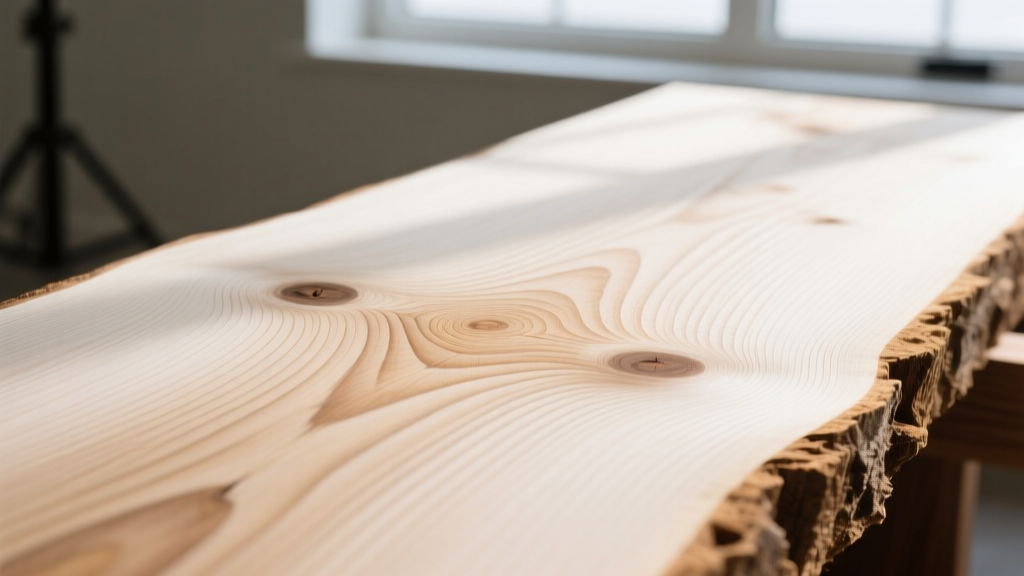
The orientation of the log during milling dictates the visual presentation of the growth rings and medullary rays.
- Plain-Sawn (Flat-Sawn): Growth rings intersect the board face at an angle of less than 45 degrees. This produces a pronounced 'cathedral' grain pattern. It is the most cost-effective milling method but is highly susceptible to tangential shrinkage, leading to cupping in wide planks.
- Quarter-Sawn: Growth rings intersect the face at 60 to 90 degrees. In species like White Oak, this exposes the medullary rays, creating a distinct 'fleck' or 'tiger stripe' pattern. Quarter-sawn lumber is dimensionally stable, resisting cupping and twisting, making it the mandatory visual and physical grade for premium wide-plank flooring and Arts & Crafts style millwork.
- Rift-Sawn: Growth rings intersect the face at 30 to 60 degrees. This produces a tight, linear grain pattern with no cathedrals and minimal fleck. It is the most expensive cut due to high waste but is specified for modern, minimalist interiors where visual uniformity is paramount.
Practical Framework: Step-by-Step Visual Inspection on the Job Site
Receiving a lumber delivery requires a systematic visual and physical inspection to ensure the material matches the purchase order specifications and grading stamps. Follow this protocol to verify quality:
- Verify the Grade Stamp: Locate the ink stamp on the end or face of the board. Confirm the species, grade (e.g., 'SEL STR' for Select Structural), moisture content at time of surfacing (e.g., 'S-DRY' for 19% max, 'MC-15' for 15% max), and the certifying agency mill number.
- Audit Dimensional Tolerances: Measure a random 10% sample of the bundle. Nominal dimensions (e.g., 2x4) differ from actual dressed dimensions (1.5' x 3.5'). Ensure the actual measurements meet the tolerances outlined in the American Softwood Lumber Standard (PS 20-21).
- Test Moisture Content (MC): Use a pin-type moisture meter on the sampled boards. For interior millwork and flooring in climate-controlled environments, the target MC should be 6% to 8%. For exterior framing, up to 19% is acceptable. A variance of more than 2% between the core and the surface of thick timbers indicates improper kiln drying, which will result in post-installation checking.
- Map the Clear Cuttings: For hardwoods, visually draw imaginary lines around the defects (knots, pith, decay). Calculate if the remaining clear areas meet the minimum size and percentage requirements for the invoiced grade.
- Check for Sticker Stain and Mold: Inspect the faces of the boards for dark, penetrating streaks. Sticker stain occurs when moisture is trapped between the lumber and the wooden stickers used during air-drying. This fungal discoloration cannot be planed out of thin stock and renders the board unusable for clear-finish architectural applications.
Expert FAQ: Visual Grading Edge Cases
Does the NHLA grading system restrict the amount of sapwood in a board?
No. A common misconception is that higher NHLA grades (like FAS) require all-heartwood. The standard NHLA rules do not restrict sapwood; a board with 100% sapwood can still grade as FAS if it meets the clear cutting yield requirements. If a project requires all-heartwood or a specific sapwood-to-heartwood ratio, this must be specified as an 'architectural grade' or 'special sort' addendum to the purchase order, which will incur a premium of 15% to 30% over standard FAS pricing.
How do I visually differentiate between a tight knot and a decayed knot?
A tight (intergrown) knot is continuous with the surrounding wood fibers; the growth rings of the knot merge seamlessly into the growth rings of the board. These are generally permitted in structural and lower-grade aesthetic lumber. A decayed (loose or encased) knot is surrounded by a dark, often crumbly ring of bark or degraded wood. It will eventually fall out, leaving a void. In structural grading, decayed knots are treated as holes and severely restrict the allowable span and load-bearing capacity of the member.
What is 'pith' and why is it banned in premium grades?
Pith is the soft, spongy core at the exact center of the tree trunk. Visually, it appears as a small, dark, irregular circle or line in the center of a board's end grain. Pith is highly unstable and acts as a focal point for severe radial checking as the wood dries. In premium structural grades and high-end architectural hardwoods, the presence of pith (often referred to as 'boxed heart') is strictly prohibited or heavily restricted because it guarantees future splitting and compromises the machining integrity of the board.
Written by
Priya KapoorPriya Kapoor is a real estate market analyst and construction economics researcher with expertise in housing affordability, development feasibility, and infrastructure investment. She holds a Master of Regional Planning from Cornell University and previously worked as a senior analyst at CBRE's Investment Properties group, where she modeled returns for $4B in mixed-use development pipelines. Priya now runs an independent research practice advising developers, municipalities, and REITs on construction cost forecasting and market timing. She publishes the quarterly "BuildMat Market Pulse" report tracking material price indices across 12 commodity categories. Based in Austin, TX, Priya serves on the board of Habitat for Humanity Austin and is a marathon runner.
More from Priya Kapoor
View all
Construction Cost
Cost to Build a 1600 Sq Ft Home in 2026: Full Breakdown
Accurate 2026 cost to build a 1600 sq ft home—material, labor, and regional pricing breakdowns included. Plan your budget with real-time estimates.
Aug 11, 2026

Wood & Lumber
Name the Types of Wood for Pressure Treatment and Preservation
Learn how to name the types of wood best suited for pressure treatment. Compare species treatability, chemical retention levels, and 2026 preservation costs.
Aug 4, 2026

Stone & Masonry
Stone Veneer Suppliers Lindenhurst: 2026 Cost Analysis
Analyze 2026 stone veneer costs in Lindenhurst, NY. Compare local supplier pricing, delivery fees, and Suffolk County installation labor rates.
Aug 4, 2026