3000 vs 4000 PSI Concrete: Installation & Finishing Guide
Compare 3000 vs 4000 PSI concrete for your project. Learn installation differences, finishing times, curing protocols, and cost impacts.

The Structural and Operational Divide
Choosing between 3000 PSI and 4000 PSI concrete is not merely a structural decision; it fundamentally alters the installation workflow, finishing timelines, and curing protocols on the job site. Compressive strength, measured at 28 days, dictates the water-cement (w/c) ratio and cementitious content of the mix. These variables directly impact workability, bleed water rates, and the heat of hydration. For contractors and DIY installers, misunderstanding these differences leads to surface defects, premature cracking, and costly callbacks.
According to the National Ready Mixed Concrete Association (NRMCA), the 28-day compressive strength is the primary metric for quality control, but the fresh concrete properties are what installers must manage in real-time. This guide breaks down the exact installation parameters for both mix designs.
Application Matrix: Where to Pour Which
Before ordering from the batch plant, match the PSI to the structural demand and environmental exposure. Over-engineering a slab with 4000 PSI when 3000 PSI suffices increases material costs and makes finishing unnecessarily difficult due to the stiffer mix.
- 3000 PSI (Approx. 20 MPa): Ideal for residential sidewalks, patios, light-duty shed foundations, and interior basement floors not subjected to heavy point loads. It offers excellent workability and a forgiving finishing window.
- 4000 PSI (Approx. 28 MPa): Required for residential driveways, garage floors, structural columns, retaining walls, and commercial warehouse floors. The higher cement content provides superior resistance to freeze-thaw cycles, de-icing salts, and heavy vehicular traffic.
Mix Design and Batch Plant Communication
The physical differences on the job site stem from the batch plant's mix design. A standard 3000 PSI mix typically contains around 470 lbs of cement per cubic yard with a w/c ratio of 0.55 to 0.60. A 4000 PSI mix increases the cement content to roughly 564 lbs per cubic yard and drops the w/c ratio to 0.45 or lower.
Managing Slump and Workability
A lower w/c ratio naturally produces a stiffer, less workable mix. If you order a 4000 PSI mix at a standard 4-inch slump, it will be exceptionally difficult to screed and float. To maintain workability without adding water (which destroys the 4000 PSI strength rating), instruct the batch plant to use a High-Range Water Reducer (HRWR), commonly known as a superplasticizer. This allows the 4000 PSI mix to achieve a 5-inch or 6-inch slump while maintaining the strict 0.45 w/c ratio required for strength. The Portland Cement Association (PCA) notes that HRWRs are essential for modern high-strength mix designs to ensure proper consolidation.
Installation and Finishing Timelines
The most significant on-site difference between 3000 and 4000 PSI concrete is the bleed water profile and the setting timeline. Because 4000 PSI has a lower w/c ratio and higher fines content, it bleeds significantly less water and sets faster. This shrinks your finishing window by 30 to 45 minutes compared to a 3000 PSI pour.
| Installation Parameter | 3000 PSI Concrete | 4000 PSI Concrete |
|---|---|---|
| Bleed Water Volume | High (0.05 - 0.10 gal/sq ft) | Low (0.01 - 0.04 gal/sq ft) |
| Bleed Water Duration | Longer; requires patience before floating | Short; surface dries quickly |
| Initial Set (Standard Temp) | ~3.5 to 4.5 hours | ~2.5 to 3.5 hours |
| Power Trowel Window | Forgiving; wide operational window | Tight; requires rapid crew deployment |
| Heat of Hydration | Moderate | High; thermal cracking risk in thick pours |
Step-by-Step Finishing Adjustments for 4000 PSI
- Screeding: Use a laser-guided screed or a heavy vibratory screed. The stiffer 4000 PSI mix requires more mechanical force to consolidate than 3000 PSI.
- Bull Floating: Because bleed water is minimal, you can bull float almost immediately after screeding. Do not wait for a heavy sheen of water to appear; it may never form.
- Edging and Grooving: Execute these steps as soon as the surface can bear weight without sinking more than 1/4 inch. The window for edging 4000 PSI closes rapidly.
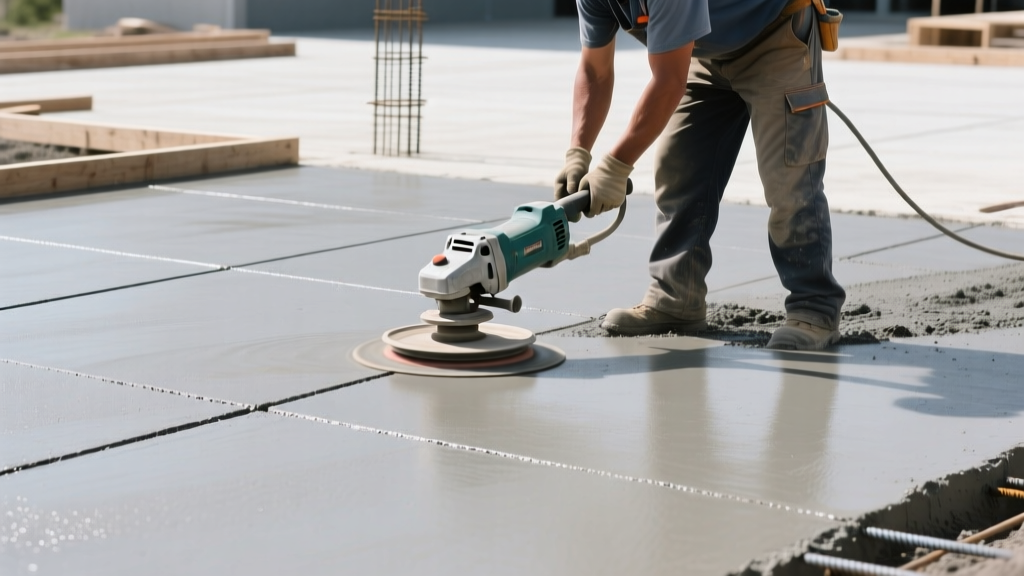
- Final Troweling: Use a ride-on or walk-behind power trowel. Monitor the surface closely; if the concrete becomes too hard, the trowel blades will tear the surface paste rather than burnishing it.
Jointing and Saw-Cutting Windows
Control joints dictate where the concrete will crack as it undergoes volumetric shrinkage. The timing of saw-cutting is highly dependent on the PSI. 4000 PSI concrete gains its critical tensile strength much faster than 3000 PSI. If you apply the standard 12-hour waiting period used for 3000 PSI sidewalk pours to a 4000 PSI driveway, the slab will likely develop random, uncontrolled shrinkage cracks before you even start the saw.
The Rule of Thumb:
- 3000 PSI: Standard wet saw-cutting can typically occur 8 to 12 hours after placement, depending on ambient temperature.
- 4000 PSI: Standard wet saw-cutting must occur within 4 to 6 hours. Alternatively, utilize an early-entry dry-cut saw (e.g., Soff-Cut) within 1 to 2 hours of final finishing to lock in the joints before thermal contraction begins.
Joint depth should remain consistent at 25% of the slab thickness (e.g., a 1-inch cut for a 4-inch slab) regardless of the PSI.
Curing Protocols and Thermal Management
Curing is not optional; it is the chemical requirement for the concrete to reach its specified PSI. However, the higher cement content in 4000 PSI mixes generates a significantly higher heat of hydration. In mass pours (thicker than 8 inches) or during hot weather, this thermal differential between the hot core and cooler surface can cause thermal cracking.
For 3000 PSI slabs, a standard spray-on membrane-forming curing compound applied after final finishing is usually sufficient. For 4000 PSI slabs, especially in extreme temperatures, wet curing with saturated burlap covered by 4-mil polyethylene sheeting is highly recommended for the first 72 hours. This method provides the moisture required for hydration while insulating the surface to mitigate thermal shock. Once the 72-hour critical period passes, the slab can be left uncovered to continue its 28-day cure.
Cost Breakdown and Yield Considerations (2026 Estimates)
When budgeting, account for both the material premium and the labor efficiency differences. While 4000 PSI costs more per yard, its faster set time can sometimes reduce labor overtime on large commercial pours.
- 3000 PSI Ready-Mix: $130 to $145 per cubic yard.
- 4000 PSI Ready-Mix: $150 to $175 per cubic yard.
- Admixture Upcharges: Adding HRWR (superplasticizers) for workability or accelerating admixtures for cold-weather 4000 PSI pours will add $8 to $15 per cubic yard.
- Pumping Fees: If the site requires a boom pump, expect a flat mobilization fee of $600 to $900, plus $10 to $15 per yard pumped. 4000 PSI mixes pump slightly easier than 3000 PSI if properly designed with HRWR, as the cohesive paste prevents segregation in the pump hopper.
Final Selection Framework
Use 3000 PSI for low-stress, pedestrian-only applications where budget and ease of finishing are the primary concerns. Mandate 4000 PSI for any surface subjected to vehicular traffic, de-icing chemicals, or heavy point loads, and ensure your finishing crew is prepared for the accelerated bleed-water and set-time profiles inherent to the higher-strength mix.
Written by
Priya KapoorPriya Kapoor is a real estate market analyst and construction economics researcher with expertise in housing affordability, development feasibility, and infrastructure investment. She holds a Master of Regional Planning from Cornell University and previously worked as a senior analyst at CBRE's Investment Properties group, where she modeled returns for $4B in mixed-use development pipelines. Priya now runs an independent research practice advising developers, municipalities, and REITs on construction cost forecasting and market timing. She publishes the quarterly "BuildMat Market Pulse" report tracking material price indices across 12 commodity categories. Based in Austin, TX, Priya serves on the board of Habitat for Humanity Austin and is a marathon runner.
More from Priya Kapoor
View all
Construction Cost
Cost to Build a 1600 Sq Ft Home in 2026: Full Breakdown
Accurate 2026 cost to build a 1600 sq ft home—material, labor, and regional pricing breakdowns included. Plan your budget with real-time estimates.
Aug 11, 2026

Wood & Lumber
Name the Types of Wood for Pressure Treatment and Preservation
Learn how to name the types of wood best suited for pressure treatment. Compare species treatability, chemical retention levels, and 2026 preservation costs.
Aug 4, 2026

Stone & Masonry
Stone Veneer Suppliers Lindenhurst: 2026 Cost Analysis
Analyze 2026 stone veneer costs in Lindenhurst, NY. Compare local supplier pricing, delivery fees, and Suffolk County installation labor rates.
Aug 4, 2026