3000 psi vs 4000 psi Concrete: Cost, Strength & Uses
Deciding between 3000 psi vs 4000 psi concrete? Compare costs, curing times, and structural limits to choose the right mix for driveways and foundations.

The Core Difference: Water-Cement Ratios and Mix Design
When ordering ready-mix concrete, the compressive strength rating—measured in pounds per square inch (psi) after 28 days of curing per American Concrete Institute (ACI) standards—dictates the mix design. The fundamental difference between 3000 psi and 4000 psi concrete lies in the water-cement (w/c) ratio and the total cementitious content.
A standard 3000 psi mix typically utilizes a w/c ratio of 0.55 to 0.60, requiring approximately 470 pounds of cement per cubic yard. To achieve 4000 psi, batch plants reduce the water content and increase the cement to roughly 560 pounds per cubic yard, dropping the w/c ratio to 0.45 to 0.50. This denser matrix results in higher compressive strength, lower permeability, and better resistance to freeze-thaw cycles when properly air-entrained.
Quick Snapshot: The 28-Day Standard
Both 3000 psi and 4000 psi ratings refer to the 28-day compressive strength tested via ASTM C39 cylinder breaks. While 4000 psi gains strength faster in the first week due to higher cement content, both mixes require the full 28-day hydration period to reach their engineered design strength.
Head-to-Head Comparison Matrix
The table below breaks down the technical specifications and practical differences between the two most common residential and light-commercial mixes.
| Feature | 3000 PSI Concrete | 4000 PSI Concrete |
|---|---|---|
| Water-Cement Ratio | 0.55 - 0.60 | 0.45 - 0.50 |
| Cement Content (per yd³) | ~470 lbs | ~560 lbs |
| Average Batch Cost | $125 - $140 / yd³ | $137 - $158 / yd³ |
| Drying Shrinkage | Moderate | Slightly Higher |
| Workability / Slump | High (easier to finish) | Lower (stiffer, may need plasticizers) |
Application Guide: Where Each Mix Excels
Selecting the right mix prevents both structural failure and unnecessary budget bloat. According to the National Ready Mixed Concrete Association (NRMCA), matching the psi to the structural load and environmental exposure is critical for longevity.
3000 PSI: The Residential Workhorse
3000 psi concrete is the baseline for most non-structural residential flatwork. It provides ample strength for pedestrian traffic and light vehicles while remaining highly workable for contractors finishing large surface areas.
- Ideal Uses: Sidewalks, patios, pool decks, interior basement slabs, and shed pads.
- Thickness Guidelines: Standard 4-inch thickness is sufficient for foot traffic and standard patio furniture.
- Reinforcement: Welded wire mesh (WWM) or fiber mesh is typically adequate; rebar is rarely required unless the subgrade is poor.
4000 PSI: The Heavy-Duty Standard
When the slab must support concentrated heavy loads, resist chemical de-icers, or span across voids, 4000 psi is the required choice. The lower permeability of this mix makes it vastly superior for exterior flatwork in northern climates where freeze-thaw cycling and road salts are prevalent.
- Ideal Uses: Driveways (especially for RVs, boats, or heavy trucks), garage floors, structural foundations, suspended slabs, and commercial loading docks.
- Thickness Guidelines: 4 inches for standard vehicles; 5 to 6 inches for driveways accommodating heavy trucks or RVs.
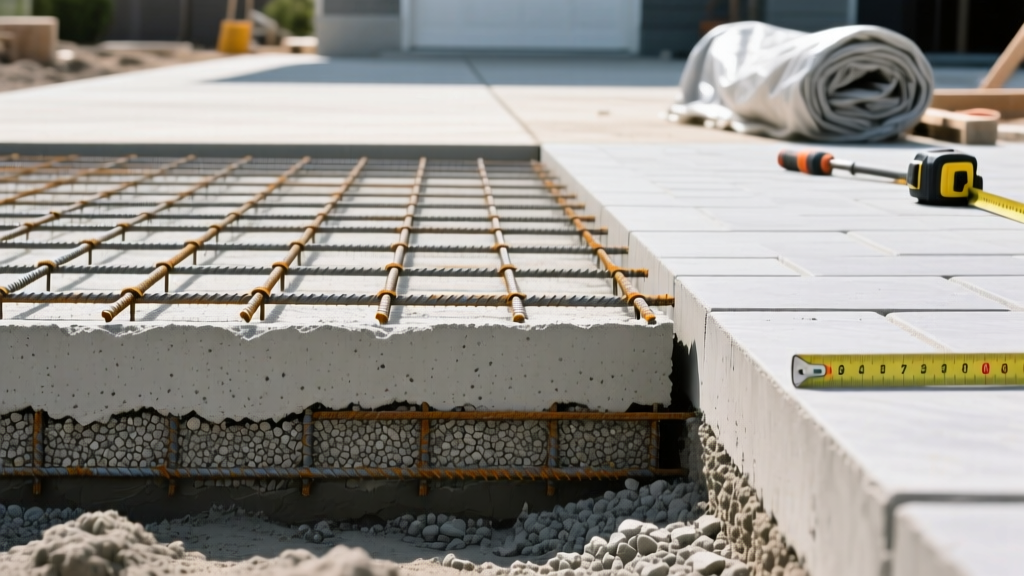
- Reinforcement: #3 or #4 rebar on a 2-foot grid is highly recommended for driveways and garage floors to control cracking under heavy point loads.
Cost Analysis: Is the Upgrade Worth It?
The financial delta between 3000 psi and 4000 psi is surprisingly narrow at the batch plant, making the upgrade highly cost-effective for high-stress applications.
Batch plant pricing for 3000 psi typically ranges from $125 to $140 per cubic yard. Upgrading to 4000 psi adds a premium of $12 to $18 per cubic yard. Let us calculate the real-world impact on a standard 2-car driveway (600 square feet, poured at 4 inches thick):
- Total Volume Required: ~7.4 cubic yards (plus 10% for waste/spillage = 8.2 cubic yards).
- Cost at 3000 psi ($130/yd³): $1,066 for materials.
- Cost at 4000 psi ($145/yd³): $1,189 for materials.
- Total Upgrade Cost: $123.
For an additional $123, the driveway gains a 33% increase in compressive strength, significantly lower water permeability, and a longer lifespan against freeze-thaw spalling. For driveways and garage floors, the 4000 psi upgrade yields an exceptional return on investment. For a backyard patio that only holds foot traffic, that $123 is better spent on decorative stamping or a higher-quality sealant.
Curing Timelines and Early Strength Gains
Scheduling subsequent construction phases requires understanding early strength gains. While both mixes reach their designated psi at 28 days, their trajectories differ.
Due to the higher cement content, 4000 psi concrete hydrates faster in the initial stages. At 7 days, a standard 4000 psi mix will typically achieve 65% to 75% of its design strength (approx. 2,600 to 3,000 psi). A 3000 psi mix at 7 days usually sits around 60% to 65% (approx. 1,800 to 1,950 psi).
Practical Scheduling Rule: You can safely drive standard passenger vehicles on a 4000 psi driveway after 5 to 7 days. However, for heavy construction traffic (like loaded concrete trucks or cranes), you must wait the full 28 days regardless of whether you ordered 3000 or 4000 psi, unless the batch plant specifically utilized accelerating admixtures (like calcium chloride or non-chloride accelerators) and high-early Type III cement.
When to Consider Alternatives: 2500 PSI and 5000+ PSI
While 3000 and 4000 psi dominate the residential market, specific scenarios demand alternative mixes.
2500 PSI: The Budget / Non-Structural Option
Some batch plants offer 2500 psi as a budget mix. This is strictly for non-structural, interior, or temporary applications. Use 2500 psi for pole barn floors in dry climates, temporary construction access roads, or interior shed pads that will never see freeze-thaw exposure or heavy point loads. It is not recommended for any exterior flatwork in northern climates.
5000 PSI and Above: Commercial and Post-Tensioned
Mixes exceeding 4500 psi enter the realm of commercial construction. You will need 5000 psi concrete for:
- Post-tensioned suspended slabs (where high early strength is required to tension the cables).
- High-rise columns and shear walls.
- Industrial floors subjected to extreme abrasion or heavy forklift traffic.
Achieving 5000+ psi requires specialized mix designs, often incorporating supplementary cementitious materials (SCMs) like fly ash or slag cement, along with high-range water reducers (superplasticizers) to maintain workability at extremely low w/c ratios. The Portland Cement Association (PCA) provides extensive guidelines on engineering these high-strength mixes.
Expert Verdict: Making the Final Call
The choice between 3000 psi vs 4000 psi concrete is not about finding the 'best' mix, but the most structurally appropriate one for the specific load and environment. Use 3000 psi for patios, sidewalks, and interior slabs where workability and budget are the primary drivers. Mandate 4000 psi for driveways, garage floors, and foundations where heavy loads, de-icing salts, and freeze-thaw cycles threaten the slab's integrity. Always ensure your contractor orders 5% to 7% air entrainment for any exterior pour in freezing climates, regardless of the psi rating, to prevent catastrophic surface spalling.
Written by
Elena RodriguezElena Rodriguez is a civil engineer and technical writer specializing in concrete technology, masonry systems, and ASTM/ACI compliance. She earned her B.S. in Civil Engineering from Texas A&M University and spent a decade at a materials testing laboratory, performing over 2,000 concrete compressive strength tests and masonry prism evaluations. Elena is an ACI-certified Field Testing Technician (Grade I) and a member of ASTM Committee C12 on Natural Building Stone. She currently consults on forensic engineering cases involving concrete failures and moisture intrusion. Based in San Antonio, TX, Elena is a proud member of the Society of Women Engineers (SWE) and coaches her daughter's FIRST Robotics team.
More from Elena Rodriguez
View all
Walls & Panels
Cost Analysis: Light Gauge Steel Framing Advantages and Disadvantages
Evaluate light gauge steel framing advantages and disadvantages through a strict cost analysis lens, comparing material, labor, and lifecycle expenses.
Aug 4, 2026

Walls & Panels
Gypsum Board Types: Exact Specifications, Thickness & Dimensions
Compare standard, Type X, and moisture-resistant gypsum board types. Get exact specifications, thicknesses, dimensions, and ASTM standards for your project.
Aug 4, 2026

Fire Resistance
Best Fire-Resistant Outdoor Decking Materials: 2026 Buyer Guide
Discover the best fire-resistant outdoor decking materials for 2026. Compare Class A PVC, aluminum, and hardwood options for WUI compliance and safety.
Aug 4, 2026