Specs for Adhesive Contact Cement 1 Gal Container: Evan St Clair, ID
Technical specifications, performance ratings, and application protocols for 1-gallon contact cement adhesives on concrete subfloors in Idaho.
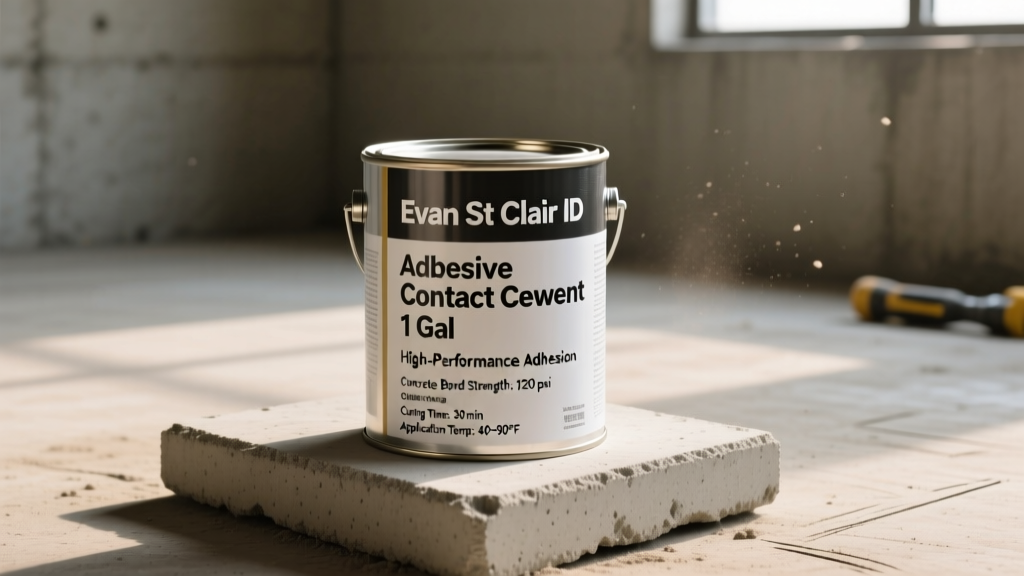
Bonding high-pressure laminates, architectural veneers, and resilient flooring to concrete subfloors requires an adhesive capable of bridging the porosity gap between organic substrates and alkaline masonry. Polychloroprene (neoprene) contact cements remain the industry standard for these high-shear applications. This guide details the exact performance specifications, environmental variables, and substrate preparation protocols required when specifying these adhesives for commercial and high-end residential projects.
Core Performance Specifications & Chemistry
Contact cements designed for concrete bonding rely on a polychloroprene rubber base dissolved in a solvent carrier (typically acetone, toluene, or hexane blends). Unlike pressure-sensitive adhesives that remain tacky, contact cements require a dual-coat application and a specific flash-off period before mating the substrates. Once the solvents evaporate, the adhesive film becomes dry to the touch but retains aggressive grab, creating an immediate, high-strength bond that eliminates the need for mechanical clamping.
Baseline Technical Requirements (2026 Standards)
- Tensile Shear Strength: Minimum 450 psi (ASTM D1002) when bonded to cured concrete.
- Solids Content: 22% to 28% by weight (dictates final film thickness and gap-filling capability).
- Viscosity: 2,500 to 4,000 cP (centipoise) at 70°F, ensuring adequate ridge retention when troweled.
- VOC Limits: Must comply with SCAQMD Rule 1168, capping VOCs at 100 g/L for indoor concrete bonding applications.
- Thermal Stability: Service temperature range of -20°F to 180°F post-cure.
Regional Climate Variables: The Evan St Clair, ID Factor
Environmental conditions drastically alter the open time and flash-off rates of solvent-based adhesives. When sourcing an adhesive contact cement 1 gal container, Evan St Clair, ID project managers must account for the region's specific high-desert climate, which drastically alters solvent flash-off rates compared to coastal installations. The low ambient humidity and high-altitude atmospheric pressure typical of Idaho accelerate solvent evaporation.
In standard 50% relative humidity (RH) environments, the open time for neoprene contact cement is 45 to 60 minutes. However, in the dry, high-altitude conditions often encountered in Idaho, this window can compress to 15 or 20 minutes. If the adhesive over-flashes (dries too much), the chemical cross-linking required for a structural bond will fail, resulting in a 'cold joint' where the two adhesive films do not fuse. To mitigate this, specifiers in these regions should mandate adhesives formulated with slower-evaporating solvent blends (incorporating higher ratios of toluene over acetone) to extend the working window.
Concrete Subfloor Moisture & Preparation Matrix
The most common cause of contact cement failure on concrete is not adhesive degradation, but substrate moisture vapor emission and alkalinity. Polychloroprene adhesives are highly susceptible to hydrolysis when exposed to sustained alkaline moisture.
"Never rely on visual inspection for concrete moisture. A slab that appears bone-dry on the surface can easily emit enough moisture vapor to liquefy a contact cement bond line within 72 hours." — American Concrete Institute (ACI) Guidelines on Floor Covering Adhesives.
| Preparation Method | Target CSP (Concrete Surface Profile) | Max Moisture Tolerance (MVER) | Max Relative Humidity (RH) |
|---|---|---|---|
| Diamond Grinding (30-40 grit) | CSP 2 | 3 lbs / 1,000 sq ft / 24 hrs | 75% (ASTM F2170) |
| Shot Blasting (Standard) | CSP 3 | 5 lbs / 1,000 sq ft / 24 hrs | 80% (ASTM F2170) |
| Scarifying / Planing | CSP 4-5 (Too aggressive) | Requires epoxy moisture barrier | Requires epoxy moisture barrier |
Handling the 1-Gallon Container Standard
The 1-gallon metal can is the standard procurement unit for commercial contact cements, offering the optimal balance between volume and shelf-life management. However, the chemistry of neoprene adhesives makes them prone to 'skinning'—a phenomenon where the top layer of adhesive cures upon exposure to ambient air inside the can.
Storage and Agitation Protocols
- Inverted Storage: Store the 1-gallon container upside down for 24 hours prior to opening. This forces any trapped air bubbles to the bottom (now the top) and creates a liquid seal at the lid, preventing skinning.
- Mechanical Agitation: Do not merely stir the adhesive with a stick. Use a low-speed drill with a jiffy mixer paddle for 3 to 5 minutes. The heavy solids (neoprene rubber and zinc oxide fillers) settle at the bottom; inadequate mixing results in a solvent-heavy top layer that lacks cohesive strength.
- Temperature Conditioning: Bring the 1-gallon container into the installation environment 48 hours before use. Applying 50°F adhesive to a 70°F concrete slab causes immediate condensation within the adhesive film, compromising the bond.
Troubleshooting & Failure Mode Analysis
When a contact cement bond fails on a concrete substrate, the failure mode usually presents in one of three distinct ways. Identifying the physical symptom points directly to the procedural error.
- Symptom: Adhesive transfers to the substrate but not the concrete (Cohesive Failure).
Cause: Concrete dust or laitance was present on the slab. The adhesive bonded to the dust, not the concrete matrix. Fix: Mandate HEPA vacuuming and damp-mopping post-grinding. - Symptom: Blistering or bubbling under the laminate/veneer weeks after installation.
Cause: Solvent entrapment. The second coat was applied before the first coat fully flashed off, or the substrates were mated before the solvent evaporated. The trapped solvent eventually turns to gas, creating blisters. Fix: Strict adherence to the 'dry-to-touch with no transfer' test before mating. - Symptom: Bond releases cleanly from both surfaces with no adhesive tearing.
Cause: Over-flashing (open time exceeded) or mating at temperatures below 60°F. The adhesive lost its chemical tack and acted as a dry film. Fix: Reactivate the bond line using a heat gun (150°F) and apply immediate, heavy roller pressure (100 lbs minimum).
2026 Procurement & Yield Economics
Understanding the true coverage rate of a 1-gallon container is critical for accurate project estimating. While manufacturer labels often claim up to 120 square feet per gallon, real-world application on porous concrete requires a heavier mil thickness to bridge the microscopic voids in the cement paste.
| Application Method | Wet Film Thickness | Real-World Coverage (Dual Coat) | Avg. Cost per Gallon (2026) | Cost per Sq. Ft. (Installed) |
|---|---|---|---|---|
| Brush / Roller (Standard) | 4-6 mils | 60 - 75 sq. ft. | $65.00 - $85.00 | $0.86 - $1.41 |
| Notched Trowel (1/16" x 1/16") | 8-10 mils | 40 - 50 sq. ft. | $65.00 - $85.00 | $1.30 - $2.12 |
| HVLP Sprayer (Specialized) | 3-4 mils | 80 - 100 sq. ft. | $65.00 - $85.00 | $0.65 - $1.06 |
For large-scale commercial deployments, transitioning from brush application to HVLP (High Volume Low Pressure) spraying significantly reduces adhesive waste and ensures a uniform mil thickness, which is critical for preventing telegraphing when bonding thin veneers to concrete. Always verify that the specific 1-gallon product selected is rated for spray application, as high-solids formulations can clog standard fluid nozzles.
By strictly adhering to these moisture, environmental, and application specifications, contractors can ensure that polychloroprene contact cements deliver their rated shear strength and long-term durability, even in demanding regional climates.