Concrete vs Sundae Stains: Troubleshooting Dairy and Sugar Spills
Dropped ice cream? Learn how to troubleshoot and remove stubborn sundae stains from sealed and unsealed concrete using enzymatic cleaners and poultices.

The Chemistry of the Spill: Why Concrete vs Sundae is a Complex Battle
The phrase "concrete vs sundae" might sound like a mismatch, but in commercial food courts, restaurant patios, and residential stamped concrete decks, dropped ice cream sundaes are a leading cause of complex, multi-layered staining. Unlike simple dirt or water spills, a sundae introduces a volatile chemical matrix to the concrete surface: butterfats, dairy proteins (casein), sucrose, tannins (from chocolate and fruit syrups), and artificial chromophores (food dyes).
Concrete is inherently porous. Its capillary network acts like a rigid sponge, drawing liquid fats and sugar water deep into the substrate. When troubleshooting concrete vs sundae spills, standard pressure washing or basic detergent mopping will fail. Water alone cannot dissolve hydrophobic butterfats, and high-pressure spray often drives the sugary syrup deeper into the capillary pores. To properly repair and restore the surface, you must break the spill down into its chemical components and treat each layer sequentially.
Surface Triage: Identifying Your Sealer and Substrate
Before applying any chemical agent, you must identify the concrete's surface profile. The cleaning protocol changes drastically depending on whether the slab is sealed, and if so, what type of sealer was used. According to surface preparation guidelines referenced by the International Concrete Repair Institute (ICRI), applying the wrong pH cleaner can permanently cloud or strip topical sealers.
| Surface Type | Vulnerability to Dairy/Fats | Recommended Cleaning Approach |
|---|---|---|
| Unsealed / Bare Concrete | High (Deep capillary absorption) | Alkaline degreasers followed by enzymatic poultice. |
| Penetrating Sealer (Silane/Siloxane) | Medium (Fats sit on surface, sugars penetrate micro-pores) | Emulsifying citrus degreasers; avoid high-alkaline strippers. |
| Topical Acrylic Sealer | Low (Stains sit on the plastic-like film) | Mild enzymatic cleaners. Avoid solvents (xylene/acetone) which melt acrylic. |
| Polyurethane / Epoxy Coating | Very Low (Non-porous barrier) | Standard neutral pH floor cleaners; mechanical agitation. |
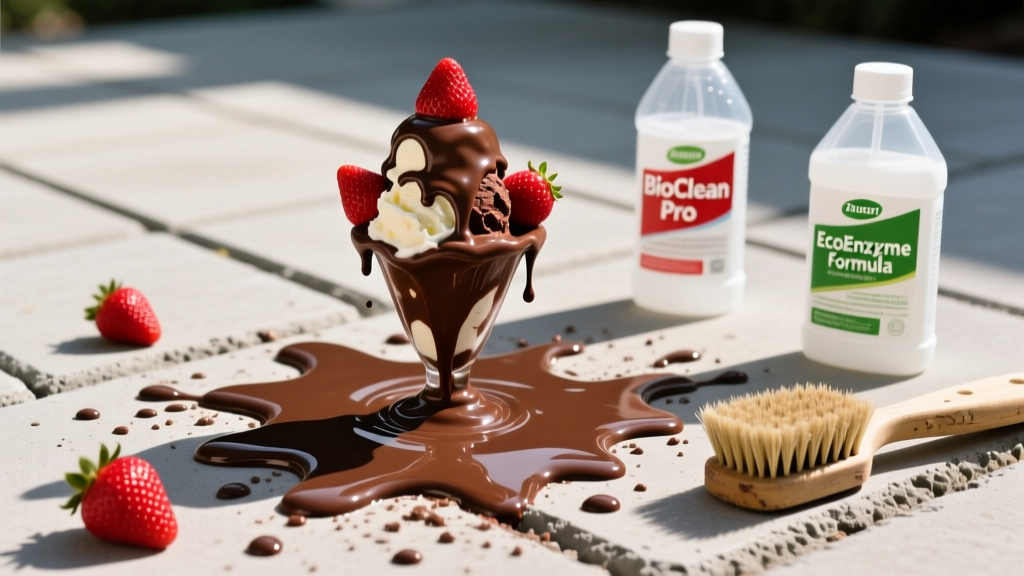
Phase 1: Dairy and Fat Extraction (The Ice Cream Base)
The foundational layer of any sundae stain is dairy fat. Butterfat is hydrophobic, meaning it repels water. If you attempt to clean a sundae spill with water and a standard neutral-pH soap, you will simply smear the fat across the surface, creating a hazy, slippery film that attracts dirt over time.
The Alkaline and Enzymatic Approach
To saponify and lift the fats, you need an alkaline degreaser with a pH between 10 and 12, or a specialized lipase enzyme cleaner. In 2026, bio-enzymatic cleaners originally designed for commercial food service and pet accidents (which contain high concentrations of lipase and protease enzymes) are the most effective tools for dairy extraction on concrete.
- Remove Solids: Scrape away all solid ice cream and toppings with a plastic putty knife. Never use metal scrapers on stamped or sealed concrete, as they will gouge the texture and breach the sealer.
- Apply Degreaser: Spray an alkaline concrete degreaser (such as Prosoco DailyKlean or a heavy-duty citrus emulsifier) directly onto the stain. Allow a 10-to-15-minute dwell time. Do not let the solution dry.
- Agitate: Scrub the area using a stiff polypropylene bristle brush. Avoid wire brushes entirely; wire bristles shed microscopic steel particles that will rust when exposed to moisture, creating secondary iron oxide stains.
- Extract: Rinse thoroughly with hot water (140°F to 160°F). Hot water keeps the fats in a liquid state, allowing them to be flushed out of the pores rather than solidifying as they cool.
Some contractors mistakenly reach for muriatic (hydrochloric) acid to clean concrete. Acid coagulates dairy proteins (casein) and hardens fats, effectively welding the sundae residue into the concrete matrix. Acid washing a dairy spill will make the stain permanent.
Phase 2: Tannin and Dye Removal (The Syrups and Sprinkles)
Once the fat is removed, you are often left with a dark brown or vibrant red/purple shadow. This is caused by tannins from chocolate syrup and artificial dyes from fruit toppings or sprinkles. These are organic chromophores that require oxidation, not degreasing.
While sodium hypochlorite (bleach) is a common oxidizer, it is highly detrimental to colored, stamped, or integrally dyed concrete, as it will strip the UV pigments and leave a bleached halo. Instead, utilize a 3% to 12% hydrogen peroxide solution. Hydrogen peroxide breaks the double carbon bonds of the chromophores, rendering them colorless without damaging the concrete's integral pigments. The Portland Cement Association frequently recommends peroxide-based oxidizers for organic stain removal on decorative flatwork.
The Poultice Protocol for Deep-Set Stains
If the sundae sat in the sun and baked into unsealed concrete for several hours before discovery, surface cleaning will not reach the deep capillary roots of the stain. You must reverse the capillary action using a poultice.
Materials Needed
- Absorbent powder: Kaolin clay, diatomaceous earth, or specialized commercial poultice powder.
- Liquid chemical: 12% hydrogen peroxide (for syrup dyes) or liquid lipase enzyme (for deep dairy fats).
- Plastic sheeting and painter's tape.
Step-by-Step Application
- Mix the Poultice: Combine the powder and liquid in a plastic bucket until it reaches the consistency of thick peanut butter.
- Apply: Trowel the mixture over the stain, extending 2 inches beyond the visible edges. The layer should be roughly 1/4-inch thick.
- Seal and Wait: Cover the poultice with plastic sheeting and tape down the edges. This slows the evaporation rate, forcing the chemical to penetrate deep into the concrete rather than drying on the surface. Leave it sealed for 24 hours.
- Dry and Draw: Remove the plastic and allow the poultice to dry completely for another 24 to 48 hours. As the water evaporates upward, it pulls the dissolved fats and dyes out of the pores and into the clay.
- Remove: Scrape away the dried, stained powder with a plastic scraper and vacuum the residue.
Post-Repair: Restoring the Surface Profile
Heavy degreasing and poultice extraction will often strip or degrade topical acrylic sealers. If your water no longer beads up on the cleaned surface, the sealer has been compromised and must be reapplied to prevent future spills from penetrating.
For exterior patios, a penetrating silane/siloxane sealer (like Siloxa-Tek 8500) is highly recommended. These sealers do not form a surface film, meaning they will not trap moisture or become slippery when wet, and they cost approximately $0.15 to $0.25 per square foot for materials in 2026. If the aesthetic requires a wet-look film, use a breathable, UV-stable polyurethane or solvent-based acrylic, applying it only when the concrete is 100% bone-dry (verified via a calcium chloride moisture test).
Frequently Asked Questions
Can I just use a pressure washer to blast away the sundae?
No. High-pressure water (above 2,500 PSI) will etch unsealed concrete and easily peel the edges of topical acrylic sealers. Furthermore, the pressure forces the sugary syrup and dairy fats deeper into the microscopic pores, making chemical extraction significantly harder.
Will the sugar in the sundae damage the concrete structurally?
While a single spilled sundae will not compromise the structural integrity of a cured slab, chronic sugar exposure in commercial environments (like outdoor ice cream parlors) can feed microbial growth and algae, leading to surface bio-deterioration and slippery biofilms over time.
How much does professional stain removal cost?
If DIY enzymatic cleaning and poulticing fail, professional concrete restoration contractors typically charge between $3.00 and $7.00 per square foot for localized chemical extraction and spot-resealing, with a minimum service call fee usually ranging from $250 to $400.
Written by
Priya KapoorPriya Kapoor is a real estate market analyst and construction economics researcher with expertise in housing affordability, development feasibility, and infrastructure investment. She holds a Master of Regional Planning from Cornell University and previously worked as a senior analyst at CBRE's Investment Properties group, where she modeled returns for $4B in mixed-use development pipelines. Priya now runs an independent research practice advising developers, municipalities, and REITs on construction cost forecasting and market timing. She publishes the quarterly "BuildMat Market Pulse" report tracking material price indices across 12 commodity categories. Based in Austin, TX, Priya serves on the board of Habitat for Humanity Austin and is a marathon runner.
More from Priya Kapoor
View all
Construction Cost
Cost to Build a 1600 Sq Ft Home in 2026: Full Breakdown
Accurate 2026 cost to build a 1600 sq ft home—material, labor, and regional pricing breakdowns included. Plan your budget with real-time estimates.
Aug 11, 2026

Wood & Lumber
Name the Types of Wood for Pressure Treatment and Preservation
Learn how to name the types of wood best suited for pressure treatment. Compare species treatability, chemical retention levels, and 2026 preservation costs.
Aug 4, 2026

Stone & Masonry
Stone Veneer Suppliers Lindenhurst: 2026 Cost Analysis
Analyze 2026 stone veneer costs in Lindenhurst, NY. Compare local supplier pricing, delivery fees, and Suffolk County installation labor rates.
Aug 4, 2026