Stamped Concrete vs Regular Concrete: Cost, Durability & ROI
Compare stamped concrete vs regular concrete for patios and driveways. Analyze 2026 costs, PSI durability, maintenance, and ROI to choose the right slab.

The Core Difference: Aesthetics vs. Utility
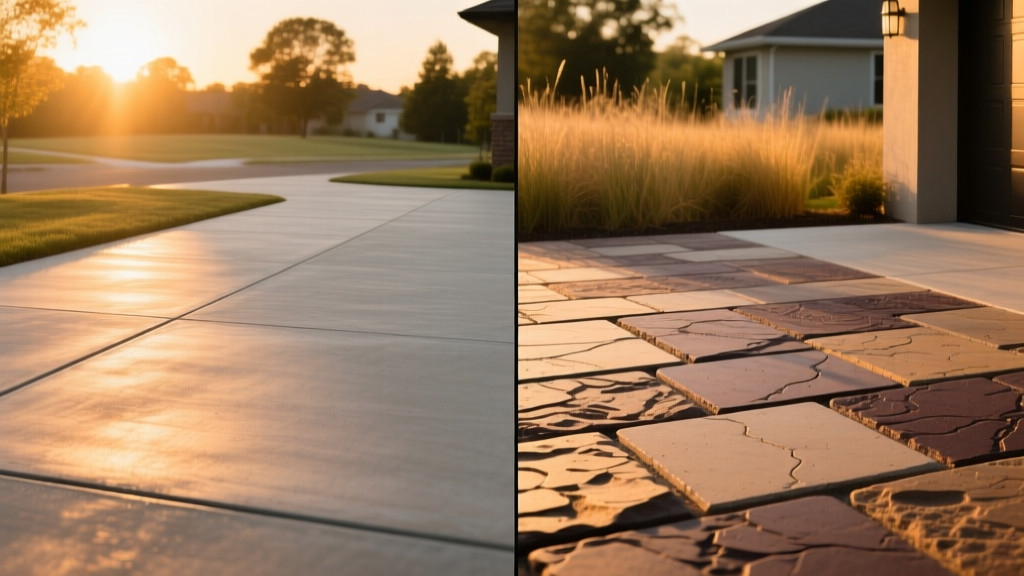
When evaluating stamped concrete vs regular concrete, the fundamental distinction lies in the surface treatment and structural intent. Regular concrete—often finished with a broom or trowel—is a utilitarian slab designed for high-traffic load-bearing and straightforward installation. Stamped concrete begins as the exact same ready-mix base but undergoes a secondary finishing process involving color hardeners, antiquing release agents, and polyurethane stamping mats applied before the initial set.
According to the National Ready Mixed Concrete Association, the structural integrity of both slabs relies on the same foundational principles: proper subgrade compaction, water-to-cement ratio control, and curing. However, the surface chemistry of stamped concrete alters its wear profile, maintenance requirements, and overall lifecycle cost.
Quick Decision Framework
- Choose Regular (Broom Finish) If: You are pouring a steep driveway, a municipal sidewalk, or a budget-constrained utility pad where maximum slip resistance and minimal maintenance are the top priorities.
- Choose Stamped If: You are designing a pool deck, a high-end patio, or a courtyard where mimicking natural stone (like ashlar slate or cobblestone) yields a higher property ROI, and you are committed to a 24-month resealing cycle.
Upfront Costs and Long-Term ROI Breakdown
The financial divergence between stamped and regular concrete is significant. While regular concrete is priced primarily by volume and basic labor, stamped concrete pricing scales with pattern complexity, color layering, and the artisan skill required to execute the stamping before the concrete cures.
| Cost Factor (Per Sq. Ft.) | Regular Concrete (Broom Finish) | Stamped (Standard 1-Color Pattern) | Stamped (Custom Multi-Color/Border) |
|---|---|---|---|
| Base Material & Pour | $4.00 - $6.00 | $5.00 - $7.50 | $6.00 - $9.00 |
| Color & Stamping Labor | N/A | $6.00 - $9.00 | $12.00 - $18.00 |
| Initial Sealing (Required) | $0.00 - $1.00 (Optional) | $1.50 - $2.50 (Mandatory) | $2.00 - $3.50 (Mandatory) |
| Total Installed Cost | $8.00 - $12.00 | $15.00 - $22.00 | $24.00 - $35.00+ |
Note: Pricing reflects 2026 national averages. Regional labor rates and site accessibility (e.g., pump truck requirements) can shift these figures by 15-20%.
Durability, Cracking, and Climate Performance
A common misconception is that stamped concrete is structurally weaker due to the surface manipulation. In reality, the application of a dry-shake color hardener (such as those manufactured by Brickform or Solomon Colors) actually increases the surface compressive strength. While a standard driveway mix is specified at 4,000 PSI, the color hardener layer can push the surface wear resistance to over 5,500 PSI, making it highly resistant to surface spalling and abrasion.
The Freeze-Thaw Factor and Air Entrainment
Both slab types require air-entrained concrete (typically 4% to 8% microscopic air bubbles) to survive freeze-thaw cycles, as outlined by the Portland Cement Association. However, stamped concrete is more vulnerable to de-icing chemicals. The acrylic sealers used on stamped surfaces can degrade when exposed to harsh magnesium chloride or rock salt, leading to moisture intrusion and subsequent surface scaling.
Control Joint Strategy
All concrete cracks; the goal is to control where it cracks. Regular concrete uses tooled joints or straightforward saw-cuts. Stamped concrete requires precision planning. Contractors must align saw-cut control joints with the natural "grout lines" of the stamp pattern (e.g., the gap between two stamped cobblestones). If a stamp pattern is not perfectly squared to the formwork, random cracking will inevitably cut through the visual center of a "stone," destroying the illusion and requiring costly epoxy repairs.
Maintenance Realities: Sealing, Resurfacing, and Repair
The maintenance divergence is where the long-term ROI of regular concrete often outpaces stamped concrete for budget-conscious homeowners. Regular concrete can be left entirely unsealed for decades, developing a natural patina. Stamped concrete must be sealed to protect the release agents and color hardeners from UV fading and moisture.
Stamped Concrete Maintenance Timeline
- Day 1-28 (Curing): Keep off heavy traffic. If a breathable cure-and-seal was applied, no immediate action is needed.
- Year 1-2 (UV & Wear Assessment): High-traffic zones (pathways, steps) will show sealer wear. The surface will look chalky or faded when dry, but vibrant when wet.
- Year 2-3 (First Reseal): Power wash with a surface cleaner (max 2,500 PSI). Allow 48 hours of dry time. Apply a fresh coat of solvent-based or water-based acrylic sealer.
- Year 5+ (Deep Maintenance): If multiple layers of solvent-based sealer have been applied, the surface may suffer from "solvent trap" (whitening/hazing). The slab must be chemically stripped using a xylene-based solvent before resealing.
Slip Resistance and Safety Additives
Standard stamped concrete is notoriously slippery when wet due to the smooth acrylic sealer. For pool decks or sloped walkways, contractors must broadcast an anti-skid additive (like SureCrete SureGrip or SharkGrip) directly into the wet sealer during application. Regular broom-finished concrete inherently provides a high coefficient of friction without chemical additives.
Installation Timelines and Curing Constraints
The installation window for stamped concrete is highly unforgiving. While a regular concrete crew can pour and finish a 1,000 sq. ft. driveway in a single morning, stamped concrete requires a synchronized, multi-day approach.
- Day 1: Pour and Stamp. The concrete must be poured, colored, and stamped within a tight 2-to-4-hour window depending on ambient temperature and humidity. Wind and direct sun accelerate the set time, risking "plastic shrinkage" cracks if the crew cannot stamp fast enough.
- Day 2: Detailing and Washing. Once cured enough to walk on, the crew saw-cuts the control joints and uses a pressure washer to remove the excess antiquing release agent from the surface, leaving color only in the recessed joints.
- Day 3 to 28: Curing. The slab must cure for a minimum of 28 days before applying a high-solids, non-breathable acrylic sealer. Trapping moisture under the sealer before the slab is fully cured will result in permanent blushing (white hazing).
Final Verdict: Which Should You Choose?
If your project is a primary vehicle thoroughfare, a steep incline, or a utility space, regular concrete offers superior traction, lower lifetime maintenance, and a fraction of the upfront cost. The American Concrete Institute consistently recommends standard flatwork for heavy vehicular loads due to the ease of joint maintenance and surface repair.
If your project is an entertainment space, a pool surround, or an architectural focal point, stamped concrete provides a luxurious aesthetic at roughly 40% to 60% the cost of true natural flagstone or pavers, while eliminating the weed-growth issues associated with paver sand joints. Just ensure your budget accounts for the mandatory bi-annual resealing cycle.
Frequently Asked Questions
Can you stamp concrete over an existing regular slab?
Not directly. Standard stamping requires a fresh, wet pour to press the mats into the surface. However, you can install a "stamped concrete overlay" (a polymer-modified cementitious skim coat) over an existing slab. Overlays are typically 1/4 to 1/2 inch thick and are stamped with thinner, more flexible mats. They cost between $10 and $18 per square foot but are prone to delamination if the underlying slab shifts.
Which is easier to repair if it cracks?
Regular concrete is significantly easier to repair. Cracks can be routed and filled with a color-matched polyurethane sealant. Stamped concrete repairs are highly visible; patching compounds rarely match the complex color variations of the antiquing release agents, often requiring a full panel replacement or a complete decorative overlay to hide the fix.
Does stamped concrete add more resale value than regular concrete?
Yes, in specific contexts. For backyard patios, pool decks, and front entryways, stamped concrete yields a higher aesthetic ROI, often appraising closer to natural stone hardscaping. For standard driveways, the ROI diminishes, as buyers prioritize functional, low-maintenance surfaces over decorative ones for vehicle parking.
Written by
Sarah WhitfieldSarah Whitfield is a chartered quantity surveyor (MRICS) and construction cost analyst with 15 years of experience in material pricing, procurement strategy, and project budgeting. She earned her degree in Construction Management from the University of Reading (UK) and has worked on projects ranging from $2M custom homes to $180M mixed-use developments across North America and Europe. Sarah currently leads cost estimating for BuildMat Insight, maintaining a proprietary database of 4,000+ material price points updated quarterly. She is a frequent contributor to RSMeans cost data panels and has presented at the International Cost Engineering Council (ICEC) congress. Based in Denver, CO, Sarah is an avid trail runner and volunteer mentor for Women in Construction.
More from Sarah Whitfield
View all
Wood & Lumber
What Are the Different Types of Wood? A Builder's Guide
Compare structural softwoods, finish hardwoods, and engineered lumber. Analyze Janka ratings, MOE values, and 2026 pricing for construction.
Aug 4, 2026

Walls & Panels
Steel Framing vs Wood Framing: Corrosion and Moisture Defense
Compare steel framing vs wood framing for moisture resistance. Learn about galvanized coatings, condensation risks, and corrosion protection strategies.
Jul 21, 2026

Stone & Masonry
How to Cut Stone Veneer: Wet Saw vs Grinder Comparison
Compare the best tools for cutting stone veneer. We review wet saws, angle grinders, and chop saws to help you achieve clean, chip-free cuts.
Jul 21, 2026