Asphalt vs Concrete Pavement: Driveway Cost and Lifespan Compared
Compare asphalt vs concrete pavement for driveways and parking lots. Analyze installation costs, lifespan, maintenance, and climate performance.

Material Science: Bitumen Binders vs. Portland Cement Hydration
The fundamental difference between asphalt and concrete pavement lies in the binder that holds the aggregate together. Asphalt pavement (technically Hot Mix Asphalt, or HMA) relies on bitumen, a viscous, petroleum-based binder that remains viscoelastic. This flexibility allows the pavement to bend slightly under heavy loads and expand during temperature fluctuations without immediate fracturing. According to the Asphalt Institute, modern HMA utilizes Performance Graded (PG) binders, such as PG 64-22, engineered to resist rutting at high temperatures (64°C) and thermal cracking at low temperatures (-22°C).
Concrete pavement, conversely, utilizes Portland cement and water to trigger a chemical hydration process, forming a rigid, crystalline matrix. This rigidity gives concrete immense compressive strength (typically 4,000 PSI for residential and light commercial applications) but makes it brittle. To manage thermal expansion and shrinkage, concrete requires engineered control joints. The American Concrete Institute (ACI) mandates that joint spacing in feet should not exceed 2 to 2.5 times the slab thickness in inches—meaning a standard 5-inch driveway slab requires joints spaced every 10 to 12.5 feet.
2026 Installation Cost Analysis and Pricing Breakdown
When evaluating asphalt vs concrete pavement, upfront capital expenditure is often the primary decision driver. Concrete consistently demands a higher initial investment due to material costs, extensive forming, and labor-intensive finishing processes. The table below outlines the average national costs per square foot for a standard 2,000-square-foot residential driveway or light commercial pad in 2026.
| Cost Component | Asphalt Pavement (HMA) | Concrete Pavement |
|---|---|---|
| Excavation & Grading | $1.00 - $1.50 / sq ft | $1.25 - $2.00 / sq ft |
| Subbase Material (Crushed Stone) | $0.75 - $1.25 / sq ft | $0.85 - $1.50 / sq ft |
| Material (HMA or Ready-Mix) | $1.50 - $2.50 / sq ft | $3.50 - $5.50 / sq ft |
| Labor, Forming & Finishing | $1.25 - $2.00 / sq ft | $4.00 - $7.00 / sq ft |
| Sealing / Curing Compounds | $0.25 - $0.50 / sq ft | $0.15 - $0.30 / sq ft |
| Total Installed Cost | $4.75 - $7.75 / sq ft | $9.75 - $16.30 / sq ft |
Lifespan, Durability, and Climate Performance
The lifespan disparity between the two materials is significant. A properly installed and maintained concrete driveway will routinely last 30 to 50 years, whereas asphalt typically requires full-depth replacement after 15 to 25 years. However, climate dictates which material performs best in a specific region.
Freeze-Thaw Cycles and De-icing Chemicals
In northern climates, concrete is highly vulnerable to freeze-thaw damage if not properly mixed. The concrete must be air-entrained (containing 5% to 7% microscopic air bubbles per ASTM C457) to provide expansion chambers for freezing water. Furthermore, applying calcium chloride or rock salt during the first winter can cause severe surface scaling. Asphalt, being dark and flexible, absorbs solar radiation to melt snow faster and is entirely immune to salt-induced chemical scaling, making it highly practical in heavy winter regions.
Heat Island Effect and UV Degradation
In southern and desert climates, asphalt faces severe UV degradation and thermal softening. The bitumen binder oxidizes under UV exposure, turning the pavement brittle and gray over time. Under extreme heat and heavy static loads (like RVs or commercial delivery trucks), asphalt can suffer from 'rutting'—permanent shear deformation. Concrete remains dimensionally stable in high heat and reflects more solar radiation, mitigating the urban heat island effect.
Maintenance Matrix: Sealing, Patching, and Resurfacing
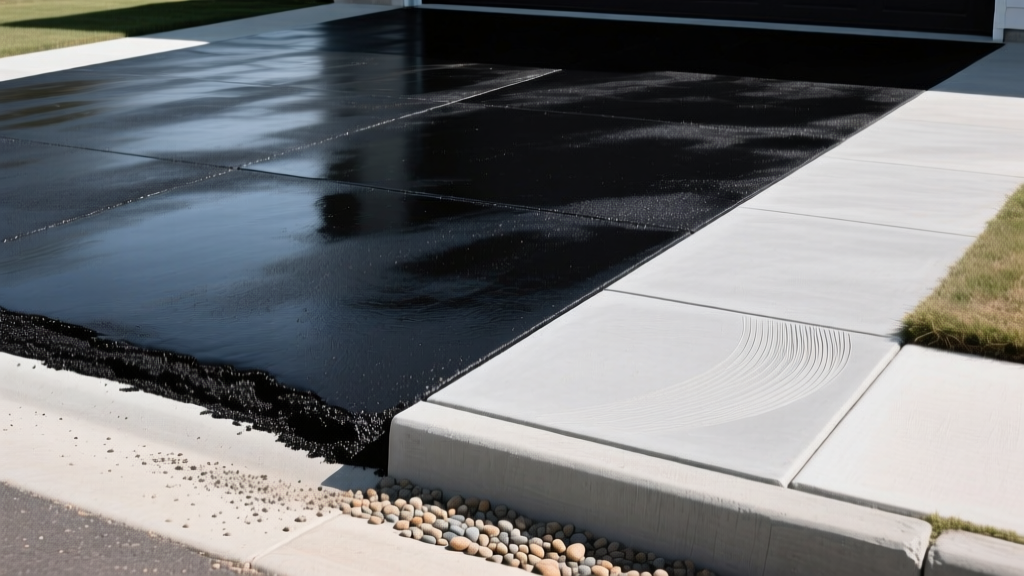
Maintenance profiles for asphalt vs concrete pavement are fundamentally different. Asphalt requires frequent, low-cost surface treatments, while concrete requires infrequent, targeted joint maintenance.
- Asphalt Sealcoating: Must be applied 90 days after installation to allow volatiles to evaporate, and reapplied every 2 to 3 years. Coal tar emulsions offer superior chemical resistance against gas and oil drips compared to asphalt emulsions.
- Concrete Joint Sealing: Control joints must be routed and filled with a high-modulus polyurethane or silicone sealant every 5 to 7 years to prevent incompressible debris (rocks, dirt) from entering the joint, which causes spalling during thermal expansion.
- Crack Repair: Asphalt cracks are routed and filled with hot-pour rubberized crack filler. Concrete cracks that exceed 1/4 inch in width often indicate subgrade failure and require epoxy injection or full-panel replacement.
Structural Specifications and Failure Modes
To ensure maximum longevity, contractors must adhere to strict mix designs and placement protocols. Below are the non-negotiable specifications for both materials.
Concrete Pavement Specifications
- Compressive Strength: Minimum 4,000 PSI at 28 days (ASTM C39).
- Slump: 4 inches maximum. Higher slumps (adding water on-site) drastically reduce surface durability and increase shrinkage cracking.
- Thickness: 4 inches for passenger vehicles; 5 to 6 inches for driveways accommodating heavy trucks or RVs.
- Reinforcement: 6x6 W1.4xW1.4 Welded Wire Fabric (WWF) or #4 rebar spaced at 24 inches on center, elevated on chairs to sit in the upper third of the slab.
- Saw-Cutting: Joints must be saw-cut to a depth of 1/4 the slab thickness within 4 to 12 hours of placement to control random shrinkage cracking.
Asphalt Pavement Specifications
- Binder Grade: PG 64-22 for moderate climates; PG 76-22 (polymer-modified) for high-heat or heavy-load areas.
- Lift Thickness: Minimum 2.5 to 3 inches of surface course applied over a 4-inch binder/base course.
- Compaction: Must achieve 92% to 94% of theoretical maximum specific gravity (Gmm) using a vibratory steel-wheel roller followed by a pneumatic-tired roller.
- Temperature: HMA must be laid at a minimum temperature of 285°F and compacted before it drops below 175°F.
Decision Framework: When to Choose Which
Selecting between asphalt and concrete pavement requires aligning material properties with project constraints. The Federal Highway Administration (FHWA) emphasizes that life-cycle cost analysis (LCCA) should drive pavement selection rather than initial bid price alone.
Choose Concrete Pavement When:
- You require a service life exceeding 30 years with minimal structural maintenance.
- The pavement will support heavy, static point loads (e.g., RV tongue jacks, commercial dumpster pads) where asphalt would rut.
- Aesthetic customization is desired (stamped, stained, or exposed aggregate finishes).
- The site experiences extreme, prolonged summer heat that would soften an asphalt surface.
Choose Asphalt Pavement When:
- Initial capital budget is strictly constrained, and you are willing to accept a 3-to-5 year sealcoating maintenance cycle.
- The project is in a severe freeze-thaw climate where road salts are heavily used, and you want to avoid concrete scaling risks.
- You need the surface opened to traffic immediately (asphalt can be driven on within 24 to 48 hours of cooling, whereas concrete requires 7 days for passenger vehicles and 28 days for full design strength).
- The subgrade is mildly unstable; asphalt's flexibility allows it to bridge minor subgrade deflections without snapping.
Written by
Priya KapoorPriya Kapoor is a real estate market analyst and construction economics researcher with expertise in housing affordability, development feasibility, and infrastructure investment. She holds a Master of Regional Planning from Cornell University and previously worked as a senior analyst at CBRE's Investment Properties group, where she modeled returns for $4B in mixed-use development pipelines. Priya now runs an independent research practice advising developers, municipalities, and REITs on construction cost forecasting and market timing. She publishes the quarterly "BuildMat Market Pulse" report tracking material price indices across 12 commodity categories. Based in Austin, TX, Priya serves on the board of Habitat for Humanity Austin and is a marathon runner.
More from Priya Kapoor
View all
Construction Cost
Cost to Build a 1600 Sq Ft Home in 2026: Full Breakdown
Accurate 2026 cost to build a 1600 sq ft home—material, labor, and regional pricing breakdowns included. Plan your budget with real-time estimates.
Aug 11, 2026

Wood & Lumber
Name the Types of Wood for Pressure Treatment and Preservation
Learn how to name the types of wood best suited for pressure treatment. Compare species treatability, chemical retention levels, and 2026 preservation costs.
Aug 4, 2026

Stone & Masonry
Stone Veneer Suppliers Lindenhurst: 2026 Cost Analysis
Analyze 2026 stone veneer costs in Lindenhurst, NY. Compare local supplier pricing, delivery fees, and Suffolk County installation labor rates.
Aug 4, 2026