How to Anchor and Install a Concrete Porch Goose Statue Securely
Learn the exact installation, anchoring, and weatherproofing procedures to securely mount a heavy concrete porch goose statue to your slab.
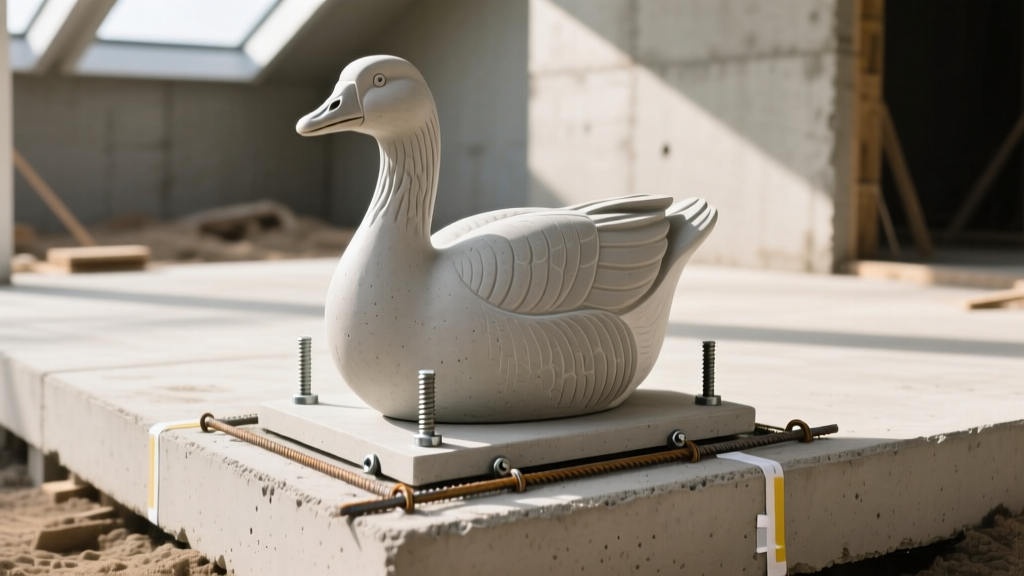
Structural Challenges of Cast Concrete Statuary
Cast concrete lawn ornaments, particularly the traditional concrete porch goose, add significant curb appeal but present unique structural and material challenges. Weighing between 80 and 150 pounds, these top-heavy, unreinforced castings are highly susceptible to wind shear, accidental tipping, and freeze-thaw damage if improperly mounted. Unlike reinforced structural concrete, decorative castings are brittle and possess low tensile strength. Therefore, installing a concrete porch goose requires a specialized approach to anchoring that accommodates both the heavy point load on your porch slab and the fragile nature of the statue's base.
The most common failure mode in statuary installation is not the statue blowing over, but rather the base spalling and cracking due to water infiltration and improper anchor expansion forces. This guide details the precise procedures for evaluating your substrate, selecting the correct hardware, and executing a weatherproof installation that will last for decades.
Evaluating the Porch Slab for Point Loads
Before drilling into your porch, you must verify the structural integrity of the existing concrete slab. A standard residential concrete porch is poured at a minimum thickness of 4 inches. However, older porches or those subjected to severe settling may have degraded subgrades, creating hollow voids beneath the surface.
- Sound the Slab: Use a heavy rubber mallet to tap the installation area. A sharp, high-pitched ring indicates solid, fully supported concrete. A dull thud suggests a void or delamination, which will cause wedge anchors to fail under lateral wind loads.
- Check for Edge Proximity: According to the American Concrete Institute (ACI) guidelines on anchoring, mechanical expansion anchors require a minimum edge distance of at least 5 times the anchor diameter to prevent the concrete edge from blowing out. For a 1/2-inch anchor, keep your drill holes at least 2.5 inches away from the physical edge of the porch slab.
- Identify Reinforcement: While most porch slabs are reinforced with wire mesh or rebar, decorative statuary bases are not. If you hit steel while drilling the porch slab, you must shift the statue's placement slightly rather than attempting to drill through the rebar, which will ruin your masonry bit and compromise the slab's tension network.
Anchor Selection Matrix for Concrete Statuary
Choosing the wrong anchor is the primary cause of base fractures. Standard carbon steel sleeve anchors exert immense outward radial pressure as they are tightened, which easily cracks the unreinforced, brittle base of a concrete porch goose. Use the matrix below to select the appropriate hardware.
| Anchor Type | Material | Expansion Force | Suitability for Cast Statuary | Estimated Cost (2026) |
|---|---|---|---|---|
| Wedge Anchor | 304 Stainless Steel | Moderate-High | Good (if base is >3" thick) | $8 - $14 each |
| Epoxy Adhesive Anchor | Threaded Rod + Epoxy | Zero (Chemical Bond) | Excellent (Best for brittle bases) | $45 - $70 per cartridge |
| Sleeve Anchor | Zinc-Plated Carbon | High | Poor (High risk of cracking base) | $3 - $6 each |
| Screw Anchor (Tapcon) | Stainless Steel | Low | Fair (Limited shear strength for tall statues) | $4 - $8 each |
Step-by-Step Drilling and Anchoring Procedure
Proper hole preparation is just as critical as the anchor itself. Dust left in a drilled hole can reduce epoxy bond strength by up to 50% and prevent mechanical anchors from seating fully.
Step 1: Template and Drilling
- Position and Mark: Place the statue in its final position. Use a pencil or marker to trace the inside of the pre-cast mounting holes in the base of the goose.
- Select the Bit: Use a high-quality, 4-cutter carbide-tipped rotary hammer bit. For a 1/2-inch wedge anchor, use a 1/2-inch bit. For epoxy anchors, drill the hole 1/16-inch larger than the threaded rod to allow for epoxy displacement.
- Drill the Hole: Set your rotary hammer to 'Hammer + Rotation' mode. Drill to a depth 1/2-inch deeper than the required embedment depth. Critical Tip: When you are within the final 1/4-inch of the hole depth, switch the drill to 'Rotation Only' mode. This prevents the hammer action from blowing out the bottom of the hole and creating a weak fracture zone in the porch slab.
Step 2: Hole Cleaning (The Most Skipped Step)
According to Simpson Strong-Tie technical literature, adhesive anchors require the 'blow-brush-blow' method. Use compressed air to blow out the dust, insert a wire bore brush and scrub the walls, and then blow it out again with compressed air until no visible dust exits the hole. For wedge anchors, a simple compressed air blowout is sufficient.
Step 3: Setting the Anchor
- For Epoxy: Inject the epoxy from the bottom of the hole upward to avoid air pockets. Insert the threaded rod with a twisting motion. Allow the epoxy to cure fully (typically 2 to 4 hours depending on ambient temperature) before placing the statue and securing the nut.
- For Wedge Anchors: Drop the anchor through the statue base into the hole. Hand-tighten the nut, then use a torque wrench. Warning: Do not exceed 30 ft-lbs of torque on a 1/2-inch anchor when seated in unreinforced cast concrete. Over-torquing will crush the porous base of the concrete porch goose.
Base Sealing and Freeze-Thaw Mitigation
The interface between the flat bottom of the statue and the porous surface of the concrete porch is a primary trap for water. When this trapped water freezes, it expands by 9%, causing severe spalling on both the porch surface and the statue base. The Portland Cement Association emphasizes that mitigating water ingress is the single most effective way to prevent freeze-thaw degradation in exterior concrete.
To seal the perimeter, use a high-grade, UV-stable polyurethane sealant like Sikaflex-1a or MasterSeal NP 1. Do not use cheap silicone or acrylic latex caulks, which will lose adhesion to the alkaline concrete surface within a single season. Apply a continuous 3/8-inch bead around the entire perimeter of the base, tooling it with a putty knife to create a smooth, sloped fillet that sheds water away from the joint.
Troubleshooting Common Installation Failures
Rust Jacking
If you use standard zinc-plated carbon steel anchors, they will eventually corrode when exposed to rain and the alkaline environment of concrete. As the steel rusts, it expands up to seven times its original volume. This phenomenon, known as rust jacking, will inevitably crack the base of your concrete porch goose from the inside out. Always specify 304 or 316 stainless steel hardware for exterior statuary, even if it costs a premium upfront.
Statue Base Cracking During Transit
Cast concrete ornaments often develop micro-fractures during shipping. Before anchoring, inspect the base closely. If you find hairline cracks, inject them with a low-viscosity structural epoxy resin before proceeding with installation. Anchoring into a compromised base will cause the cracks to propagate rapidly once wind loads are applied to the tall neck of the goose.
Alkali-Silica Reaction (ASR) Staining
Some decorative concrete mixes contain reactive aggregates that, when exposed to moisture and the alkalinity of the porch slab, produce a gel that expands and causes surface 'pop-outs' or rust-colored staining. To prevent ASR staining from marring your porch, apply a penetrating silane/siloxane water repellent to the bottom of the statue base before setting it onto the sealed porch surface.