Polished Concrete vs. Epoxy: Cost, Durability and Best Uses
Compare polished concrete vs. epoxy flooring. Explore installation costs, durability, moisture limits, and best applications for each system.
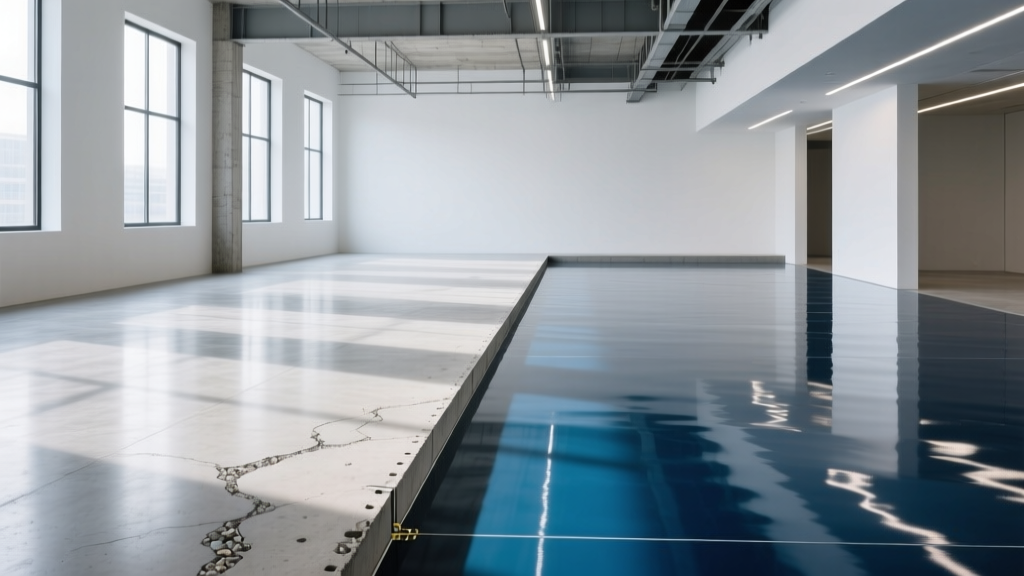
The Core Difference: Subtractive vs. Additive Systems
When evaluating polished concrete vs. epoxy for commercial, industrial, or high-end residential floors, the fundamental difference lies in how the surface is modified. Polished concrete is a subtractive process. It relies on heavy planetary grinders equipped with diamond-impregnated segments to mechanically cut, refine, and burnish the existing concrete slab, followed by the application of a chemical densifier (typically lithium or sodium silicate) to harden the surface. The concrete itself becomes the wear surface.
Epoxy flooring, conversely, is an additive system. It involves applying a thermosetting resin (epoxide) combined with a polyamine hardener over the prepared concrete. This creates a rigid, plastic-like coating that sits on top of the slab. While both systems yield seamless, low-maintenance floors, their physical properties dictate entirely different performance lifespans, installation requirements, and failure modes.
Head-to-Head Comparison Matrix
| Performance Metric | Mechanically Polished Concrete | 100% Solids Epoxy System |
|---|---|---|
| System Thickness | 0 mm (Subtractive grind) | 10 to 40 mils (0.25 - 1 mm) |
| Installation Time | 3 to 7 days (depending on grit level) | 2 to 4 days (including cure time) |
| VOC Emissions | Zero to ultra-low (water-based densifiers) | Zero (100% solids) to high (solvent-based) |
| UV Stability | 100% UV stable; will not yellow | Poor; yellows without a polyaspartic/urethane topcoat |
| Impact Resistance | High (chips rather than peeling) | Moderate (heavy dropped steel can crack the resin) |
| Chemical Resistance | Moderate (vulnerable to strong acids) | Exceptional (resists oils, solvents, and battery acids) |
| Lifespan | 10 to 20+ years with routine burnishing | 5 to 10 years before recoating is required |
The Moisture Vapor Transmission (MVT) Trap
The most common reason epoxy floors fail prematurely is moisture vapor transmission (MVT) from the subgrade. Because epoxy forms an impermeable plastic membrane, hydrostatic pressure will cause the coating to blister, delaminate, and peel if the slab emits too much moisture. According to testing standards referenced by the American Concrete Institute (ACI), installers must perform in-situ relative humidity (RH) testing per ASTM F2170 before applying any film-forming coating.
- Epoxy Limit: If RH levels exceed 75% (or calcium chloride tests per ASTM F1869 exceed 3-5 lbs/1000 sq. ft./24 hours), standard epoxy will fail. Mitigation requires a specialized moisture-vapor-blocking epoxy primer, adding $1.50 to $3.00 per square foot to the project cost.
- Polished Concrete Advantage: Polished concrete is entirely breathable. It is completely unaffected by high MVT, making it the mandatory choice for ground-level slabs without an intact sub-slab vapor barrier.
True Cost Breakdown: Upfront vs. Lifecycle
Comparing the cost of polished concrete vs. epoxy requires looking beyond the initial bid. Prices fluctuate based on slab condition, aggregate exposure, and regional labor rates.
Polished Concrete Pricing
- Basic Industrial (400-grit, matte finish): $3.50 – $5.50 per sq. ft.
- Commercial Satin (800-grit, light aggregate): $5.00 – $8.00 per sq. ft.
- High-End Residential/Retail (1500 to 3000-grit, heavy aggregate exposure): $8.00 – $14.00+ per sq. ft.
- Lifecycle Cost: Requires an auto-scrubber and occasional diamond-impregnated maintenance pads. No recoating is ever necessary.
Epoxy System Pricing
- Water-Based/DIY Kits: $1.50 – $3.00 per sq. ft. (High failure rate; not recommended for commercial use).
- 100% Solids Epoxy with Flake Broadcast: $5.00 – $9.00 per sq. ft.
- Metallic Epoxy with Polyaspartic Topcoat: $9.00 – $15.00+ per sq. ft.
- Lifecycle Cost: The topcoat (especially if polyurethane or polyaspartic) will require a light sanding and recoating every 5 to 8 years in high-traffic environments, costing roughly 40% of the original installation price.
Surface Preparation: The Make-or-Break Phase
Proper surface preparation is non-negotiable for both systems, but the methodology differs drastically. The International Concrete Repair Institute (ICRI) utilizes Concrete Surface Profile (CSP) chips to standardize preparation.
For epoxy, the slab must be shot-blasted or scarified to achieve a CSP-2 or CSP-3 profile. This opens the pores of the concrete, allowing the liquid epoxy to penetrate and form a mechanical bond. Acid etching, a common DIY method, is universally rejected by commercial coating manufacturers because it fails to remove laitance and leaves residual salts that inhibit adhesion.
For polished concrete, preparation involves removing existing coatings, adhesives, or mastics using coarse metal-bond diamonds (typically 16 to 30 grit). If the slab has extensive VCT tile glue residue, chemical scarifiers or aggressive carbide scraping is required to prevent "ghosting"—where the adhesive burns into the concrete during the high-friction polishing stages, leaving permanent dark stains.
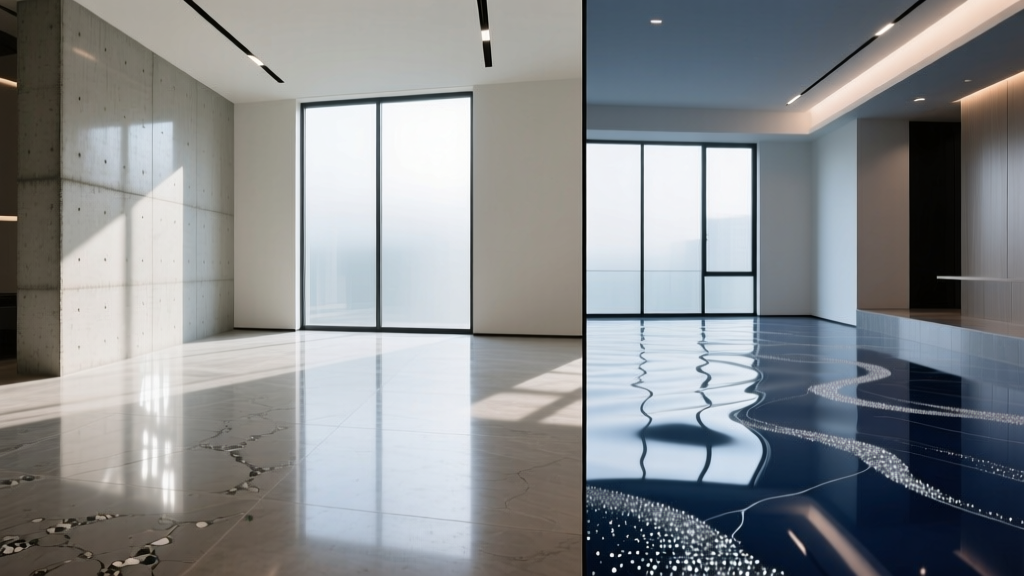
Application Decision Framework
Use this framework to specify the correct flooring system for your facility based on operational demands.
Specify Polished Concrete When:
- Retail and Showrooms: You need a high-gloss, UV-stable floor that reflects ambient lighting (reducing electrical costs by up to 15%).
- Warehouses and Logistics: Forklift traffic will destroy epoxy over time via tire abrasion. Polished concrete hardens under friction and resists tire marks.
- Historic or Older Buildings: The slab lacks a sub-grade vapor barrier, and moisture mitigation is cost-prohibitive.
Specify Epoxy (or Polyaspartic) When:
- Food & Beverage Processing: USDA/FDA compliance requires a seamless, cove-base floor that can withstand daily washdowns with caustic chemicals and boiling water. (Note: Urethane mortar is often preferred over standard epoxy here for thermal shock resistance).
- Automotive Garages and Shops: The floor requires extreme resistance to oil, brake fluid, transmission fluid, and battery acid, which will etch and stain bare polished concrete.
- Cleanrooms and Laboratories: You require a strictly particulate-free, non-dusting environment where the concrete's natural microscopic pores must be entirely sealed.
Slip Resistance and Safety Compliance
A common misconception is that high-gloss polished concrete is inherently slippery. When kept clean and dry, a properly burnished 800-grit polished floor meets or exceeds the OSHA and ADA guidelines for the Static Coefficient of Friction (SCOF). However, when wet, polished concrete becomes hazardous. For wet areas, installers must leave the floor at a lower 400-grit hone or apply a penetrating anti-slip guard.
Epoxy floors are naturally slippery when wet due to the plastic surface. To meet safety standards, installers must broadcast aluminum oxide or silica sand into the wet epoxy or topcoat. While this provides excellent grip, it slightly reduces the aesthetic gloss and makes the floor harder to mop clean, requiring aggressive deck-scrubbing in commercial kitchens.
Common Failure Modes and Prevention
- Epoxy Delamination at Control Joints: Epoxy is rigid. If poured over active expansion or control joints, the concrete's natural thermal movement will crack the epoxy coating. Prevention: Saw-cut and fill joints with a flexible polyurea joint filler after the epoxy has cured.
- Polished Concrete "Bird Baths": If the original concrete pour was poorly leveled, the polishing grinder will follow the exact contour of the floor, leaving low spots that pool water. Prevention: Specify F-min numbers (FF/FL) of 50/35 or higher during the initial slab pour if polishing is the intended finish.
- Epoxy Amine Blush: In high-humidity, low-temperature environments, the hardener in epoxy can react with atmospheric moisture, creating a waxy, oily film (amine blush) that prevents topcoats from bonding. Prevention: Use moisture-tolerant epoxy formulations or strictly control the HVAC environment during the 24-hour cure window.
Written by
James ThorntonJames Thornton is a construction industry veteran with 25 years of hands-on experience in wood framing, lumber grading, and residential building codes. He started as a framing carpenter in rural Oregon, earned his ICC Residential Building Inspector certification, and eventually became a senior plan reviewer for the City of Portland Bureau of Development Services. James holds a B.S. in Wood Science & Technology from Oregon State University and is a certified lumber grader through the West Coast Lumber Inspection Bureau (WCLIB). He has inspected over 3,000 residential construction sites and authored the city's internal guide on advanced framing techniques (2x6 at 24" O.C.). James lives in Bend, OR, where he builds custom timber-frame cabins and competes in lumberjack sports.
More from James Thornton
View all
Insulation
Best Home Insulation Materials: Complete 2026 Guide
Compare top home insulation materials for 2026. Find R-values, installed costs per square foot, and best uses for fiberglass, spray foam, and mineral wool.
Aug 4, 2026

Sustainable Building
Certify Your Green Building Material for LEED and WELL
Step-by-step guide to certifying a green building material for LEED v5 and WELL v2. Master EPDs, HPDs, and VOC limits for 2026 project specifications.
Aug 4, 2026

Stone & Masonry
Veneer Stacked Stone Panels: Interior Design & Style Showcase
Discover how veneer stacked stone panels transform interiors. Explore modern design profiles, material pairings, and technical installation specs.
Aug 4, 2026