Fiber Reinforced Concrete Lifespan: Durability Analysis & Failure Modes
Analyze the lifespan and durability of fiber reinforced concrete. Compare steel, synthetic, and glass fibers, failure modes, and lifecycle costs.
The Core Mechanics of Fiber Reinforced Concrete Durability
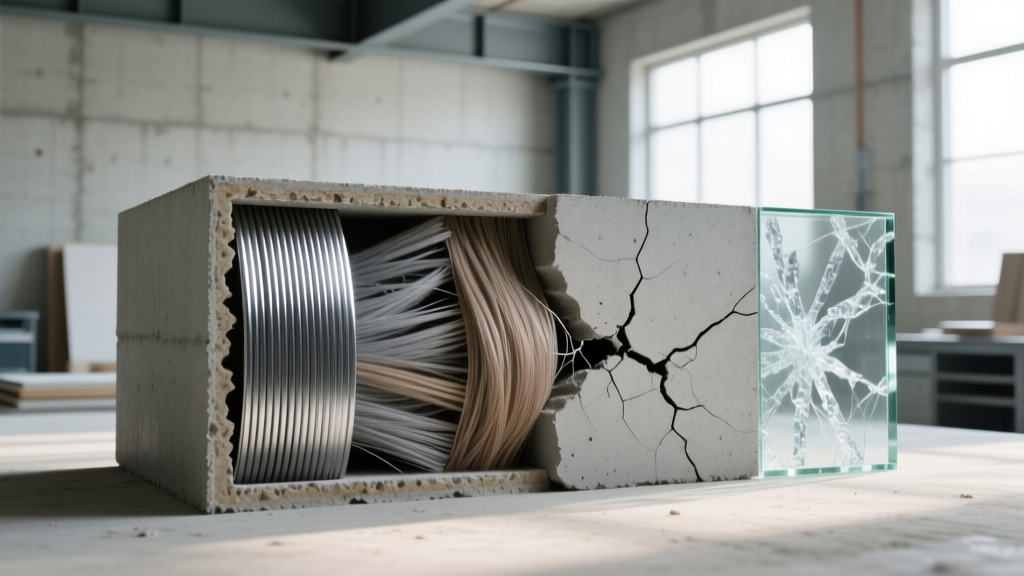
Traditional concrete exhibits high compressive strength but fails in a brittle manner under tensile stress, leading to rapid crack propagation and reduced service life. Fiber reinforced concrete (FRC) fundamentally alters this post-cracking behavior. By dispersing discrete fibers throughout the cementitious matrix, FRC provides three-dimensional micro-reinforcement that bridges micro-cracks, transferring tensile stresses across the fracture plane and drastically improving ductility.
- Standard Unreinforced Concrete: 25–40 years before major spalling/joint deterioration in harsh climates.
- FRC (Optimized Dosage): 40–60+ years, primarily due to a 30–50% reduction in crack widths and delayed chloride ingress.
- Residual Flexural Strength: Measured via ASTM C1609; high-performance FRC maintains 40-60% of its peak load capacity at a deflection of L/150.
The durability advantage of FRC is not derived from an increase in ultimate compressive strength, but from its ability to control crack widths. By keeping micro-cracks tightly closed (typically under 0.01 inches), FRC severely restricts the penetration of water, chlorides, and sulfates. This directly mitigates the primary degradation mechanisms of concrete: freeze-thaw scaling, alkali-silica reaction (ASR) expansion, and reinforcement corrosion.
Fiber Types and Their Impact on Service Life
Selecting the correct fiber type is the most critical variable in lifespan prediction. Each material interacts differently with the alkaline cement environment and external environmental stressors. The American Concrete Institute (ACI) Committee 544 categorizes these materials based on their structural and durability contributions.
| Fiber Type | Standard Dosage (per yd³) | 2026 Avg. Cost | Primary Durability Benefit | Lifespan Impact |
|---|---|---|---|---|
| Hooked-End Steel | 50–100 lbs | $0.95–$1.25/lb | High post-cracking load transfer; structural crack control. | Extends slab life by 20-30%; reduces joint spalling. |
| Macro-Synthetic | 3–8 lbs | $1.80–$2.40/lb | 100% immune to chloride corrosion; excellent freeze-thaw resistance. | Ideal for marine/de-icing environments; 40%+ life extension. |
| AR Glass (Alkali-Resistant) | 2–5% by weight | $1.40–$1.90/lb | Prevents plastic shrinkage cracking in thin precast sections. | Maintains architectural integrity; prevents surface crazing. |
| Carbon | 0.5–2% by volume | $14.00–$18.00/lb | High tensile modulus; negligible creep; chemical inertness. | Used in extreme chemical exposure; 50+ year structural lifespan. |
Real-World Failure Modes and Edge Cases
While FRC significantly enhances durability, improper specification or batching can introduce unique failure modes that prematurely end the concrete's service life. Understanding these edge cases is vital for structural engineers and contractors.
1. Alkali-Silica Reaction (ASR) and Glass Fiber Embrittlement
Standard E-glass fibers will dissolve in the highly alkaline environment of hydrating Portland cement (pH > 12.5), leading to severe embrittlement and catastrophic failure within 2 to 5 years. To achieve long-term durability, specifications must mandate Alkali-Resistant (AR) glass fibers containing a minimum of 16% Zirconium dioxide (ZrO2). Even with AR glass, long-term tensile strength in wet environments may drop by up to 20% over a decade, requiring conservative safety factors in structural design.
2. Fiber Clumping (Ball-ing) in High-Volume Steel Mixes
When steel fiber dosages exceed 80 lbs/yd³, or when fibers have an aspect ratio (length/diameter) greater than 80, the fibers can tangle into spherical 'balls' during mixing. These balls create localized voids and honeycombs in the hardened concrete, acting as stress concentrators that drastically reduce compressive strength and accelerate freeze-thaw scaling. Mitigation requires strict adherence to batching sequences: adding fibers to the aggregate before cement, or using specialized high-shear mixers, and limiting slump to a maximum of 5 inches without superplasticizers.
3. UV Degradation in Exposed Synthetic Fibers
Macro-synthetic fibers (polypropylene or polyolefin blends) are highly durable internally but vulnerable to ultraviolet radiation if exposed on the surface. In troweled industrial floors or exterior flatwork, 'fiber bloom' occurs when fibers protrude from the surface. Prolonged UV exposure degrades these protruding fibers, leading to surface fuzzing and minor scaling. While this does not compromise structural integrity, it degrades the aesthetic and surface abrasion resistance. Proper finishing techniques, including timely burnishing and the application of UV-stable densifiers, are required to encapsulate the fibers.
'According to the Portland Cement Association's durability guidelines, the integration of macro-synthetic fibers in pavements exposed to heavy de-icing salts effectively eliminates the corrosion-induced spalling associated with traditional steel reinforcement, shifting the primary maintenance cycle from 15 years to over 35 years.'
Cost vs. Lifespan: Is FRC Worth the Premium?
Evaluating FRC requires shifting from initial bid costs to lifecycle cost analysis (LCCA). As of 2026, the material cost for FRC is typically 5% to 12% higher per cubic yard than plain concrete, depending on the fiber type and dosage. However, the labor and long-term maintenance savings frequently offset this premium.
Traditional Rebar/Mesh
- Material: $0.65/sq ft
- Labor (Tying/Placement): $1.20 - $1.80/sq ft
- Risk: High risk of rebar misplacement (stepping on chairs), leading to top-down cracking.
Fiber Reinforced Concrete
- Material (Fiber Premium): $0.80 - $1.10/sq ft
- Labor: $0.00 (Mixed at batch plant or added on-site in seconds)
- Risk: Zero risk of misplacement; uniform 3D reinforcement throughout the slab depth.
For a standard 50,000 square foot industrial warehouse slab (6 inches thick), utilizing 60 lbs/yd³ of hooked-end steel fibers eliminates approximately 14,000 linear feet of rebar tying labor. This reduces the total installed cost by 8% to 14% while simultaneously increasing the slab's fatigue life under heavy forklift traffic by an estimated 25%, as verified by Federal Highway Administration (FHWA) pavement studies on FRC overlays.
Specification Guide: Matching Fiber to Environment
To maximize the lifespan of FRC, engineers must specify the correct fiber based on the specific environmental exposure and structural demands. Use the following decision framework for 2026 specifications:
- Heavy Industrial Floors (Forklift Traffic, Impact): Specify Hooked-End Steel Fibers. Require a minimum residual strength factor (Re,3) of 0.35 per ASTM C1018 or equivalent performance under ASTM C1609. Dosage: 60–80 lbs/yd³.
- Marine Structures, Bridge Decks, and De-icing Exposure: Specify Macro-Synthetic Fibers. The complete immunity to chloride-induced corrosion ensures the reinforcement does not rust and spall the concrete cover. Dosage: 4–6 lbs/yd³.
- Shotcrete and Tunnel Linings: Specify Steel or Macro-Synthetic Fibers depending on groundwater chemistry. If sulfates are present, synthetic is mandatory to prevent steel corrosion. Require high early-age flexural toughness.
- Architectural Precast and GFRC (Glass Fiber Reinforced Concrete): Specify AR Glass Fibers. Use a spray-up or premix method with a polymer-modified matrix to ensure high surface finish durability and prevent micro-crazing.
Frequently Asked Questions
Does fiber reinforced concrete eliminate the need for control joints?
No. While FRC significantly reduces random plastic shrinkage cracking and allows for wider joint spacing (often increasing joint spacing by 20% to 50% compared to plain concrete), control joints are still required to induce cracking at predetermined, straight lines. Omitting joints entirely will result in unsightly, uncontrolled cracking, even with high fiber dosages.
Can FRC be pumped, and does it affect the pump equipment?
Yes, FRC can be pumped, but it requires specific mix designs. Steel fibers with aspect ratios over 65 can interlock and cause blockages in the pump hopper or pipeline bends. To ensure pumpability, limit the maximum fiber length to 1.5 inches, use a well-graded aggregate with a higher sand fraction (mortar-rich mix), and maintain a consistent slump of 4 to 6 inches. Macro-synthetic fibers generally pump with fewer restrictions.
How does FRC perform in fire and high-heat environments?
Steel fibers maintain their structural integrity in high heat, making them suitable for industrial furnace foundations. Conversely, synthetic fibers melt at approximately 320°F (160°C). Interestingly, this melting is often engineered as a durability feature: the vaporized synthetic fibers create a microscopic network of channels that allow expanding steam to escape during a severe fire, drastically reducing explosive spalling in high-strength concrete columns and tunnels.