Asphalt Driveway Cost vs Concrete: 2026 Price Analysis
Compare asphalt driveway cost vs concrete for 2026. Get a detailed price breakdown, lifespan data, and maintenance costs to choose the best paving material.

The True Cost of Paving: Beyond the Square Foot Price
When evaluating the asphalt driveway cost vs concrete, homeowners and contractors often fixate on the initial per-square-foot installation price. However, a true cost breakdown analysis requires looking at the 30-year financial lifecycle of the pavement. In 2026, material pricing has stabilized following the supply chain fluctuations of the early 2020s, but the divergence in long-term maintenance between bitumen-based asphalt and Portland cement concrete remains stark. According to the National Ready Mixed Concrete Association (NRMCA), concrete pavements consistently demonstrate a lower lifecycle cost due to their extended service life and minimal maintenance requirements, despite a higher upfront capital expenditure.
Material and Labor Breakdown: Asphalt vs. Concrete
To understand the initial capital outlay, we must break down the specific material specifications and labor requirements for both options. A proper installation is not just about the surface layer; the sub-base preparation dictates the structural integrity of the driveway.
Asphalt Specifications and Pricing
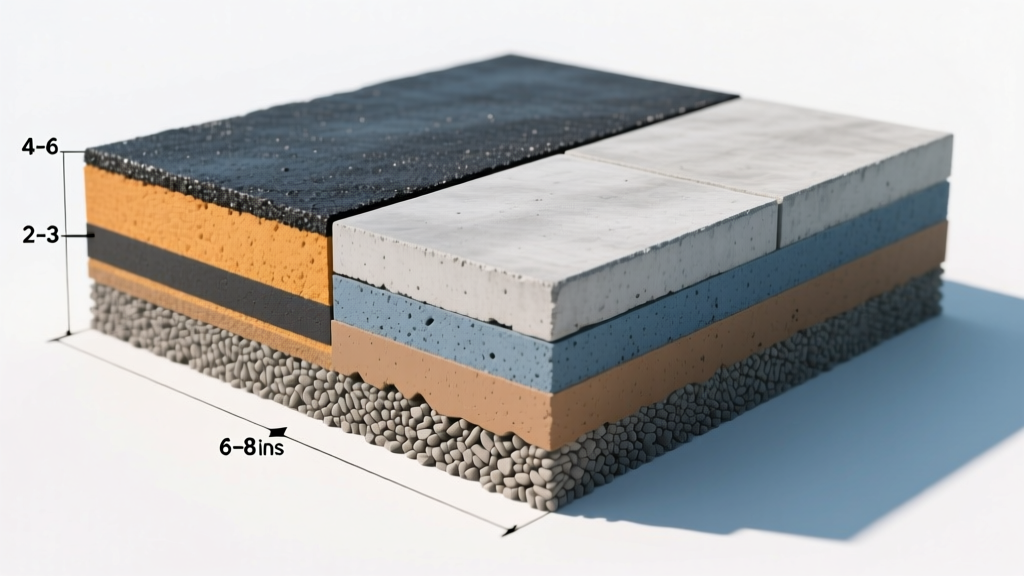
A standard residential asphalt driveway in 2026 requires a 4 to 6-inch compacted aggregate base topped with 2 to 3 inches of Hot Mix Asphalt (HMA). For most moderate climates, a Performance Grade (PG) 64-22 binder is specified by the National Asphalt Pavement Association (NAPA) to resist rutting in summer and thermal cracking in winter. Labor for asphalt is highly mechanized, utilizing paving machines and heavy rollers, which keeps installation times short—usually 1 to 2 days for a standard pad.
Concrete Specifications and Pricing
Concrete driveways require a 4 to 6-inch compacted gravel sub-base, followed by a 4-inch pour of 4,000 PSI air-entrained concrete. The air-entrainment (typically 5% to 7% microscopic air bubbles) is non-negotiable in freeze-thaw climates to prevent surface spalling. Reinforcement via 6x6 W1.4xW1.4 welded wire mesh or synthetic macro-fibers is standard to control shrinkage cracking. Labor is more intensive, requiring forming, pouring, screeding, floating, and troweling, often stretching the installation timeline to 3 to 5 days including curing time.
| Cost Factor | Asphalt (HMA) | Concrete (4,000 PSI) |
|---|---|---|
| Demolition & Haul-away (Existing) | $600 - $900 | $600 - $900 |
| Grading & Aggregate Sub-base | $900 - $1,200 | $900 - $1,200 |
| Surface Material (Bitumen/Cement) | $1,200 - $1,800 | $2,100 - $3,000 |
| Labor, Forming & Finishing | $600 - $1,200 | $1,800 - $2,700 |
| Total Initial Installation | $3,300 - $5,100 | $5,400 - $7,800 |
Hidden Costs and Site Preparation Variables
The matrix above assumes a straightforward, flat site with standard soil conditions. Real-world site variables can drastically alter the final invoice for both materials.
- Expansive Clay Soils: If your soil test reveals high-plasticity clay, you will need to over-excavate and import structural fill, or use a geogrid stabilization layer. This adds $1.50 to $3.00 per square foot. Concrete is slightly more forgiving of minor subgrade movement due to its rigid slab nature, whereas asphalt will telegraph subgrade failures into surface depressions.
- Tree Root Mitigation: Installing near mature trees requires root barriers or thicker edge beams. Concrete can be poured with thickened edge beams (grade beams) to bridge root zones, adding roughly $400 to $800 to the forming labor.
- Permits and HOA Restrictions: Many municipalities charge $50 to $150 for right-of-way apron permits. Furthermore, some Homeowners Associations strictly mandate concrete or specific decorative finishes, which can push concrete costs up by 30% to 50% if exposed aggregate or stamped patterns are required.
Long-Term Financial Impact: Maintenance and Lifespan
The most critical error in the asphalt driveway cost vs concrete debate is ignoring the maintenance ledger. The Federal Highway Administration (FHWA) pavement management guidelines highlight that flexible pavements (asphalt) require periodic surface treatments to prevent oxidation and water infiltration, while rigid pavements (concrete) primarily require joint maintenance.
Asphalt Maintenance Profile
Lifespan: 15 to 20 years before structural failure.
Sealcoating: Required every 3 to 5 years. Cost: $0.15 to $0.25 per sq. ft. ($90 - $150 per application).
Crack Filling: Annual inspection and routing/filling of thermal cracks. Cost: $1 to $3 per linear foot.
Overlay: At year 12-15, a 1.5-inch mill and overlay is usually required. Cost: $3.00 to $4.50 per sq. ft.
Concrete Maintenance Profile
Lifespan: 30 to 40+ years structurally.
Sealing: Penetrating silane/siloxane sealers applied every 5 to 7 years to prevent chloride/salt intrusion. Cost: $0.20 to $0.35 per sq. ft.
Joint Caulking: Replacing polyurethane joint sealant every 10 years to prevent water from eroding the sub-base. Cost: $2 to $4 per linear foot.
Slabjacking: If a section settles, polyurethane foam jacking can lift it. Cost: $150 to $300 per sunken slab.
The 30-Year ROI Calculation
To definitively settle the financial comparison, let us project the costs over a 30-year ownership period for a 600-square-foot driveway in a moderate climate zone.
"While asphalt wins the initial bidding war by roughly 35%, the compounding maintenance and the inevitable mid-life overlay erase that savings by year 18. By year 30, concrete has delivered a superior return on investment, alongside a significantly higher residual property value."
30-Year Asphalt Cost Projection
- Initial Installation: $4,200
- Sealcoating (6 applications over 30 years): $720
- Crack filling and minor patching: $450
- Mill and Overlay at Year 15: $2,400
- Total 30-Year Cost: $7,770
30-Year Concrete Cost Projection
- Initial Installation: $6,600
- Penetrating Sealer (4 applications): $720
- Joint resealing and pressure washing: $350
- Minor slabjacking or corner repair: $400
- Total 30-Year Cost: $8,070
Analysis: The 30-year costs are remarkably close, with concrete edging out slightly higher in raw dollars in this specific moderate-climate model. However, this raw math ignores the time value of money and property value appreciation. A concrete driveway consistently yields a higher resale value premium and eliminates the multi-day disruption of an asphalt overlay project in year 15.
Climate and Usage: When to Choose Which
Financials aside, environmental stressors must dictate your material choice. Choosing the wrong material for your microclimate will accelerate the degradation timelines outlined above.
Choose Asphalt If:
- You live in an extremely cold climate with frequent freeze-thaw cycles and heavy municipal salt usage. (Note: Salt does not chemically attack asphalt, whereas it can cause severe scaling in improperly cured concrete).
- Your budget is strictly capped at the initial installation phase, and you plan to sell the home within 5 to 7 years.
- The driveway features complex, tight-radius curves that are difficult and expensive to form with wooden concrete forms.
Choose Concrete If:
- You live in a hot, sunny climate. Asphalt absorbs heat (reaching 140°F+ on summer days) and can soften, leading to tire scuffing and edge deformation. Concrete reflects solar radiation and remains structurally rigid.
- You park heavy RVs, boats, or commercial trucks. Point loads from RV jack stands will punch through asphalt in high heat, whereas a 5-inch thick 4,500 PSI concrete pad will support them indefinitely.
- You want to integrate decorative elements like exposed aggregate, stamped patterns, or integral color to match your home's architectural style.
Final Verdict: Calculating Your 30-Year ROI
The debate over asphalt driveway cost vs concrete ultimately hinges on your time horizon and capital availability. If you are optimizing for the lowest possible day-one expenditure, asphalt is the undisputed winner, offering a reliable, functional surface at roughly $5.50 to $8.50 per square foot installed. However, if you are treating your driveway as a long-term infrastructure asset, concrete's 40-year lifespan, minimal maintenance profile, and superior load-bearing capacity make it the smarter financial decision for homeowners planning to stay in their properties for a decade or more. Always demand a minimum 4,000 PSI mix design with proper air-entrainment for concrete, or a PG-graded binder with a compacted aggregate base for asphalt, to ensure your investment reaches its maximum lifecycle potential.
Written by
Marcus ChenMarcus Chen is a licensed structural engineer (PE) and building materials analyst with over 12 years of experience across residential, commercial, and industrial construction. He holds a Master of Science in Civil Engineering from UC Berkeley and spent six years at Thornton Tomasetti before transitioning to independent consulting and technical writing. Marcus specializes in material selection for seismic-prone regions, concrete reinforcement strategies, and lifecycle cost analysis. His work has been cited by the American Concrete Institute (ACI) and the Structural Engineers Association of California (SEAOC). When he is not on a job site or at his desk, you will find him hiking the Sierra Nevada or restoring a 1920s craftsman bungalow in Oakland, CA.
More from Marcus Chen
View all
Construction Cost
How Much Did the Eiffel Tower Cost to Build?
How much did the Eiffel Tower cost to build in 1889? We adjust for inflation and compare its budget to modern skyscraper construction.
Aug 4, 2026

Fire Resistance
What Is a Fire Resistant Material? Testing & Certification Guide
Discover what is a fire resistant material through ASTM and UL testing. Learn how fire ratings, certifications, and assemblies work in construction.
Aug 4, 2026

Construction Cost
How Much Did the Burj Khalifa Cost to Build?
How much did the Burj Khalifa cost to build? We break down the $1.5B project and extract 5 money-saving strategies for your next build.
Jul 30, 2026