Asphalt Driveway vs Concrete: Mix Design and Cost Breakdown
Compare asphalt driveway vs concrete through mix design, structural thickness, climate resilience, and 2026 lifecycle costs to choose the right pavement.

Binder Chemistry: Bitumen vs. Portland Cement Hydration
The fundamental difference between an asphalt driveway vs concrete lies in the binder chemistry. Asphalt pavement is technically a bituminous concrete, relying on a petroleum-derived bitumen binder to glue aggregates together. Concrete utilizes Portland cement, which undergoes a chemical hydration reaction with water to form a rigid, crystalline matrix. This chemical divergence dictates everything from installation temperatures to long-term structural behavior.
Hot Mix Asphalt (HMA) must be installed at temperatures between 275°F and 325°F. As it cools, the bitumen transitions from a viscous liquid to a viscoelastic solid, allowing the pavement to flex slightly under vehicular loads without cracking. Conversely, Portland cement concrete is placed at ambient temperatures (ideally between 50°F and 75°F) and gains strength through exothermic hydration. According to the Portland Cement Association, this rigid crystalline structure provides immense compressive strength but lacks the inherent flexibility of bituminous binders, necessitating precise jointing to control thermal cracking.
Aggregate Gradation and Mix Specifications
Both materials require carefully graded aggregates, but the mix design methodologies differ significantly. Modern asphalt driveways utilize the Superpave (Superior Performing Asphalt Pavements) mix design system, which tailors the binder grade and aggregate structure to specific local climate conditions and traffic loads. Concrete mix designs are governed by ACI (American Concrete Institute) standards, focusing heavily on the water-cement (w/c) ratio and air-entrainment for durability.
Comparative Mix Design Parameters
| Parameter | Residential Concrete (4000 psi) | Hot Mix Asphalt (Superpave) |
|---|---|---|
| Binder Type | Type I/II Portland Cement | Performance Grade (e.g., PG 64-22) Bitumen |
| Binder Content | 10% - 15% by weight | 4.5% - 6.0% by weight |
| Max Aggregate Size | 3/4-inch crushed angular stone | 3/4-inch or 1/2-inch crushed stone |
| Critical Ratio | 0.40 - 0.45 Water/Cement Ratio | VMA (Voids in Mineral Aggregate) > 14% |
| Special Additives | Air-entraining agents (5-7% air) | Hydrated lime or liquid anti-strip agents |
For concrete driveways in freeze-thaw climates, air-entrainment is non-negotiable. Microscopic air bubbles (5% to 7% of the total volume) act as expansion chambers for freezing water, preventing internal spalling. The Asphalt Institute notes that for asphalt, the critical metric is ensuring adequate VMA to prevent binder drain-off while maintaining enough asphalt film thickness to resist oxidation and raveling over time.
Structural Cross-Section and Subgrade Demands
A driveway is only as stable as the soil beneath it. The structural cross-section required for an asphalt driveway vs concrete varies based on the subgrade's California Bearing Ratio (CBR) and the expected vehicle loads (e.g., standard sedans vs. heavy RVs or dump trucks).
- Standard Concrete Cross-Section: 4 to 5 inches of concrete slab placed directly over a 4-inch compacted crushed stone base (ASTM D2940). Wire mesh or #4 rebar spaced at 18 inches is often added for temperature crack control, though fiber mesh is increasingly used for secondary shrinkage reinforcement.
- Standard Asphalt Cross-Section: 2.5 to 3 inches of HMA surface course over a 4 to 6 inches of compacted aggregate base course. In poor soil conditions, an additional 2 inches of binder course (larger aggregate, higher structural capacity) is required beneath the surface layer.
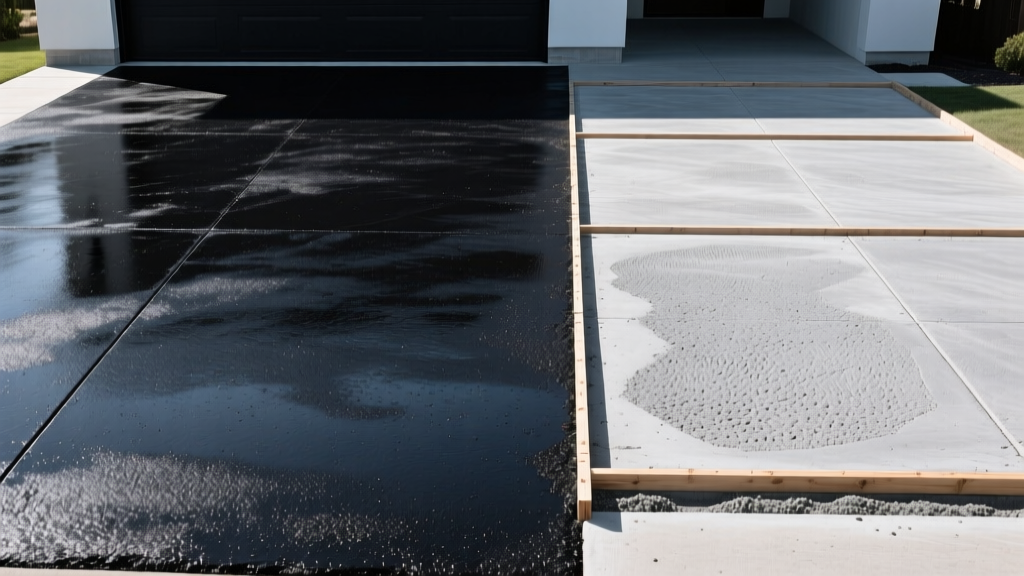
Climate Resilience: Freeze-Thaw and Thermal Expansion
Environmental exposure heavily influences the degradation rate of both materials. Asphalt is highly susceptible to UV oxidation and thermal softening. In high-summer temperatures, standard PG 64 binders can soften, leading to rutting under heavy, stationary loads (like RV tires or trailer jacks). To combat this, contractors in hot climates must upgrade to stiffer binders (e.g., PG 70-22) or use polymer-modified asphalt (PMA).
Concrete faces different thermal challenges. While it does not soften in the heat, it is subject to significant thermal expansion. Without properly spaced control joints (cut to a depth of 25% of the slab thickness, spaced every 10 to 12 feet), the slab will relieve internal tensile stress by cracking randomly. Furthermore, the use of magnesium chloride or calcium chloride de-icing salts on new concrete (less than 1 year old) causes severe surface scaling by altering the osmotic pressure of the pore water.
"The urban heat island effect is significantly exacerbated by dark pavements. Traditional asphalt can reach surface temperatures of 140°F to 150°F on a 90°F summer day, contributing to localized warming and stormwater thermal pollution." — U.S. Environmental Protection Agency (EPA)
To mitigate heat absorption, homeowners are increasingly turning to stamped or stained concrete, or utilizing cool-pavement asphalt sealcoats that reflect higher solar radiation.
Lifecycle Cost and Maintenance Matrix
When evaluating an asphalt driveway vs concrete, the initial installation cost is only one variable. The lifecycle cost—including curing times, maintenance intervals, and ultimate lifespan—paints a more accurate financial picture for 2026 residential projects.
2026 Cost and Maintenance Breakdown
| Metric | Asphalt Driveway | Concrete Driveway |
|---|---|---|
| Initial Installed Cost | $5.00 - $9.00 per sq. ft. | $9.00 - $16.00 per sq. ft. |
| Cure / Ready-to-Drive Time | 48 to 72 hours | 7 days (for passenger vehicles) |
| Routine Maintenance | Sealcoat every 3-5 years ($0.20-$0.35/sq. ft.) | Penetrating sealer every 3-5 years ($0.50-$0.80/sq. ft.) |
| Expected Lifespan | 15 to 20 years | 30 to 40+ years |
| Repair Methodology | Patching, infrared reheating, or overlay | Slab jacking, epoxy injection, or full panel replacement |
While asphalt requires a lower upfront capital expenditure, the cumulative cost of bi-decadal sealcoating and eventual overlay narrows the financial gap significantly by year 25. Concrete demands a higher initial investment but generally requires less intensive maintenance, provided the initial mix design and subgrade preparation were executed correctly.
Site-Specific Decision Framework
Selecting between these two materials requires matching the pavement properties to your specific site constraints and usage patterns. Use the following framework to finalize your material specification:
Specify Hot Mix Asphalt if:
- Your project budget is strictly capped, and initial cost is the primary constraint.
- You live in a region with extreme, prolonged freeze-thaw cycles where flexible pavements tolerate frost heave better than rigid slabs.
- You require immediate use of the driveway (under 72 hours) due to construction scheduling.
- The driveway features a complex, steep gradient where the high skid resistance of fresh asphalt is advantageous.
Specify Portland Cement Concrete if:
- You intend to park heavy, stationary loads (RVs, boat trailers, or dump trucks) for extended periods, preventing the rutting associated with bituminous creep.
- Your property features large, mature trees with aggressive root systems; concrete's rigid bridging capability handles minor subgrade displacement better than asphalt.
- You want to maximize long-term property value and curb appeal through decorative finishes (stamped, exposed aggregate, or integral color).
- You are located in a high-heat, high-UV climate where standard asphalt binders would rapidly oxidize, ravel, and require frequent resurfacing.
Written by
James ThorntonJames Thornton is a construction industry veteran with 25 years of hands-on experience in wood framing, lumber grading, and residential building codes. He started as a framing carpenter in rural Oregon, earned his ICC Residential Building Inspector certification, and eventually became a senior plan reviewer for the City of Portland Bureau of Development Services. James holds a B.S. in Wood Science & Technology from Oregon State University and is a certified lumber grader through the West Coast Lumber Inspection Bureau (WCLIB). He has inspected over 3,000 residential construction sites and authored the city's internal guide on advanced framing techniques (2x6 at 24" O.C.). James lives in Bend, OR, where he builds custom timber-frame cabins and competes in lumberjack sports.
More from James Thornton
View all
Insulation
Best Home Insulation Materials: Complete 2026 Guide
Compare top home insulation materials for 2026. Find R-values, installed costs per square foot, and best uses for fiberglass, spray foam, and mineral wool.
Aug 4, 2026

Sustainable Building
Certify Your Green Building Material for LEED and WELL
Step-by-step guide to certifying a green building material for LEED v5 and WELL v2. Master EPDs, HPDs, and VOC limits for 2026 project specifications.
Aug 4, 2026

Stone & Masonry
Veneer Stacked Stone Panels: Interior Design & Style Showcase
Discover how veneer stacked stone panels transform interiors. Explore modern design profiles, material pairings, and technical installation specs.
Aug 4, 2026