Flow Fill vs Concrete: 2026 Cost Breakdown Analysis
Compare the 2026 installed costs of flow fill (CLSM) vs standard concrete. Analyze material, labor, equipment, and rework expenses for utility trenches.

Material Composition and Base Pricing (2026 Rates)
To accurately compare flow fill vs concrete, we must first separate the raw material costs from the installed costs. Standard structural concrete and flow fill utilize fundamentally different mix designs, which directly impacts the batch price at the ready-mix plant.
Standard 3000 psi concrete relies on a dense matrix of Portland cement, fine sand, coarse aggregate (gravel), and water, often supplemented with chemical admixtures to achieve a workable 4-inch slump. Flow fill, governed by the Federal Highway Administration (FHWA) guidelines for Controlled Low-Strength Material (CLSM), eliminates coarse aggregate entirely. It utilizes high volumes of supplementary cementitious materials (like Class F fly ash or slag), fine sand, water, and a minimal amount of cement to achieve a highly fluid, self-compacting slurry.
| Material Metric | Standard 3000 psi Concrete | Flow Fill (CLSM - Excavatable) |
|---|---|---|
| 2026 Base Material Cost | $145 - $165 per CY | $95 - $115 per CY |
| Cement Content (per CY) | 450 - 550 lbs | 50 - 100 lbs |
| Fly Ash / Slag Content | 0 - 150 lbs | 200 - 350 lbs |
| Coarse Aggregate | ~2,800 lbs (3/4" gravel) | 0 lbs (None) |
| Target 28-Day Strength | 3,000 - 4,000 psi | 50 - 150 psi |
On a purely volumetric basis, flow fill offers a 25% to 35% discount at the batch plant. This is primarily driven by the substitution of expensive Portland cement with inexpensive fly ash, and the elimination of coarse aggregate. However, material cost is only the first variable in the financial equation.
The Hidden Multiplier: Trench Width and Excavation Volumes
The most significant cost divergence between flow fill and concrete occurs before the trucks even arrive on site. When backfilling utility trenches, the choice of material dictates the required excavation width.
The Compaction Constraint
If a project specifies standard concrete or compacted granular backfill, the trench must be wide enough to accommodate workers, formwork, or mechanical compaction equipment. A standard 12-inch utility pipe requires a minimum 24-inch to 30-inch trench width to allow a worker to safely enter, set forms, or operate a trench roller and plate compactor to achieve the required 95% Proctor density.
The Flow Fill Advantage
Because flow fill is entirely self-leveling and requires zero mechanical vibration or tamping, the trench only needs to be wide enough to fit the pipe plus a minimal clearance for the delivery chute. A 12-inch pipe can be backfilled in a 14-inch or 16-inch trench.
Labor and Equipment: Crew Sizing and Placement Speed
According to data tracked by the American Concrete Institute (ACI), placing structural concrete is a labor-intensive process requiring skilled finishers. Flow fill placement, conversely, is largely a gravity-fed operation.
- Concrete Crew Requirements: Placing concrete in trenches requires a crew of 3 to 5 workers. Tasks include setting and stripping formwork, operating internal pencil vibrators to consolidate the mix, screeding the surface, and finishing. Burdened labor rates for skilled concrete finishers average $85 per hour in 2026.
- Flow Fill Crew Requirements: CLSM placement requires only 1 to 2 general laborers (averaging $65 per hour burdened) to guide the truck chute and manage the hose. There is no vibration, no formwork, and no finishing.
- Equipment Rentals: Concrete requires vibrators, screeds, and potentially trench shoring. Flow fill requires no specialized placement equipment, eliminating daily rental fees that typically range from $150 to $300 per day.
"The fluidity of CLSM allows it to fill irregular voids and encapsulate utilities without the honeycombing or void spaces commonly associated with improperly vibrated structural concrete."
Total Installed Cost Matrix: 100 CY Trench Backfill Scenario
To visualize the true financial impact, consider a 2026 case study of a municipal water line project requiring 100 cubic yards of backfill over a 300-linear-foot trench.
| Cost Category | Standard Concrete (24" Trench) | Flow Fill / CLSM (16" Trench) |
|---|---|---|
| Excavation & Spoils Removal | $4,200 (Larger volume) | $2,250 (Reduced volume) |
| Material (Delivered) | $15,500 ($155/CY avg) | $10,500 ($105/CY avg) |
| Labor (Placement & Finishing) | $3,400 (4-man crew, 2 days) | $780 (2-man crew, 1 day) |
| Equipment (Vibrators/Forms) | $650 | $0 |
| Total Installed Cost | $23,750 ($237/CY) | $13,530 ($135/CY) |
In this scenario, the flow fill vs concrete comparison yields a 43% total project savings. The material discount accounts for roughly $5,000 of the savings, while the remaining $5,200 is generated through reduced earthwork, smaller crews, and eliminated equipment.
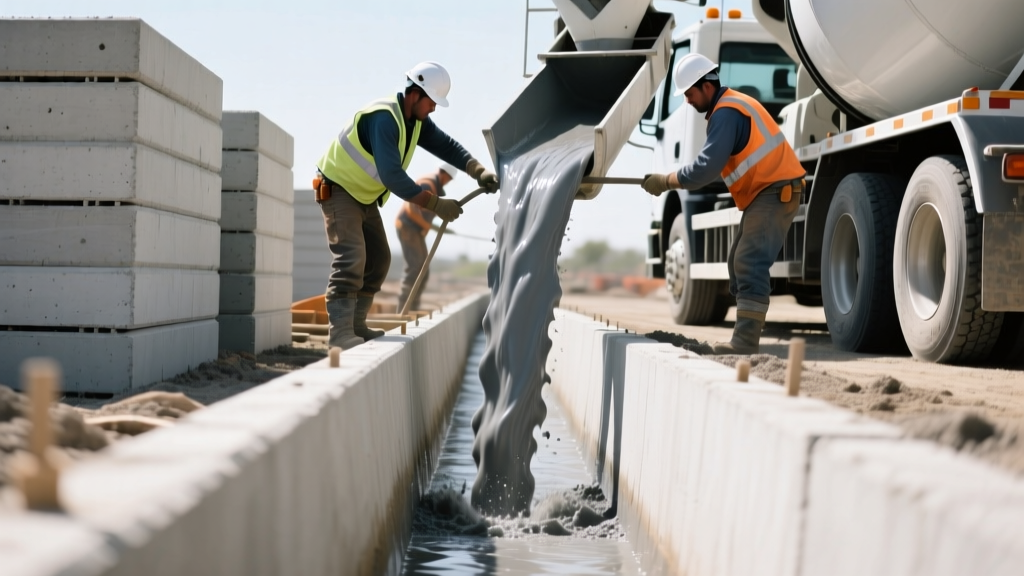
Long-Term Financial Implications: Excavatability and Rework
Utility infrastructure inevitably requires future maintenance, repairs, or upgrades. The cost to access a buried pipe is a critical lifecycle metric that is often ignored during initial construction estimating.
The ASTM International standard D4832 provides testing protocols for CLSM. For utility backfill, engineers specifically design flow fill to be "excavatable." This means the mix is engineered to reach a maximum 28-day compressive strength of 100 to 150 psi. At this strength, the material is solid enough to support surface loads and prevent settlement, but soft enough to be dug with standard manual shovels or light bucket equipment.
The Cost of Digging Up Concrete
If a 3,000 psi concrete encasement is used around a water main, accessing the pipe for a repair requires heavy demolition. Contractors must deploy hydraulic breakers, skid steers, and potentially hydro-excavation to avoid damaging the pipe. A repair excavation that takes two workers four hours in flow fill can easily stretch to two full days in structural concrete, adding $2,000 to $4,000 in emergency rework costs per incident.
Settlement Risks
Conversely, if a contractor attempts to save money by using poorly compacted granular soil instead of flow fill or concrete, the long-term cost of road subsidence and sinkhole repair can exceed $15,000 per location. Flow fill eliminates the risk of human error in compaction, providing a guaranteed, uniform density that prevents future asphalt settlement.
Decision Framework: When to Specify Which Material
While flow fill dominates in trench backfill and void filling, it is not a universal replacement for concrete. Use the following framework to guide your 2026 material specifications:
Specify Flow Fill (CLSM) When:
- Filling abandoned pipelines, septic tanks, or irregular underground voids.
- Backfilling utility trenches in tight, restricted-access urban corridors.
- Working in deep trenches where worker entry for mechanical compaction poses a safety or shoring expense.
- Future access to the buried utilities is highly probable.
Specify Standard Structural Concrete When:
- Pouring structural foundations, footings, or grade beams.
- Constructing retaining walls, manhole bases, or thrust blocks that must resist high lateral shear forces.
- Creating surface-level slabs, sidewalks, or curbs that require a trowel-finished surface.
- The application requires compressive strengths exceeding 1,500 psi or specific reinforcement (rebar) integration.
Written by
James ThorntonJames Thornton is a construction industry veteran with 25 years of hands-on experience in wood framing, lumber grading, and residential building codes. He started as a framing carpenter in rural Oregon, earned his ICC Residential Building Inspector certification, and eventually became a senior plan reviewer for the City of Portland Bureau of Development Services. James holds a B.S. in Wood Science & Technology from Oregon State University and is a certified lumber grader through the West Coast Lumber Inspection Bureau (WCLIB). He has inspected over 3,000 residential construction sites and authored the city's internal guide on advanced framing techniques (2x6 at 24" O.C.). James lives in Bend, OR, where he builds custom timber-frame cabins and competes in lumberjack sports.
More from James Thornton
View all
Insulation
Best Home Insulation Materials: Complete 2026 Guide
Compare top home insulation materials for 2026. Find R-values, installed costs per square foot, and best uses for fiberglass, spray foam, and mineral wool.
Aug 4, 2026

Sustainable Building
Certify Your Green Building Material for LEED and WELL
Step-by-step guide to certifying a green building material for LEED v5 and WELL v2. Master EPDs, HPDs, and VOC limits for 2026 project specifications.
Aug 4, 2026

Stone & Masonry
Veneer Stacked Stone Panels: Interior Design & Style Showcase
Discover how veneer stacked stone panels transform interiors. Explore modern design profiles, material pairings, and technical installation specs.
Aug 4, 2026