Top Basement Cement Brands for Waterproofing & Repair 2026
Compare top basement cement brands like Quikrete, Sakrete, and UGL Drylok. Expert 2026 guide on hydraulic cements, coatings, and structural repairs.
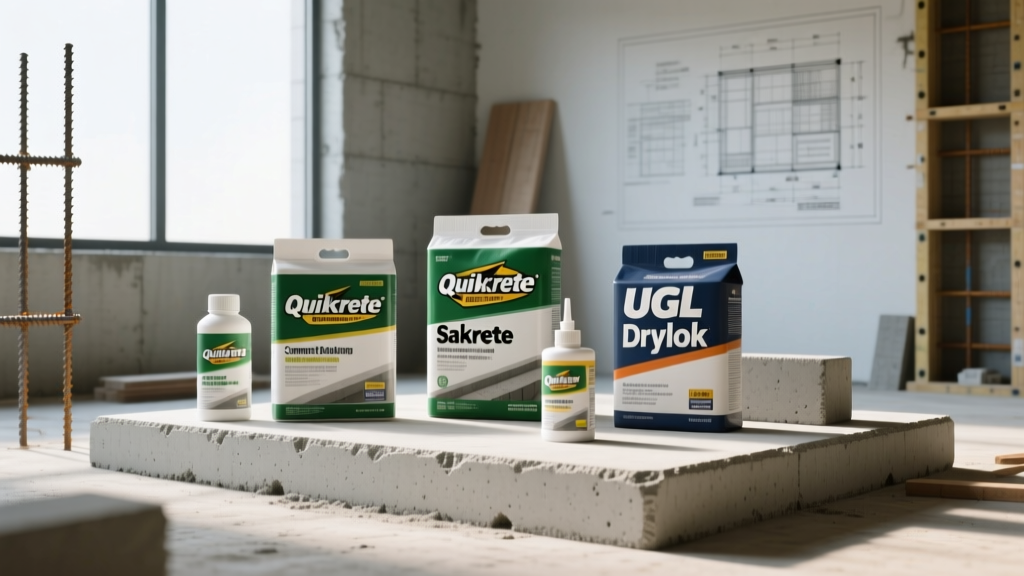
The Chemistry of Below-Grade Moisture: Why Standard Mixes Fail
Hydrostatic pressure exerts up to 2,000 pounds of force per square foot on below-grade foundation walls during heavy saturation. Standard Portland cement mixes (Type N or Type S mortar) are fundamentally unsuited for active basement leaks because they shrink microscopically during the curing process, creating capillary channels that water easily penetrates. True basement cement products rely on calcium aluminate chemistry or polymer-modified crystalline structures that expand upon contact with moisture, effectively choking off water migration.
According to the Portland Cement Association, below-grade durability requires materials that can withstand continuous moisture exposure without sulfating or degrading. This deep-dive analyzes the leading basement cement brands in 2026, breaking down their chemical compositions, ideal use cases, and real-world limitations.
Active Leak Intervention: Quikrete vs. Sakrete Hydraulic Cements
When water is actively flowing through a foundation crack or pipe penetration, standard patching compounds will wash out before they cure. Hydraulic cements are engineered to set in 3 to 5 minutes, even underwater. The two dominant retail brands in this space are Quikrete and Sakrete.
Quikrete Hydraulic Water-Stop Cement (Model #1221-10)
Quikrete’s formulation relies on a high-ratio calcium aluminate base. When mixed with water, it triggers a rapid exothermic (heat-generating) reaction. 2026 Pricing: ~$24.50 per 10lb tub. Yield: 0.09 cubic feet. The critical advantage of Quikrete is its expansive curing property; it physically swells into the pores of the surrounding concrete, creating a mechanical lock that resists up to 1,200 PSI of compressive strength within 24 hours.
Sakrete Leak Stopper (Model #61291002)
Sakrete’s competing product offers a nearly identical 3-minute set time but features a slightly finer aggregate grind, making it easier to press into hairline fissures without excessive force. 2026 Pricing: ~$22.00 per 10lb tub. While Sakrete is more cost-effective, it lacks the aggressive expansive force of Quikrete, making it better suited for static seepage rather than high-pressure, gushing leaks.
Never apply hydraulic cement to a V-shaped crack. The water pressure will push the plug out like a cork. Use a cold chisel to undercut the crack into an inverted 'V' (dovetail) shape, where the back of the crack is wider than the surface opening. This allows the expanding cement to lock permanently behind the concrete face.
Cementitious Waterproofing Coatings: UGL Drylok vs. BASF MasterSeal
Once active leaks are plugged, the broader foundation walls require a negative-side waterproofing barrier. Cementitious coatings penetrate the concrete pores and crystallize, blocking moisture vapor transmission.
UGL Drylok Extreme Masonry Waterproofer
Drylok remains the benchmark for DIY and light-commercial basement sealing. The 'Extreme' line (Model #28613) is rated to withstand 15 PSI of hydrostatic pressure, which equates to a 34-foot head of water. Unlike older oil-based formulations, the 2026 water-based Extreme formula utilizes nano-silica particles that migrate deep into concrete capillaries. It requires two coats applied in opposing directions (cross-hatching) to achieve its warranty-rated 10-mil thickness.
BASF MasterSeal 583 (Formerly Thoroseal Foundation Coating)
For commercial applications or severe residential moisture issues, BASF’s polymer-modified MasterSeal 583 is the professional standard. It is a two-component system (powder and liquid acrylic polymer) that provides exceptional flexibility. While standard cementitious coatings are brittle and can crack if the foundation shifts, MasterSeal 583 can bridge hairline shrinkage cracks up to 1/16th of an inch due to its polymer matrix. Drawback: It requires a mandatory damp-curing period of 48 hours, which is often impractical in finished basements.
2026 Product Comparison Matrix
| Brand / Product | Type | Set / Cure Time | Hydrostatic Rating | Avg. Cost (2026) |
|---|---|---|---|---|
| Quikrete Hydraulic Water-Stop | Plugging Compound | 3-5 Minutes | Active Flow | $24.50 / 10lb |
| Sakrete Leak Stopper | Plugging Compound | 3 Minutes | Active Flow | $22.00 / 10lb |
| UGL Drylok Extreme | Cementitious Coating | 24 Hours (Full Cure) | 15 PSI | $48.00 / Gallon |
| BASF MasterSeal 583 | Polymer-Modified Coating | 48 Hours (Damp Cure) | High / Flexible | $85.00 / 50lb Set |
Surface Preparation: The Efflorescence Barrier
The number one cause of basement cement coating failure is improper surface preparation. The Environmental Protection Agency (EPA) notes that trapped moisture and mineral deposits create environments ripe for mold and structural degradation. Before applying any cementitious coating, you must address efflorescence—the white, powdery salt deposits left behind by evaporating groundwater.
- Outdated Method: Muriatic acid. While effective at dissolving salts, it is highly corrosive, emits toxic fumes in unventilated basements, and can degrade the concrete surface if not neutralized properly.
- 2026 Standard: Phosphoric acid-based cleaners or specialized efflorescence removers (e.g., RadonSeal Efflorescence Cleaner). These convert salts into soluble compounds that can be flushed away without damaging the concrete's tensile strength.
After chemical cleaning, the wall must be mechanically abraded using a wire brush or a diamond cup wheel on an angle grinder to open the concrete pores. If water beads on the surface after prep, a residual form-release agent or silane sealer is present and must be removed via shot-blasting or chemical stripping.
Cost Analysis & Coverage Rates
Budgeting a basement cement project requires understanding the difference between linear foot repairs and square foot coatings. For a standard 1,000 square foot basement (approx. 120 linear feet of wall):
- Targeted Crack Repair: Using Quikrete Hydraulic Water-Stop, expect to use 1lb of material per linear foot of a standard 1/2-inch crack. Total material cost for 10 active leaks: ~$60.
- Full Perimeter Coating (Drylok Extreme): Coverage is 75-100 sq. ft. per gallon per coat. A two-coat system requires 20-26 gallons. Total material cost: $960 - $1,248.
- Professional-Grade Coating (MasterSeal 583): Covers 100 sq. ft. per 50lb set per coat. Requires 20 sets for two coats. Total material cost: ~$1,700.
While DIY coatings save on labor, they only address negative-side water pressure. If hydrostatic pressure builds behind the coating, it can cause spalling. For chronic water issues, exterior positive-side membrane installation combined with interior French drains remains the only permanent structural solution.
Frequently Asked Questions
Can I mix hydraulic cement in a standard mortar mixer?
No. Hydraulic cement sets too rapidly (3-5 minutes). It must be mixed by hand in a small bucket using a margin trowel, preparing only as much as you can apply within 2 minutes.
Does basement cement stop radon gas?
Hydraulic cements and standard cementitious coatings will reduce soil gas entry points, but they are not classified as radon barriers. For radon mitigation, specialized elastomeric sealants and active sub-slab depressurization systems are required.
What is the minimum application temperature?
Both the ambient air and the concrete surface must be above 45°F (7°C) for 24 hours. The exothermic reaction in hydraulic cement can be stunted by freezing temperatures, resulting in a weak, crumbly plug.