Epoxy Concrete Repair: Scenario Matching & Application Guide
Master epoxy concrete repair with our scenario matching guide. Learn when to use injection resins vs. mortars, edge cases, and ASTM standards.
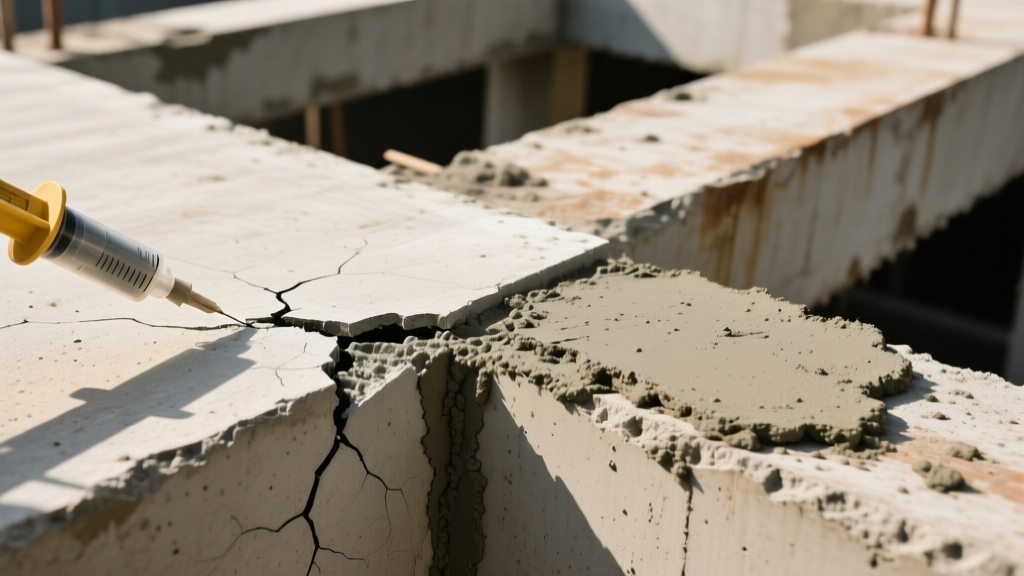
Epoxy concrete repair provides unmatched tensile strength, chemical resistance, and structural continuity when applied correctly. However, misapplication—specifically using rigid epoxies in dynamic environments or ignoring substrate moisture—leads to catastrophic delamination and secondary cracking. Successful repair relies entirely on scenario matching: aligning the specific rheology and modulus of the epoxy system with the mechanical and environmental realities of the defect.
The Chemistry of Failure: Why Epoxy Isn't Always the Answer
Epoxy resins are thermosetting polymers. Once cured, they possess a modulus of elasticity significantly higher than that of standard concrete (often exceeding 2.5 million psi compared to concrete's 3 to 5 million psi, but with vastly superior tensile strength). This rigidity is an asset for static, structural load transfer, but a critical liability in environments subject to thermal cycling, dynamic loading, or active structural movement. If the concrete substrate moves beyond the epoxy's elongation limit (typically 1% to 5% for standard structural epoxies), the repair will not flex; instead, it will induce a new crack adjacent to the repair zone.
Scenario Matching Matrix: When to Deploy Epoxy
Selecting the correct formulation requires evaluating the defect geometry, substrate condition, and structural requirements. The ASTM C881 standard classifies epoxy bonding systems by type, grade, and class. Use the matrix below to match your scenario to the correct specification.
| Defect Scenario | Crack Width / Depth | Substrate Condition | Recommended Epoxy Type | ASTM C881 Spec |
|---|---|---|---|---|
| Static Structural Cracks | 0.002 in. to 0.25 in. | Dry, sound concrete | Low-Viscosity Injection Resin | Type I, Grade 1, Class B/C |
| Spalls & Edge Breaks | > 0.5 in. depth | Dry, CSP 3-5 profile | High-Build Epoxy Mortar | Type VI, Grade 3, Class B/C |
| Damp / Weeping Cracks | 0.01 in. to 0.125 in. | Moisture present (no hydrostatic pressure) | Moisture-Tolerant Hydrophobic Epoxy | Type I or II (Moisture-Insensitive) |
| Active / Thermal Cracks | Any width | Dynamic movement expected | DO NOT USE EPOXY (Use Polyurethane) | N/A (Refer to ASTM C1193) |
Scenario A: Structural Crack Injection (Static Cracks)
For dormant cracks compromising structural integrity, low-viscosity epoxy (100 to 500 centipoise) is mandatory. The objective is deep penetration via capillary action or low-pressure injection. Products like Sikadur 52 or MasterEmaco S 488 (when formulated for injection) are industry standards. Application Specifics: For cracks narrower than 0.005 inches, gravity feeding is insufficient. You must use mechanical injection ports spaced at intervals equal to the slab thickness, injecting from the lowest point upward to displace trapped air. Cure times for Type I epoxies are highly temperature-dependent; at 70°F (21°C), expect a 12-hour gel time, dropping to 4 hours at 90°F (32°C).
Scenario B: Spalling and Edge Repairs (Heavy Duty)
When reconstructing missing concrete at joints, columns, or heavy-traffic floors, a trowelable epoxy mortar (Type VI) is required. These are 100% solids systems heavily loaded with graded silica or quartz aggregates. Application Specifics: Unlike cementitious patching compounds, epoxy mortars do not shrink during cure and achieve compressive strengths exceeding 10,000 psi within 24 hours. They must be mixed in small batches (no more than 0.5 cubic feet at a time) to prevent exothermic runaway, which can cause the material to boil, degrade, and lose adhesion.
If a crack is actively cycling due to thermal expansion, structural settling, or dynamic live loads, epoxy will fail. The rigid repair will act as a stress concentrator, causing the concrete to tear itself apart adjacent to the epoxy line. For active cracks, you must use a flexible, high-elongation polyurethane sealant or injection foam (e.g., Sikaflex-1a or MasterSeal 690) capable of accommodating ±25% to ±50% joint movement.
Critical Edge Cases: When Standard Epoxy Will Fail
Standard bisphenol-A (BPA) epoxies are highly sensitive to two environmental factors: moisture and temperature. Ignoring these will result in bond failure, regardless of surface preparation.
- The Moisture Threshold: Standard epoxies require a dry substrate. Moisture content must be below 4% by weight (CM method) or 75% Relative Humidity (per ASTM F2170). If moisture is present, the epoxy will emulsify, turning milky and losing up to 60% of its bond strength. Solution: Use a moisture-mitigating epoxy primer (like Sikadur 199) or a specialized hydrophobic injection resin that chemically reacts with water to form a closed-cell foam seal.
- The Temperature Floor: Epoxies rely on an exothermic chemical reaction to cure. If the ambient and substrate temperature is below 50°F (10°C), the reaction stalls, resulting in a permanently tacky, uncured film. Solution: Use cold-weather formulated epoxies with accelerated amine hardeners, or artificially heat the substrate using forced-air heaters (never open flame, which introduces carbon dioxide and causes amine blush).
Cost and Yield Analysis: Budgeting for Epoxy Repair
Epoxy systems command a premium over cementitious or polyurethane alternatives, but their longevity in high-stress environments justifies the initial capital expenditure. Below is a 2026 pricing and yield framework for commercial applications.
| Material Category | Average Unit Cost (2026) | Typical Yield / Coverage | Labor Factor |
|---|---|---|---|
| Low-Viscosity Injection Resin (2-Part Cartridge) | $85 - $120 per gallon | ~231 cubic inches per gallon | High (Requires port drilling, sealing, pressurized pumping) |
| High-Build Epoxy Mortar (Pail/Kit) | $160 - $220 per cubic foot | 1 cubic foot per 1 cubic foot of void | Medium (Requires forming, troweling, finishing) |
| Moisture-Mitigating Epoxy Primer | $110 - $140 per gallon | 250 - 350 sq. ft. per gallon | Low (Roller or squeegee application) |
Surface Preparation: The 80% Rule of Epoxy Adhesion
According to guidelines published by the International Concrete Repair Institute (ICRI), up to 80% of all epoxy coating and bonding failures are directly attributable to inadequate surface preparation. Epoxy does not bond to concrete; it mechanically locks into the microscopic pores of the substrate.
To achieve proper mechanical interlock, the substrate must be profiled to a CSP (Concrete Surface Profile) of 3 to 5. This requires aggressive mechanical abrasion:
- Shot Blasting or Scarifying: Required for large horizontal areas to remove laitance, curing compounds, and existing sealers.
- Diamond Grinding: Necessary for edge repairs and vertical surfaces where shot blasting is impractical.
- Acid Etching: Do not use. Acid etching leaves residual salts that interfere with the epoxy's amine hardener, and it fails to achieve a CSP greater than 2.
After profiling, the substrate must be blown clean with oil-free compressed air and vacuumed. Any residual dust will act as a bond-breaker, creating a microscopic slip plane between the epoxy and the concrete.
Expert Troubleshooting: Common Application Failures
Even with correct scenario matching, field errors can compromise the repair. Recognize these failure modes and their remedies:
Amine Blush (Carbamation)
Symptom: A waxy, oily, or sticky film appears on the surface of the curing epoxy, preventing subsequent coats or toppings from adhering. Cause: The amine hardener reacts with carbon dioxide and moisture in the air instead of the epoxy resin. This is common in high-humidity, low-temperature environments. Remedy: Wash the surface with warm water and a stiff bristle brush, then dry thoroughly before applying the next layer. Prevent by ensuring adequate ventilation and avoiding application when the dew point is within 5°F of the substrate temperature.
Exothermic Runaway (Thermal Degradation)
Symptom: The mixed epoxy begins to smoke, crackle, or turn brown/black in the mixing bucket, eventually curing into a brittle, degraded mass. Cause: Mixing too large a batch at once, or mixing in a deep, narrow bucket that traps heat. The chemical reaction generates heat; if the heat cannot dissipate, it accelerates the reaction exponentially. Remedy: Discard the batch. Prevent by mixing smaller volumes, using wide/shallow mixing containers, and pouring the mixed material onto a flat surface immediately after blending to increase the surface area for heat dissipation.
Delamination Under Load
Symptom: The epoxy patch sounds hollow when tapped with a hammer and eventually pops out under traffic. Cause: Failure to achieve the required CSP profile, presence of residual curing compounds, or applying the epoxy over a damp substrate. Remedy: Saw-cut the perimeter of the failed repair, remove the material, re-profile the substrate to CSP 4, verify moisture levels per American Concrete Institute (ACI) standards, and reapply.