Showcasing Various Types of Concrete for Modern Building Applications
Explore an application showcase of various types of concrete, including high-strength, SCC, pervious, and shotcrete, with 2026 pricing and structural specs.

The Foundation of Modern Architecture: Matching Mix to Application
Selecting from the various types of concrete available in the modern construction market requires a precise understanding of structural loads, environmental exposure, and architectural intent. Standard ready-mix concrete (typically 3,000 to 4,000 PSI) is sufficient for basic residential slabs, but commercial, infrastructure, and specialized architectural projects demand engineered mix designs. According to the Portland Cement Association, advanced admixtures and supplementary cementitious materials (SCMs) now allow engineers to manipulate the rheology, permeability, and compressive strength of concrete to meet exact project specifications.
This application showcase examines four specialized concrete types, detailing their structural properties, real-world use cases, and 2026 procurement considerations.
High-Strength Structural Concrete: Skyscrapers and Bridge Piers
High-strength concrete (HSC) is defined by the American Concrete Institute (ACI) as any mix achieving a compressive strength greater than 6,000 PSI, though modern high-rise projects routinely specify mixes between 8,000 and 14,000 PSI. The primary application for HSC is in vertical load-bearing elements—columns, shear walls, and bridge piers—where reducing the cross-sectional area of the concrete maximizes usable floor space.
Mix Design Specifications for 10,000 PSI HSC
- Water-to-Cement (w/c) Ratio: Strictly maintained below 0.30 to minimize capillary porosity.
- SCMs: Incorporation of 8-12% silica fume by weight of cement to densify the interfacial transition zone (ITZ).
- Admixtures: Polycarboxylate ether (PCE) based high-range water reducers (HRWR) to maintain workability at low w/c ratios.
- Aggregate: Crushed granite or basalt, maximum size 3/8 inch to 1/2 inch, to prevent internal micro-cracking under extreme loads.
Application Showcase: In the construction of a 40-story commercial tower, utilizing 10,000 PSI HSC for the ground-floor columns reduces the column diameter by approximately 25% compared to standard 4,000 PSI concrete. This yields an additional 1,200 square feet of leasable space on the ground floor alone, easily justifying the material premium.
2026 Cost Factor: Expect to pay between $185 and $240 per cubic yard for 8,000+ PSI mixes, representing a 40-60% premium over standard 4,000 PSI ready-mix, driven by the cost of silica fume and advanced PCE superplasticizers.
Self-Consolidating Concrete (SCC): Complex Formwork and Architectural Facades
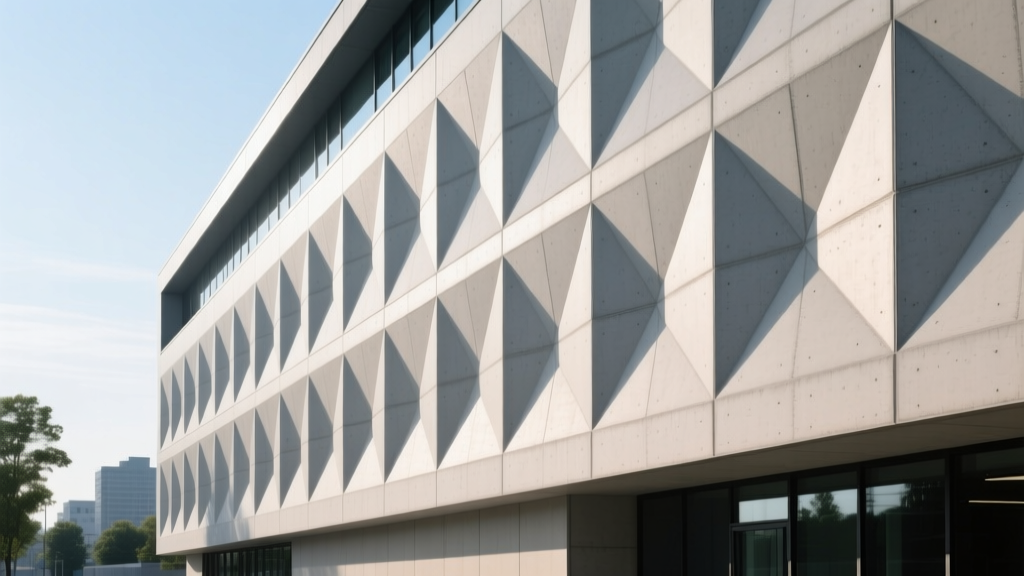
Self-Consolidating Concrete (SCC) flows under its own weight, filling highly congested rework and complex architectural formwork without the need for mechanical vibration. This eliminates the risk of honeycombing and surface voids, making it the mandatory choice for architectural precast panels, exposed aggregate facades, and heavily reinforced seismic shear walls.
SCC vs. Traditional Vibrated Concrete: A Field Comparison
| Parameter | Traditional Vibrated Mix | Self-Consolidating Concrete (SCC) |
|---|---|---|
| Slump / Flow | 4 to 6 inches (Slump) | 22 to 28 inches (Slump Flow) |
| Consolidation Method | Internal pencil vibrators required | Gravity and rheology only; zero vibration |
| Labor Requirement | High (vibrator operators + finishers) | Low (placement crew only) |
| Surface Finish Quality | Prone to bug holes if vibrated poorly | Mirror-smooth, architectural-grade finish |
| Material Cost Premium | Baseline | +15% to 22% per cubic yard |
Quality Control Testing: Standard slump tests are invalid for SCC. Field technicians must use the Slump Flow test (measuring the diameter of the spread), the J-Ring test (to assess passing ability through congested rebar), and the Visual Stability Index (VSI) to ensure the mix does not segregate. Viscosity Modifying Admixtures (VMAs) are frequently dosed at the truck to adjust stability on-site.
Pervious Concrete: Sustainable Parking Lots and Stormwater Management
Pervious (or permeable) concrete is a specialized zero-slump mix consisting of Portland cement, coarse aggregate, and water, with little to no fine sand. This creates a highly porous structure with a void ratio of 15% to 25%, allowing water to pass directly through the pavement and into the subgrade. The U.S. Environmental Protection Agency (EPA) recognizes pervious concrete as a primary Best Management Practice (BMP) for reducing stormwater runoff and filtering pollutants.
Pervious concrete is highly susceptible to freeze-thaw damage if the subgrade becomes saturated. In northern climates, it must be installed over a minimum 12-inch layer of clean, washed open-graded crushed stone (e.g., ASTM No. 57 or No. 8 aggregate) to serve as a reservoir and capillary break. Never place pervious concrete directly over clay or poorly draining soils.
Application Showcase: A 50,000-square-foot commercial retail parking lot utilizing 4,000 PSI pervious concrete can capture and infiltrate up to 8 gallons of water per minute per square foot. This often allows developers to eliminate the need for costly underground retention vaults and surface detention ponds, saving $4 to $7 per square foot in overall site development costs.
Maintenance Reality: The void structure will clog with sediment over time. Facility managers must implement a strict maintenance schedule utilizing regenerative air vacuum sweepers twice annually to maintain the infiltration rate.
Shotcrete (Gunite): Pool Shells and Slope Stabilization
Shotcrete is not a specific mix design, but rather a method of placement where concrete or mortar is pneumatically projected at high velocity onto a surface. It is the exclusive choice for complex curved structures (like swimming pools and domes), thin-shell roofs, and soil nailing for slope stabilization.
Wet-Mix vs. Dry-Mix Shotcrete: Decision Flow
- Evaluate the Volume and Thickness: If the project requires thick structural layers (over 4 inches) and high hourly production rates (e.g., a commercial retaining wall), specify Wet-Mix Shotcrete. The water is added at the mixer, and the batch is pumped to the nozzle where compressed air propels it.
- Evaluate Overhead and Repair Work: If the application involves overhead repairs, thin layers, or requires stopping and starting frequently (e.g., pool coves or tunnel patching), specify Dry-Mix Shotcrete (Gunite). The dry cement and aggregate are blown through the hose, and water is introduced only at the nozzle.
Rebound Management: A critical factor in shotcrete economics is "rebound"—the material that bounces off the surface upon impact. Wet-mix shotcrete typically generates 5% to 10% rebound, while dry-mix can generate 15% to 25%. This rebound material is structurally compromised (rich in coarse aggregate, poor in cement paste) and must be completely removed and discarded before the next layer is applied to prevent structural delamination.
2026 Procurement and Decision Matrix
When specifying among the various types of concrete for a mixed-use development or infrastructure project, use the following matrix to align material properties with budget and structural requirements.
| Concrete Type | Target PSI | Avg. Cost (per CY) | Primary Application | Form Removal Time |
|---|---|---|---|---|
| Standard Ready-Mix | 3,000 - 4,000 | $135 - $155 | Flatwork, footings, standard slabs | 3 - 7 Days |
| High-Strength (HSC) | 8,000 - 14,000 | $185 - $240 | High-rise columns, bridge piers | 1 - 3 Days (Early strength) |
| Self-Consolidating (SCC) | 4,000 - 6,000 | $160 - $190 | Architectural precast, dense rebar | 2 - 5 Days |
| Pervious | 2,500 - 4,000 | $170 - $210 | Stormwater parking lots, walkways | 7 Days (Requires curing mats) |
| Shotcrete (Wet-Mix) | 5,000 - 7,000 | $200 - $260* | Retaining walls, pool shells | N/A (No formwork used) |
*Note: Shotcrete pricing is highly variable and often quoted per square foot of in-place coverage rather than per cubic yard, due to rebound waste and specialized pumping labor.
Quality Control and Testing Protocols
Regardless of the mix selected, rigorous field testing is non-negotiable. For standard and high-strength mixes, ASTM C31 mandates the casting of cylindrical test specimens cured under controlled conditions to verify 7-day and 28-day compressive strength. For SCC, field technicians must monitor the temperature of the mix; high ambient temperatures accelerate the hydration of the PCE admixtures, leading to rapid slump loss in the truck drum. In summer months, specify retarding admixtures or utilize chilled mixing water and flaked ice to ensure the concrete arrives at the pour site within the specified slump flow tolerance.
Written by
Elena RodriguezElena Rodriguez is a civil engineer and technical writer specializing in concrete technology, masonry systems, and ASTM/ACI compliance. She earned her B.S. in Civil Engineering from Texas A&M University and spent a decade at a materials testing laboratory, performing over 2,000 concrete compressive strength tests and masonry prism evaluations. Elena is an ACI-certified Field Testing Technician (Grade I) and a member of ASTM Committee C12 on Natural Building Stone. She currently consults on forensic engineering cases involving concrete failures and moisture intrusion. Based in San Antonio, TX, Elena is a proud member of the Society of Women Engineers (SWE) and coaches her daughter's FIRST Robotics team.
More from Elena Rodriguez
View all
Walls & Panels
Cost Analysis: Light Gauge Steel Framing Advantages and Disadvantages
Evaluate light gauge steel framing advantages and disadvantages through a strict cost analysis lens, comparing material, labor, and lifecycle expenses.
Aug 4, 2026

Walls & Panels
Gypsum Board Types: Exact Specifications, Thickness & Dimensions
Compare standard, Type X, and moisture-resistant gypsum board types. Get exact specifications, thicknesses, dimensions, and ASTM standards for your project.
Aug 4, 2026

Fire Resistance
Best Fire-Resistant Outdoor Decking Materials: 2026 Buyer Guide
Discover the best fire-resistant outdoor decking materials for 2026. Compare Class A PVC, aluminum, and hardwood options for WUI compliance and safety.
Aug 4, 2026