Cost of Concrete vs Pavers: 2026 Driveway & Patio Pricing Guide
Compare the true cost of concrete vs pavers for 2026 driveways and patios. Breakdowns of material, labor, maintenance, and long-term ROI.

The Upfront Cost Breakdown: Poured Concrete vs. Paving Stones
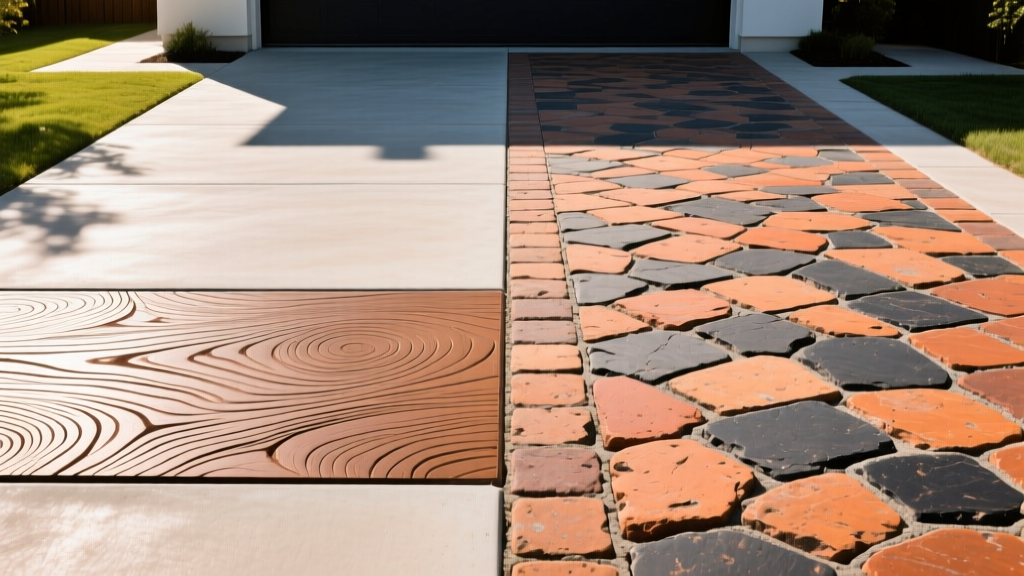
When evaluating the cost of concrete vs pavers for exterior hardscaping, homeowners and contractors often focus solely on the initial installation price. However, a true financial comparison requires analyzing material grades, labor intensity, and site preparation. In 2026, standard poured concrete remains the most budget-friendly option for large, continuous spans, while concrete pavers command a premium due to manufacturing precision and manual installation labor.
| Material Type | Material Cost (per sq ft) | Labor & Equipment (per sq ft) | Total Installed Cost (per sq ft) |
|---|---|---|---|
| Standard Poured Concrete (4000 PSI, broom finish) | $2.50 - $4.00 | $4.50 - $7.00 | $7.00 - $11.00 |
| Stamped/Decorative Concrete | $4.00 - $6.50 | $8.00 - $12.00 | $12.00 - $18.50 |
| Standard Concrete Pavers (60mm) | $3.50 - $6.00 | $7.00 - $10.00 | $10.50 - $16.00 |
| Premium/Permeable Pavers (80mm+) | $7.00 - $12.00 | $10.00 - $15.00 | $17.00 - $27.00 |
For a standard 600-square-foot driveway, a basic poured concrete slab will cost between $4,200 and $6,600, whereas a standard paver installation will range from $6,300 to $9,600. The labor disparity is the primary driver; pouring and finishing concrete is a rapid, mechanized process, while laying pavers requires meticulous hand-placement, cutting, and joint-sanding.
Subgrade Preparation: The Hidden Equalizer
A common misconception is that pavers require a more rigorous base than concrete. In reality, both systems demand identical subgrade preparation to prevent catastrophic failure. Approximately 70% of paver settling issues and 50% of concrete slab fractures stem from inadequate base compaction.
Both installations require excavating 8 to 10 inches of topsoil and replacing it with a 4-to-6-inch layer of Class II road base (3/4-inch minus crushed aggregate). This base must be compacted in 2-inch lifts using a vibratory plate compactor to achieve 95% Standard Proctor density. Pavers require an additional 1-inch layer of coarse, washed concrete sand as a bedding course, which adds roughly $0.75 to $1.25 per square foot to the material cost. Concrete slabs, conversely, are poured directly over the compacted aggregate or a vapor barrier, but require formwork and reinforcement (typically 6x6 W1.4xW1.4 welded wire mesh or macro-synthetic fibers), which balances out the base cost differential.
Long-Term Financial Impact: Maintenance and Failure Modes
The true cost of concrete vs pavers diverges significantly 10 to 15 years post-installation, when environmental stressors and ground movement inevitably take their toll.
Concrete: Cracking, Spalling, and Slab Jacking
Concrete is a rigid monolith. When the subgrade shifts due to frost heave, tree root intrusion, or soil consolidation, the slab cracks. While control joints are cut to dictate where cracking occurs, random fractures are common. Repairing a sunken concrete slab requires polyjacking (injecting high-density polyurethane foam beneath the slab), which costs between $5.00 and $9.00 per square foot. If the slab is severely fractured, demolition and replacement are the only options, costing upwards of $12.00 per square fact just for the localized tear-out and repour. Furthermore, concrete in cold climates requires annual or biennial sealing ($0.50 - $1.00 per sq ft) to prevent water ingress and subsequent spalling from de-icing salts.
Pavers: Settling, Joint Sand, and Edge Restraints
Pavers are a flexible pavement system. If the subgrade shifts, the pavers move with it, preventing structural fractures. Repairing a settled area involves "unzipping" the pavers, adding and compacting new base material, and relaying the original stones. This localized repair costs $4.00 to $8.00 per square foot but leaves no visible patch marks, unlike concrete repairs. The primary maintenance cost for pavers is joint maintenance. Polymeric sand, which locks the pavers together and prevents weed growth, degrades over 5 to 8 years and must be reapplied, costing roughly $1.50 to $2.50 per square foot. Additionally, if the perimeter edge restraints (plastic or concrete curbs held by 10-inch spikes) fail, the pavers will spread, requiring professional re-tamping and re-anchoring.
Climate Performance and Material Specifications
Local climate heavily dictates which material offers the better long-term return on investment. Material specifications must be adjusted based on regional weather patterns to avoid premature degradation.
Expert Specification Note: In regions with severe freeze-thaw cycles, standard concrete will spall and delaminate within five years unless it is mixed with 5% to 7% air entrainment. This microscopic bubble network gives expanding water a place to go. According to the Portland Cement Association, proper air-entrainment is non-negotiable for exterior flatwork in northern climates. Conversely, interlocking concrete pavers manufactured to ASTM C936 standards boast a minimum compressive strength of 8,000 PSI and max water absorption of 5%, making them inherently more resistant to freeze-thaw damage than standard 4,000 PSI poured concrete.
In high-heat urban environments, standard dark-colored concrete and asphalt contribute to the heat island effect. Light-colored concrete pavers or pervious concrete systems are increasingly mandated by municipal stormwater codes to promote ground infiltration and reduce thermal mass. Permeable pavers (ASTM C1781) require a specialized open-graded aggregate base that acts as an underground retention basin, adding $4.00 to $6.00 per square foot to the total project cost but often qualifying the homeowner for municipal stormwater tax credits.
Decision Framework: Matching Material to Project Scope
Selecting between poured concrete and pavers should not be based on aesthetics alone. Use the following operational parameters to determine the most structurally and financially sound choice for your specific project.
- Choose Poured Concrete If: The project is a large, continuous area (over 1,000 sq ft) where budget constraints are strict; the design requires a modern, minimalist aesthetic with clean, uninterrupted lines; the site has stable, well-draining soil with minimal tree root interference; and you prefer a low-maintenance surface for the first 10 years.
- Choose Concrete Pavers If: The site is located in a severe freeze-thaw climate where ground heave is guaranteed; the driveway or patio covers underground utilities (sewer lines, gas lines) that may require future excavation access; local municipal codes require permeable surfaces for stormwater management; or the design features complex curves, radii, and multiple color transitions that would require expensive, labor-intensive concrete forming and stamping.
- Choose Stamped Concrete If: You desire the aesthetic of natural stone or brick but have a mid-tier budget that cannot accommodate the labor costs of hand-laid pavers, provided you are willing to commit to a strict biennial resealing schedule to protect the color hardeners and release agents.
Ultimately, the cost of concrete vs pavers is a trade-off between initial capital expenditure and long-term repair flexibility. Poured concrete wins on day-one pricing and rapid installation, while pavers provide a superior lifecycle value in volatile soil conditions and offer a permanent, patch-free repair methodology.
Written by
Priya KapoorPriya Kapoor is a real estate market analyst and construction economics researcher with expertise in housing affordability, development feasibility, and infrastructure investment. She holds a Master of Regional Planning from Cornell University and previously worked as a senior analyst at CBRE's Investment Properties group, where she modeled returns for $4B in mixed-use development pipelines. Priya now runs an independent research practice advising developers, municipalities, and REITs on construction cost forecasting and market timing. She publishes the quarterly "BuildMat Market Pulse" report tracking material price indices across 12 commodity categories. Based in Austin, TX, Priya serves on the board of Habitat for Humanity Austin and is a marathon runner.
More from Priya Kapoor
View all
Construction Cost
Cost to Build a 1600 Sq Ft Home in 2026: Full Breakdown
Accurate 2026 cost to build a 1600 sq ft home—material, labor, and regional pricing breakdowns included. Plan your budget with real-time estimates.
Aug 11, 2026

Wood & Lumber
Name the Types of Wood for Pressure Treatment and Preservation
Learn how to name the types of wood best suited for pressure treatment. Compare species treatability, chemical retention levels, and 2026 preservation costs.
Aug 4, 2026

Stone & Masonry
Stone Veneer Suppliers Lindenhurst: 2026 Cost Analysis
Analyze 2026 stone veneer costs in Lindenhurst, NY. Compare local supplier pricing, delivery fees, and Suffolk County installation labor rates.
Aug 4, 2026