Best Concrete Nails & Masonry Fastener Brands for 2026
Compare top concrete nails and masonry fastener brands for 2026. Deep dive into Hilti, Ramset, and Simpson product lines, pricing, and shear strengths.
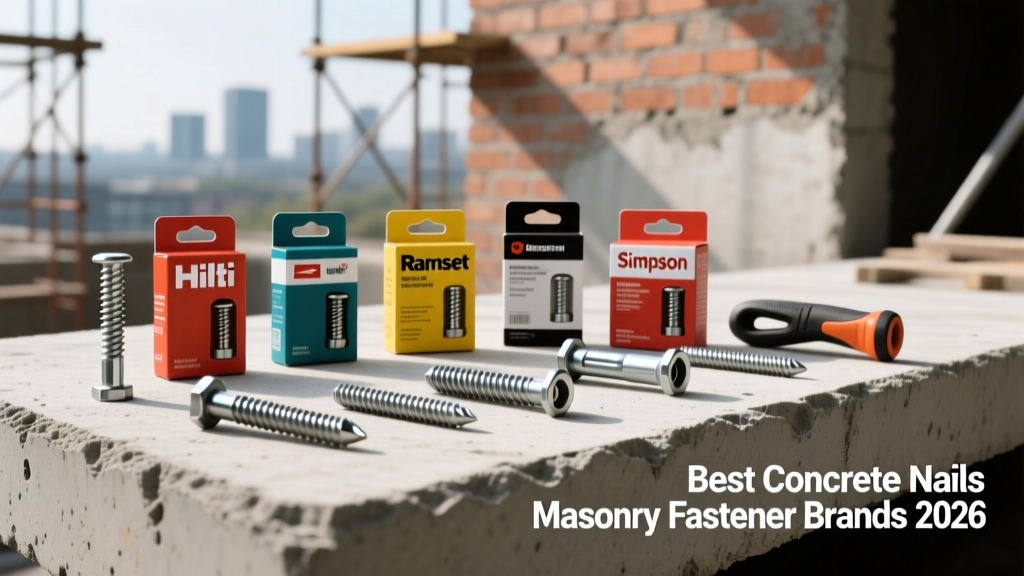
Metallurgy and Mechanics: Why Standard Nails Shatter in Masonry
Driving a standard framing nail into cured concrete results in immediate deformation. Standard framing nails are manufactured from low-carbon steel (typically 1008 to 1018 grades) designed for ductility and bending without snapping. Concrete nails, by contrast, require a fundamentally different metallurgical profile. They are forged from high-carbon steel (1045 to 1060 grades) and undergo a rigorous quenching and tempering process to achieve a Rockwell Hardness (HRC) between 48 and 55.
This high hardness grants the fastener the compressive strength required to displace the aggregate and cement paste in a concrete matrix without buckling. However, this comes at the cost of ductility. A concrete nail will not bend gracefully under lateral stress; it will experience brittle fracture. Understanding this trade-off is critical when selecting fasteners for structural tie-downs versus non-structural furring strip attachments. According to guidelines published by the American Concrete Institute (ACI), fastener selection must account for both the compressive strength of the substrate (measured in PSI) and the anticipated shear and tensile loads.
Brand & Product Line Deep-Dive: The 2026 Market Leaders
The masonry fastener market is heavily segmented by application method (hand-driven vs. powder/gas-actuated) and load requirements. Here is a technical breakdown of the dominant product lines currently defining the industry standard.
Hilti: Engineering the Premium Tier
Hilti dominates the high-performance powder-actuated and gas-actuated fastener space. Their concrete nails are engineered for specific substrate densities, eliminating the guesswork that leads on-site misfires.
- X-HSN (High Strength Nail): Designed specifically for high-strength concrete (5,000 to 8,000 PSI) and steel-to-concrete applications. The shank features a specialized knurling pattern that maintains pull-out resistance even in cracked concrete zones. Average cost: $0.65 - $0.85 per pin.
- X-ENP (Enhanced Nail Pin): The workhorse for standard poured concrete (3,000 to 5,000 PSI). The X-ENP-22 series includes a built-in centering washer, which is critical for securing metal track to concrete without the head slipping off the narrow flange. Average cost: $0.40 - $0.55 per pin.
For a comprehensive look at their engineered fastening systems, review the Hilti Fastener Systems catalog.
Ramset: The Powder-Actuated Workhorse
Ramset (now part of ITW) remains the default choice for general contractors utilizing .300 caliber powder-actuated tools. Their product line prioritizes volume, reliability, and broad compatibility across legacy tool platforms.
- Trublu Drive Pins: Featuring a blue polymer strip that holds the pin and washer together, reducing jamming in the tool magazine. The shank is smooth, relying on the extreme velocity of the powder load to fuse the steel to the concrete pores via friction welding. Average cost: $0.25 - $0.35 per pin.
- Fluted Masonry Nails (Hand-Driven): For applications where powder tools are restricted (e.g., occupied renovations, noise-sensitive hospitals), Ramset produces heavy-duty fluted nails. The longitudinal grooves act as a cutting edge, clearing dust from the hole and reducing driving resistance by up to 30% compared to smooth shanks. Average cost: $8.00 - $12.00 per 1 lb box.
Simpson Strong-Tie: Bridging Nails and Structural Screws
While traditional concrete nails excel in shear strength, they perform poorly in withdrawal (pull-out) scenarios. Simpson Strong-Tie addresses this by blurring the line between nails and structural masonry screws.
- Strong-Drive® Masonry Screws: When a structural ledger board or seismic shear wall requires high withdrawal resistance, Simpson’s masonry screws replace traditional concrete nails. They feature a self-tapping thread and a corrosion-resistant Stalgard® coating. Unlike nails, they can be removed and re-driven without destroying the concrete threads. Average cost: $0.30 - $0.50 per screw.
Structural engineers frequently specify these over standard nails for seismic retrofitting. More details on structural anchoring can be found in the Simpson Strong-Tie Masonry Solutions guide.
Product Line Comparison Matrix
| Brand | Product Line | Fastener Type | Optimal Substrate PSI | Primary Strength | Est. Unit Cost (2026) |
|---|---|---|---|---|---|
| Hilti | X-HSN | Powder/Gas Pin | 5,000 - 8,000 PSI | High Shear / Cracked Concrete | $0.75 |
| Hilti | X-ENP-22 | Powder/Gas Pin | 3,000 - 5,000 PSI | Shear / Track Fastening | $0.48 |
| Ramset | Trublu .300 | Powder Pin | 2,500 - 4,500 PSI | General Shear / Volume | $0.30 |
| Ramset | Fluted Hand Nail | Hand-Driven Nail | Block / Soft Pour | Low-Profile Shear | $0.12 |
| Simpson | Strong-Drive | Masonry Screw | 2,000 - 6,000 PSI | High Withdrawal / Seismic | $0.42 |
Substrate Matching: Selecting the Right Concrete Nail
Selecting a concrete nail without verifying the substrate condition is the leading cause of fastener failure on commercial job sites. The state of the concrete dictates the fastener geometry and installation method.
⚠️ Warning: Fastening into Green Concrete
Concrete that has cured for less than 28 days (green concrete) has not reached its full compressive strength and retains high moisture content. Driving high-velocity powder-actuated pins into green concrete often results in 'blowout'—where the fastener displaces a massive crater of wet aggregate, leaving zero holding power. For green concrete, use hand-driven fluted concrete nails or wait until the slab reaches a minimum of 3,000 PSI (typically 7-14 days depending on the mix design and ambient temperature).
Hollow CMU vs. Solid Poured Concrete
When anchoring into Concrete Masonry Units (CMU), the fastener must engage the solid web of the block, not the hollow cell. Standard smooth-shank powder pins will pass straight through the 1-inch face shell and fall into the void. For hollow CMU, contractors must use specialized hollow-block pins with elongated knurled shanks, or switch to masonry screws that can bridge the void and bite into the rear face shell.
Troubleshooting Common Installation Failures
Even with premium fasteners, installation errors lead to costly rework. Use this diagnostic framework to identify and correct on-site failures.
- Symptom: The nail shatters or snaps upon impact.
Cause: Substrate PSI exceeds the fastener's hardness rating, or the fastener struck embedded aggregate (quartz/granite) at a direct perpendicular angle.
Fix: Upgrade to a high-strength pin (e.g., Hilti X-HSN). If aggregate spalling persists, shift the fastening location 2 inches laterally to bypass the hard stone. - Symptom: The nail bends like a pretzel without penetrating.
Cause: Using standard low-carbon framing nails, or the powder load (caliber) is too weak for the concrete density.
Fix: Verify the nails are high-carbon masonry grade. Step up the powder load color code (e.g., move from a Yellow .27 load to a Red .27 load). - Symptom: The fastener head shears off, leaving the shank embedded.
Cause: The tool was not held perfectly perpendicular (90 degrees) to the substrate, creating lateral sheer stress on the brittle high-carbon head during the driving phase.
Fix: Retrain operators on tool alignment. Utilize tool extensions or kyclamps that enforce a 90-degree drive angle.
The Hidden Cost of Cheap Fasteners: A Labor Analysis
Procurement teams frequently push for generic, unbranded concrete nails to save on material costs. In 2026, a box of 1,000 generic smooth-shank pins might cost $180, compared to $450 for a box of 1,000 branded, knurled pins. However, this material savings is rapidly erased by labor inefficiencies.
Generic pins suffer from a 15% to 25% failure rate in high-strength commercial slabs (misfires, bent pins, head shears). If a journeyman ironworker earning $65/hour spends just 30 extra minutes per 1,000 fasteners extracting bent pins, clearing jammed tool magazines, and re-firing missed connections, the labor penalty is $32.50. Furthermore, a failed fastener in a structural track requires an engineer's sign-off or a costly epoxy anchor retrofit, which can exceed $45 per point. Specifying premium, substrate-matched concrete nails from Hilti or Ramset guarantees a 98% first-time drive success rate, protecting the project's labor margins and structural integrity.