Fiber Concrete vs Wire Mesh: Mix Design & Crack Control Guide
Compare fiber concrete vs wire mesh for slab-on-grade. Explore mix design adjustments, dosage rates, cost differences, and structural crack control limits.

The Core Debate: Dispersed Reinforcement vs. Planar Grids
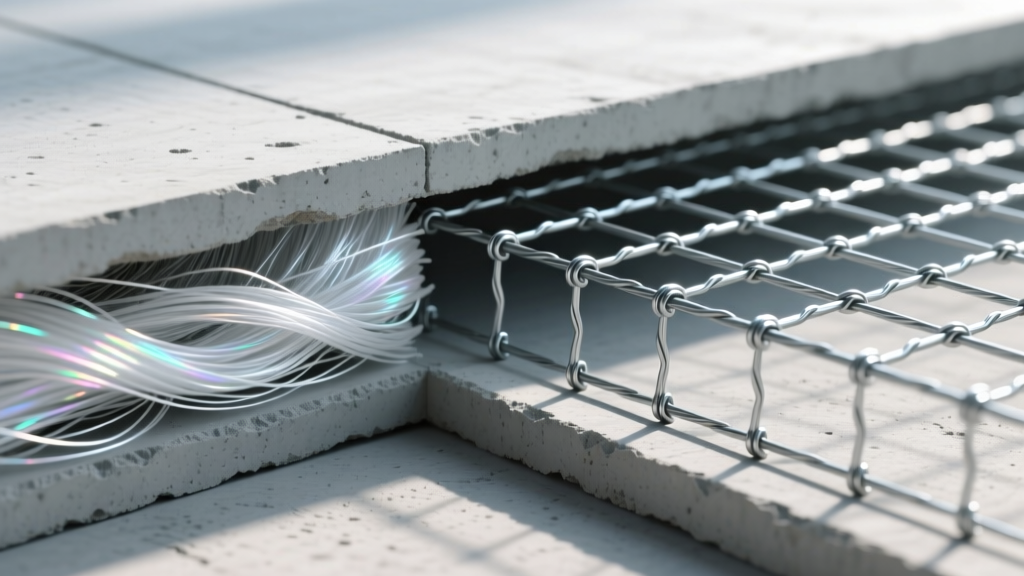
When designing slab-on-grade concrete, engineers and contractors must choose between three-dimensional dispersed reinforcement (fibers) and two-dimensional planar grids (welded wire mesh or WWF). While both aim to mitigate cracking, their mechanisms, mix design implications, and structural limitations are fundamentally different. Fiber reinforcement alters the rheology of the concrete batch itself, demanding specific admixture adjustments, whereas wire mesh leaves the mix design unchanged but introduces severe placement and labor variables on the job site.
Mix Design Adjustments for Fiber-Reinforced Concrete
Introducing fibers into a concrete mix is not a simple 'drop-in' addition. The physical presence of millions of individual filaments increases the total surface area within the batch, fundamentally changing the water demand, slump retention, and air-entrainment requirements.
Micro-Synthetic Fibers (Polypropylene)
Dosed typically between 0.5 and 1.5 lbs per cubic yard (lbs/cy), micro-synthetic fibers (ASTM C1116 Type III) are engineered to control plastic shrinkage cracking during the first 24 hours of curing. According to the Portland Cement Association (PCA), these fibers do not significantly increase the compressive or flexural strength of the hardened concrete. However, they do reduce the measured slump by approximately 0.5 to 1.0 inches. To maintain a target 4-inch slump without increasing the water-cement ratio (which would compromise strength), batch plants must introduce a polycarboxylate-based High-Range Water Reducer (HRWR). Furthermore, the friction of the fibers can trap microscopic air bubbles, often requiring a slight reduction in Air-Entraining Admixture (AEA) to keep air content within the critical 5-7% range for freeze-thaw durability.
Macro-Synthetic and Steel Fibers
When the design requires post-cracking residual strength (often replacing temperature and shrinkage steel in industrial floors), macro-fibers or steel fibers are used. Steel fibers (ASTM C1116 Type I) are dosed heavily, ranging from 40 to 100 lbs/cy. This massive inclusion acts like a stiff aggregate network, causing severe slump loss—sometimes dropping a 6-inch slump to 2 inches within minutes. Mix designers must compensate by increasing the paste volume (adding fly ash or slag cement) and utilizing high-dosage superplasticizers.
Critical Batching Rule: Steel and macro-synthetic fibers must be introduced into the drum during the aggregate weighing phase at the batch plant. Adding fibers at the job site via the truck chute almost guarantees 'balling'—the formation of dry, unmixed fiber clumps that create severe structural voids in the finished slab.
Wire Mesh (WWF) Placement and Concrete Interaction
Welded Wire Fabric (WWF), governed by ASTM A1064, does not alter the concrete batch ticket. The most common specification for residential and light commercial slabs is 6x6 W1.4xW1.4 (historically known as 6x6 10/10). Because the mesh is placed on the subgrade, the mix design remains standard, but the physical placement process introduces the single greatest point of failure in slab construction: the neutral axis problem.
For wire mesh to resist tensile shrinkage stresses, it must be located in the upper third of the slab thickness. In a 4-inch slab, the mesh should sit roughly 1.5 inches below the surface. In practice, contractors lay the mesh flat on the ground and pour concrete directly over it. The weight of the concrete and the workers stepping on the mesh during screeding pushes the grid to the very bottom of the slab. Once positioned below the neutral axis, the mesh provides zero tensile benefit for surface shrinkage cracking, functioning only as a dead weight. To prevent this, mesh must be tied to concrete chairs or pulled up during the pour—both of which drastically increase labor time and cost.
Cost & Labor Breakdown: 2026 Pricing Realities
When evaluating fiber concrete vs wire mesh, the material cost is only a fraction of the equation. The elimination of on-site labor is where fiber reinforcement provides its highest return on investment.
| Parameter | Micro-Synthetic Fiber | Macro-Steel Fiber | 6x6 W1.4 Wire Mesh |
|---|---|---|---|
| Material Dosage | 0.75 - 1.5 lbs/cy | 40 - 60 lbs/cy | 0.15 lbs/sq ft |
| Batch Plant Surcharge | $12 - $18 per cy | $45 - $65 per cy | N/A (Site delivered) |
| Site Material Cost | $0.00 | $0.00 | $0.18 - $0.24 / sq ft |
| Labor & Chairs | $0.00 | $0.00 | $0.35 - $0.50 / sq ft |
| Total Installed Premium | ~$0.06 / sq ft | ~$0.25 / sq ft | ~$0.55 - $0.75 / sq ft |
Based on a standard 4-inch thick slab (81 square feet per cubic yard), micro-synthetic fibers add roughly $0.06 per square foot to the total project cost. In contrast, wire mesh, when factoring in the physical steel, plastic chairs, and the 45-60 minutes of labor required to lay and tie a 1,000 sq ft area, pushes the premium to over $0.55 per square foot. The National Ready Mixed Concrete Association (NRMCA) frequently cites this labor savings as the primary driver for the industry's shift toward synthetic fibers in commercial flatwork.
Crack Control vs. Structural Capacity: The Engineering Truth
A dangerous misconception in residential construction is that either fibers or wire mesh will prevent concrete from cracking. Concrete will crack; the goal is to control where and how wide those cracks become.
The Limits of Shrinkage Reinforcement
Both micro-fibers and standard W1.4 wire mesh are classified as temperature and shrinkage reinforcement. They are designed to hold tightly together the micro-cracks that form as concrete cures and shrinks volumetrically. Neither material possesses the cross-sectional area or yield strength to bridge structural cracks caused by subgrade settlement, heavy point loads, or inadequate slab thickness. If a driveway is poured over poorly compacted clay, both the fibers and the mesh will yield, and the slab will snap.
Joint Spacing Remains Mandatory
According to guidelines published by the Washington State Department of Transportation and ACI Committee 360, the use of fiber reinforcement does not eliminate the need for control joints. Control joints (saw-cut or tooled) create a planned weak point, forcing the concrete to crack in a straight, hidden line. While fibers may allow for a slight increase in joint spacing (e.g., moving from 10-foot to 12-foot grids in some industrial applications), omitting joints entirely when using fiber concrete will result in random, unsurface map-cracking across the slab.
Actionable Specification Framework
To specify the correct reinforcement system, match the application to the material's mechanical strengths:
- Residential Driveways & Patios: Specify 1.0 lb/cy of micro-synthetic polypropylene fiber. Combine with a 4-inch minimum thickness, compacted aggregate base, and saw-cut control joints at 10-foot intervals. This eliminates the risk of mesh sinking to the bottom of the slab while providing superior plastic shrinkage protection.
- Industrial Warehouses & Forklift Aisles: Specify 40-50 lbs/cy of hooked-end steel fibers or 5.0 lbs/cy of macro-synthetic structural fibers. This provides the post-cracking flexural toughness required to resist spalling at joints under heavy dynamic wheel loads.
- Structural Slabs on Grade (Expansive Soils): Use a hybrid approach or stick to engineered rebar grids (#4 bars at 12 inches on center). Fibers cannot compensate for the tensile bending moments induced by soil heave.
Written by
Priya KapoorPriya Kapoor is a real estate market analyst and construction economics researcher with expertise in housing affordability, development feasibility, and infrastructure investment. She holds a Master of Regional Planning from Cornell University and previously worked as a senior analyst at CBRE's Investment Properties group, where she modeled returns for $4B in mixed-use development pipelines. Priya now runs an independent research practice advising developers, municipalities, and REITs on construction cost forecasting and market timing. She publishes the quarterly "BuildMat Market Pulse" report tracking material price indices across 12 commodity categories. Based in Austin, TX, Priya serves on the board of Habitat for Humanity Austin and is a marathon runner.
More from Priya Kapoor
View all
Construction Cost
Cost to Build a 1600 Sq Ft Home in 2026: Full Breakdown
Accurate 2026 cost to build a 1600 sq ft home—material, labor, and regional pricing breakdowns included. Plan your budget with real-time estimates.
Aug 11, 2026

Wood & Lumber
Name the Types of Wood for Pressure Treatment and Preservation
Learn how to name the types of wood best suited for pressure treatment. Compare species treatability, chemical retention levels, and 2026 preservation costs.
Aug 4, 2026

Stone & Masonry
Stone Veneer Suppliers Lindenhurst: 2026 Cost Analysis
Analyze 2026 stone veneer costs in Lindenhurst, NY. Compare local supplier pricing, delivery fees, and Suffolk County installation labor rates.
Aug 4, 2026