Concrete vs Hempcrete: 2026 Cost Breakdown & Wall Assembly Analysis
Compare concrete vs hempcrete costs in 2026. Detailed breakdown of material, labor, structural framing, and lifecycle energy expenses for both wall systems.

The Assembly Reality: Why Material Price is Misleading
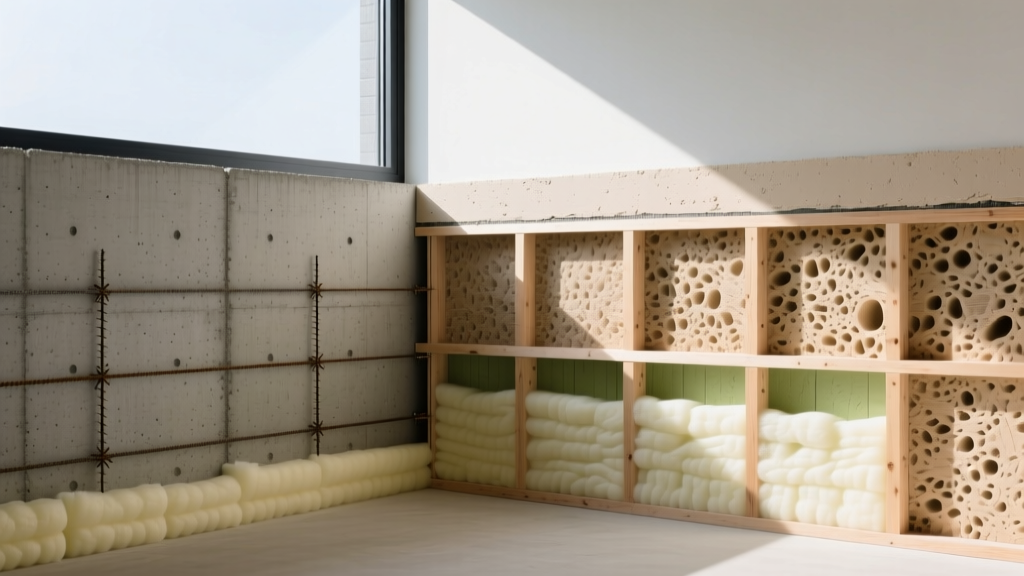
When evaluating concrete vs hempcrete for residential or commercial wall systems, relying on raw material costs per cubic yard leads to severe budget miscalculations. Traditional Portland cement concrete is a structural, load-bearing material that requires formwork, steel rebar, and supplementary insulation to meet modern energy codes. Hempcrete—a bio-composite of hemp hurd, water, and lime binder—is strictly non-structural. It provides exceptional hygrothermal insulation but must be cast around or applied to a separate load-bearing frame (typically timber or light-gauge steel).
Therefore, an accurate 2026 cost analysis cannot compare a cubic yard of ready-mix concrete to a cubic yard of hemp-lime. Builders and developers must compare the whole-wall assembly cost per square foot, factoring in structural framing, thermal resistance, air sealing, labor intensity, and construction loan interest carries dictated by curing times.
2026 Whole-Wall Cost Matrix: ICF Concrete vs. Cast Hempcrete
The following matrix compares an 8-inch Insulated Concrete Form (ICF) wall assembly against a 12-inch cast-in-place hempcrete wall on a timber frame. Pricing reflects 2026 national averages for materials and specialized labor.
| Assembly Component | 8-inch ICF Concrete | 12-inch Cast Hempcrete |
|---|---|---|
| Structural Framing / Formwork | $6.50 / sq ft (ICF blocks act as stay-in-place forms) | $14.00 / sq ft (Engineered timber frame required) |
| Core Fill / Bio-Aggregate Mix | $5.20 / sq ft (Ready-mix + rebar) | $16.50 / sq ft (Hemp hurd + Tradical lime binder) |
| Specialized Installation Labor | $8.00 / sq ft | $18.00 / sq ft (Cast-in-place tamping) |
| Exterior / Interior Finishes | $4.50 / sq ft (Direct stucco / drywall) | $9.50 / sq ft (Lime render / clay plaster required) |
| Total Assembly Cost | $24.20 / sq ft | $58.00 / sq ft |
| Effective R-Value (Whole Wall) | R-23 to R-26 | R-28 to R-32 (Hygrothermal mass adjusted) |
Deconstructing the Hempcrete Premium
Supply Chain and Material Scarcity
While Portland cement is a globally commoditized material with localized batch plants ensuring low transport costs, hempcrete relies on a fragmented agricultural supply chain. The cost of hemp hurd (the woody inner core of the hemp stalk) fluctuates based on regional farming yields and decortication facility capacities. Furthermore, specialized lime binders—such as Tradical PF 70 or St. Astier NHL 3.5—must be formulated specifically to carbonize with the hemp rather than simply hydrate. In 2026, shipping these proprietary binders to non-regional build sites adds $1.50 to $3.00 per square foot in freight surcharges.
Labor Intensity and the Curing Carry
Concrete formwork and pouring are highly mechanized. A standard residential foundation and stem wall can be poured and stripped in under 72 hours. Cast-in-place hempcrete is intensely manual. The mixture must be tamped into temporary forms in 4-to-6-inch lifts to prevent compaction, which would destroy the material's porous insulating structure.
More critically, hempcrete requires extensive drying time. While concrete reaches structural cure in 28 days, a 12-inch hempcrete wall can take 60 to 90 days to dry sufficiently (dropping below 15% moisture content) before lime renders or clay plasters can be applied without trapping moisture. For commercial developers, this 60-day schedule extension increases construction loan interest carries and delays certificate of occupancy, adding thousands in soft costs.
Operational & Lifecycle Cost Offsets
Upfront capital expenditure is only one side of the ledger. According to the U.S. Department of Energy, the integration of high thermal mass materials significantly reduces peak heating and cooling loads. Hempcrete excels in this arena due to its hygrothermal properties. Unlike rigid foam insulation used in ICF concrete, which simply resists heat transfer, hempcrete actively absorbs and releases ambient moisture and heat.
- HVAC Downsizing: A 2,500 sq ft home built with a 12-inch hempcrete envelope typically requires a 1.5 to 2-ton heat pump, whereas an identical code-minimum concrete or wood-frame home requires a 3-ton system. This saves $4,000 to $7,000 in upfront mechanical equipment costs.
- Mold and Moisture Mitigation: Hempcrete's high alkalinity (pH 9-10 from the lime binder) naturally inhibits mold growth and deters pests, eliminating the need for chemical treatments, toxic vapor barriers, and future remediation costs associated with trapped condensation in traditional wall cavities.
- End-of-Life Decommissioning: Concrete demolition and landfill tipping fees average $50 to $120 per ton in 2026. Hempcrete walls can be crushed and composted or used as agricultural soil amendments, reducing demolition costs to near zero.
The Carbon Tax & Incentive Variable
As embodied carbon regulations tighten globally, the financial gap between concrete and hempcrete narrows. Traditional concrete production is responsible for roughly 8% of global CO2 emissions. While the Portland Cement Association notes that modern mixes utilizing Supplementary Cementitious Materials (SCMs) like fly ash or slag can reduce this footprint by 30%, concrete remains a net carbon emitter.
Hempcrete is definitively carbon-negative. The hemp plant sequesters CO2 during its rapid 100-day growth cycle, and the lime binder continues to absorb CO2 as it carbonizes over the lifespan of the building. In jurisdictions enforcing Buy Clean procurement policies or offering LEED v5 carbon credits, the documented sequestration of a hempcrete envelope can yield direct tax rebates or expedited permitting, effectively subsidizing the initial material premium.
Decision Framework: Budget Allocation Strategy
Use the following framework to determine which material aligns with your project's financial and structural realities:
Choose ICF Concrete When:
- The site is in a high-wind, hurricane, or tornado corridor requiring extreme impact and shear resistance.
- The project involves below-grade foundation walls or retaining walls where constant soil moisture contact is guaranteed.
- You require rapid enclosure to secure interior trades and minimize construction loan interest.
- Local labor markets lack specialized bio-material contractors.
Choose Hempcrete When:
- The project targets net-zero carbon certification, Passive House standards, or strict embodied carbon caps.
- The design utilizes an exposed timber frame aesthetic where the bio-composite can be cast as infill.
- The climate features high humidity swings, leveraging hempcrete's moisture-buffering capacity to eliminate mechanical dehumidification.
- The budget allows for a 130%+ premium on the wall assembly, offset by long-term operational savings and potential carbon incentives.
Summary Verdict
If the primary constraint is initial capital outlay and structural simplicity, poured concrete or ICF remains the undisputed economic choice in 2026. However, if the project scope encompasses whole-building lifecycle analysis, indoor air quality, and carbon compliance, hempcrete transitions from an expensive niche alternative to a strategically viable investment that pays dividends through mechanical downsizing, energy resilience, and regulatory incentives.
Written by
Priya KapoorPriya Kapoor is a real estate market analyst and construction economics researcher with expertise in housing affordability, development feasibility, and infrastructure investment. She holds a Master of Regional Planning from Cornell University and previously worked as a senior analyst at CBRE's Investment Properties group, where she modeled returns for $4B in mixed-use development pipelines. Priya now runs an independent research practice advising developers, municipalities, and REITs on construction cost forecasting and market timing. She publishes the quarterly "BuildMat Market Pulse" report tracking material price indices across 12 commodity categories. Based in Austin, TX, Priya serves on the board of Habitat for Humanity Austin and is a marathon runner.
More from Priya Kapoor
View all
Construction Cost
Cost to Build a 1600 Sq Ft Home in 2026: Full Breakdown
Accurate 2026 cost to build a 1600 sq ft home—material, labor, and regional pricing breakdowns included. Plan your budget with real-time estimates.
Aug 11, 2026

Wood & Lumber
Name the Types of Wood for Pressure Treatment and Preservation
Learn how to name the types of wood best suited for pressure treatment. Compare species treatability, chemical retention levels, and 2026 preservation costs.
Aug 4, 2026

Stone & Masonry
Stone Veneer Suppliers Lindenhurst: 2026 Cost Analysis
Analyze 2026 stone veneer costs in Lindenhurst, NY. Compare local supplier pricing, delivery fees, and Suffolk County installation labor rates.
Aug 4, 2026