Chiggers vs Concrete Mites: Identification and Perimeter Control
Identify chiggers vs concrete mites around patios. Compare chemical, physical, and hardscape alternatives to protect concrete and prevent bites.
The Perimeter Pest Problem: Chiggers vs Concrete Mites
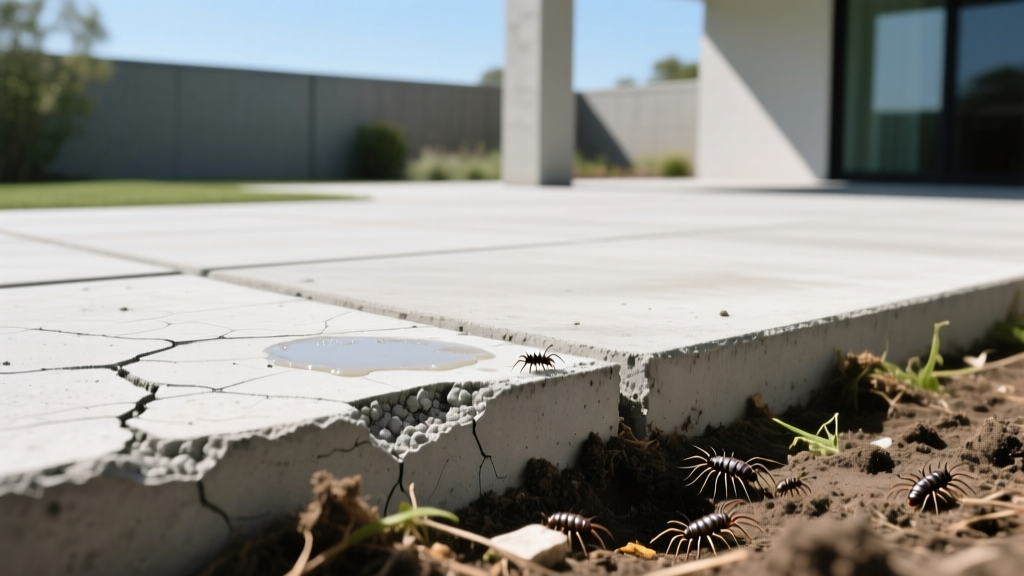
Homeowners and contractors frequently encounter swarms of microscopic red arachnids around concrete patios, driveway edges, and retaining walls. When bites occur or red stains appear on the pavement, the culprit is often misidentified. Understanding the biological and behavioral differences between chiggers and so-called 'concrete mites' is critical for selecting the correct perimeter defense strategy. Treating a concrete slab for the wrong pest leads to wasted chemical applications, unresolved staining, and continued human exposure to biting larvae.
Chiggers (Trombiculidae): The Soil Dwellers
Chiggers are the larval stage of trombiculid mites. They do not live on concrete. Instead, they thrive in the high-humidity microclimates of soil thatch, grass, and brush immediately adjacent to concrete edges. Measuring only 0.3mm, chigger larvae wait on the tips of grass blades near the patio perimeter. When a human walks past, they attach to the skin and inject digestive enzymes that liquefy tissue, causing intense pruritic dermatitis. According to the Centers for Disease Control and Prevention, chiggers do not burrow into the skin or drink blood; the severe itching is an allergic reaction to the stylostome (a feeding tube) formed in the skin. They are a biological hazard, not a structural one.
'Concrete Mites' (Clover Mites & Balaustium): The Pavement Swarmers
The term 'concrete mite' is a colloquial misnomer usually referring to Clover Mites (Bryobia praetiosa) or Balaustium mites. Clover mites are slightly larger (0.75mm) and possess distinctly elongated front legs. They do not bite humans or pets. Instead, they swarm across sun-warmed concrete surfaces—particularly on south- and west-facing exposures—during early spring and late autumn. While harmless to humans, clover mites pose a unique aesthetic threat to concrete. Their hemolymph contains a dense red pigment that leaves severe, rust-colored stains when the mites are crushed on porous, unsealed Portland cement matrices. The UC Agriculture and Natural Resources integrated pest management program notes that these mites often migrate from adjacent lawns onto concrete foundations seeking overwintering sites or moisture.
Identification Matrix: Bites, Swarms, and Concrete Impact
Use the following diagnostic matrix to determine which pest is occupying your concrete perimeter before selecting a mitigation alternative.
| Feature | Chiggers (Trombiculidae) | Clover Mites (Concrete Mites) |
|---|---|---|
| Primary Location | Soil thatch, grass edges, brush | On the concrete surface, foundation walls |
| Human Impact | Severe itching, red welts, dermatitis | None (do not bite humans) |
| Concrete Impact | None | Red staining when crushed on porous slabs |
| Peak Activity | Summer (high humidity, 77-86°F) | Spring and Autumn (cooler temperatures) |
| Visual Identification | 0.3mm, six-legged larvae, bright red | 0.75mm, eight-legged, elongated front legs |
Comparing Mitigation Alternatives for Concrete Perimeters
Managing the interface between a concrete slab and the surrounding landscape requires comparing alternative approaches. Relying solely on broad-spectrum pesticides is often ineffective against mite staining and environmentally taxing. Below is a comparison of three primary perimeter defense alternatives.
Alternative 1: Chemical Perimeter Barriers
Best for: Active chigger infestations in adjacent lawns.
Application: Liquid bifenthrin (7.9% suspension concentrate, such as Talstar P) applied at a rate of 1 oz per gallon of water. The spray must cover a 2-foot vertical band up the concrete foundation and a 3-foot horizontal band outward into the soil.
Pros: Highly effective at killing chigger larvae on contact; provides up to 90 days of residual control in the soil thatch.
Cons: Does not prevent clover mites from physically walking onto the concrete and being crushed; requires repeated application; toxic to aquatic environments if runoff reaches drainage systems.
Alternative 2: Physical Concrete Sealing (Silane/Siloxane)
Best for: Preventing clover mite stains and facilitating easy wash-off.
Application: Penetrating silane/siloxane sealers (e.g., Armor SX5000 WB) applied via low-pressure HVLP sprayer. These sealers penetrate up to 4mm into the concrete capillaries and react chemically to form a hydrophobic resin barrier.
Pros: Permanently alters the surface tension of the concrete, preventing mite hemolymph from absorbing into the pores; makes routine pressure washing highly effective; lasts 5 to 7 years.
Cons: Does not kill or repel pests; higher upfront material cost (approximately $150 per 5-gallon bucket, covering ~1,250 sq ft).
Alternative 3: Hardscape Buffer Zones (Design Alternative)
Best for: Long-term, zero-maintenance elimination of both pests at the slab edge.
Application: Excavating a 12-inch to 18-inch trench along the concrete perimeter and filling it with 3/4-inch crushed granite or river rock over a woven geotextile fabric.
Pros: Completely eliminates the high-humidity thatch layer required for chigger survival; removes the grassy migration path for clover mites; improves drainage away from the concrete slab.
Cons: High initial labor and material cost; requires occasional weeding or pre-emergent herbicide application to keep the rock bed clear of organic debris.

Concrete Stain Removal Protocol for Clover Mites
If clover mites have already stained an unsealed concrete patio, standard cleaning methods will often worsen the damage. Follow this specific protocol to extract the pigment:
- Dry Vacuum: Use a shop vac to remove all live and dead mites from the surface before introducing water. Crushing them with a broom will release more pigment.
- Alkaline Pre-Soak: Apply an alkaline cleaner, such as Trisodium Phosphate (TSP) mixed at 2 oz per gallon of warm water, or a specialized heavy-duty concrete degreaser. Allow it to dwell for 15 minutes without drying.
- Agitation: Scrub the stained area with a stiff-bristled synthetic brush to loosen the pigment from the concrete pores.
- Hot Water Extraction: Pressure wash the surface using a minimum of 2,500 PSI with hot water (180°F if available) to flush the emulsified pigment out of the capillaries.
Decision Framework: Which Strategy to Choose?
Select your perimeter management strategy based on the specific symptoms observed at your concrete installation:
- Scenario A: Humans are experiencing bites near the patio, but no bugs are visible on the concrete itself.
Action: You have a chigger problem in the adjacent lawn. Implement Alternative 1 (Chemical Barrier) targeting the soil edge, and consider Alternative 3 (Hardscape Buffer) for a permanent fix. - Scenario B: Concrete is covered in red bugs, but no one is getting bitten, and the slab is showing red stains.
Action: You have a clover mite swarm. Do not waste money on heavy soil pesticides. Implement the Stain Removal Protocol, followed by Alternative 2 (Silane Sealer) to protect the concrete from future staining. - Scenario C: Both biting and staining are occurring simultaneously.
Action: Implement a combined approach. Apply a targeted bifenthrin spray to the soil thatch for chiggers, and apply a silane/siloxane sealer to the concrete surface to mitigate clover mite staining.
By accurately distinguishing between the biting larvae in the soil and the staining swarmers on the pavement, property owners can deploy targeted, cost-effective alternatives that protect both human health and the structural aesthetics of their concrete investments.
Written by
James ThorntonJames Thornton is a construction industry veteran with 25 years of hands-on experience in wood framing, lumber grading, and residential building codes. He started as a framing carpenter in rural Oregon, earned his ICC Residential Building Inspector certification, and eventually became a senior plan reviewer for the City of Portland Bureau of Development Services. James holds a B.S. in Wood Science & Technology from Oregon State University and is a certified lumber grader through the West Coast Lumber Inspection Bureau (WCLIB). He has inspected over 3,000 residential construction sites and authored the city's internal guide on advanced framing techniques (2x6 at 24" O.C.). James lives in Bend, OR, where he builds custom timber-frame cabins and competes in lumberjack sports.
More from James Thornton
View all
Insulation
Best Home Insulation Materials: Complete 2026 Guide
Compare top home insulation materials for 2026. Find R-values, installed costs per square foot, and best uses for fiberglass, spray foam, and mineral wool.
Aug 4, 2026

Sustainable Building
Certify Your Green Building Material for LEED and WELL
Step-by-step guide to certifying a green building material for LEED v5 and WELL v2. Master EPDs, HPDs, and VOC limits for 2026 project specifications.
Aug 4, 2026

Stone & Masonry
Veneer Stacked Stone Panels: Interior Design & Style Showcase
Discover how veneer stacked stone panels transform interiors. Explore modern design profiles, material pairings, and technical installation specs.
Aug 4, 2026