Cost of Concrete vs Asphalt Driveways: 2026 Paving Guide
Compare the 2026 cost of concrete vs asphalt for driveways and parking lots. Includes installation pricing, lifespan, and hidden maintenance expenses.
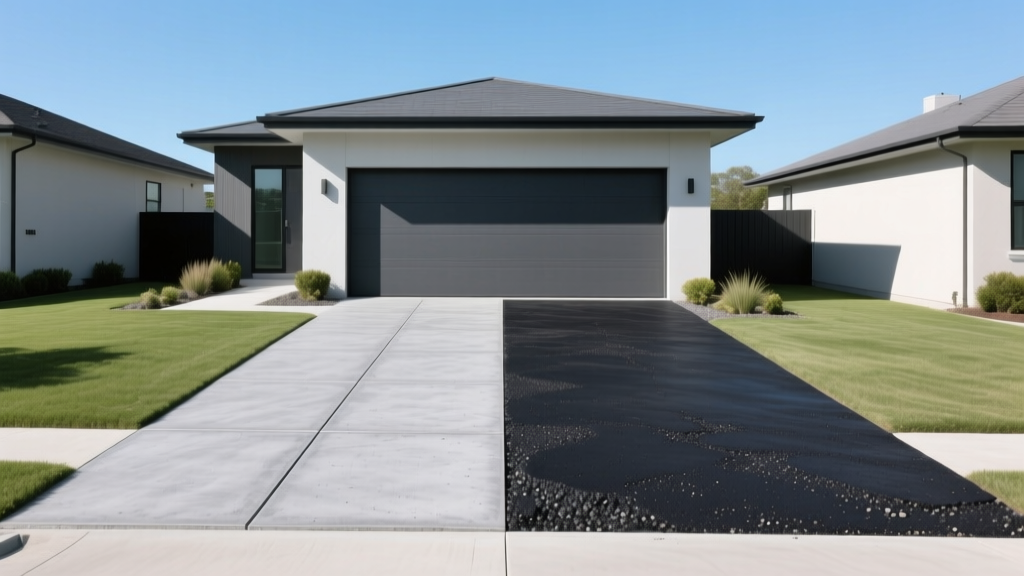
The 2026 Paving Landscape: Upfront vs. Lifetime Costs
Choosing between concrete and asphalt requires looking past the initial contractor quote. In 2026, material volatility and regional labor shortages have shifted the pricing dynamics for both surfaces. While asphalt remains the lower-cost entry point, concrete’s extended lifespan and reduced maintenance intervals often yield a lower total cost of ownership over a 40-year horizon. The American Concrete Institute (ACI) emphasizes that proper subgrade preparation and mix design are the true determinants of pavement longevity, regardless of the surface material chosen.
Below is the 2026 national average cost breakdown for a standard 600-square-foot residential driveway or small commercial pad, assuming a stable, well-draining subgrade.
| Cost Metric (Per Sq. Ft.) | Concrete (4,000 PSI, Broom Finish) | Asphalt (2-Inch Surface Course) |
|---|---|---|
| Subgrade Prep & Base Aggregate | $2.50 - $4.00 | $1.50 - $2.50 |
| Material & Installation | $6.00 - $9.50 | $3.00 - $5.50 |
| Total Initial Cost (600 sq ft) | $5,100 - $8,100 | $2,700 - $4,800 |
| Required Maintenance (Years 1-20) | $600 - $900 (Sealing & Joint Caulking) | $1,800 - $2,500 (Sealcoating & Patching) |
| Expected Lifespan | 30 - 50 Years | 15 - 25 Years |
Application Showcase: Where Each Material Wins
Pavement performance is highly dependent on the specific application. A material that excels in a shaded pedestrian walkway may fail prematurely under the static load of a commercial dumpster.
Residential Driveways: The Curb Appeal & RV Factor
For standard passenger vehicles, both materials perform adequately. However, if you park an RV, boat, or heavy truck on your driveway, concrete is the mandatory choice. Asphalt relies on a bituminous binder that softens at high temperatures. During peak summer months, surface temperatures on dark asphalt can exceed 140°F. Under the concentrated point-loads of RV tires or trailer jack stands, asphalt will rut and permanently deform. Concrete, maintaining structural rigidity up to 400°F, suffers no thermal deformation. Furthermore, concrete offers superior reflectance (albedo), reducing the urban heat island effect and keeping adjacent landscaping cooler.
Commercial Loading Docks & Logistics Yards
In commercial applications where time-to-service is critical, asphalt dominates. A newly paved asphalt loading dock can bear heavy forklift and semi-truck traffic within 24 to 48 hours of compaction. Concrete, conversely, requires a minimum of 7 days to reach sufficient compressive strength (typically 3,000 PSI) for heavy vehicular traffic, and 28 days to reach its full design strength of 4,000 to 5,000 PSI. For logistics facilities that cannot afford week-long operational downtimes, asphalt’s rapid cure time offsets its higher long-term maintenance costs.
Municipal Walkways and Recreational Paths
For pedestrian paths, concrete is the superior application. Asphalt requires a heavy roller for proper compaction, making it difficult to maneuver in tight, winding park trails or narrow urban sidewalks. Concrete can be formed and poured in complex geometries, curved radii, and tight corners. Additionally, concrete’s lighter color provides better nighttime visibility for pedestrians and reduces the heat radiating upward to park-goers during summer months.
Hidden Costs and Failure Modes
Contractor quotes frequently omit site-specific variables that drastically alter the final invoice. Understanding these failure modes prevents costly change orders.
If your site features expansive clay, the subgrade preparation cost will double. Clay swells when wet and shrinks when dry, causing severe differential settlement. For concrete, contractors must excavate 8 to 12 inches and replace it with a compacted crushed stone base to prevent slab cracking. For asphalt, a thick geogrid reinforcement layer is required beneath the aggregate base to prevent alligator cracking. Budget an additional $2.00 to $3.50 per square foot for soil remediation.
In freeze-thaw climates, the chemicals you use to melt ice dictate your pavement's lifespan. Magnesium chloride and calcium chloride aggressively attack concrete's calcium silicate hydrate matrix, causing surface scaling and spalling within three winters. Asphalt is immune to chemical de-icers but becomes brittle in extreme cold, leading to transverse thermal cracking. If using concrete in northern climates, mandate an air-entrained mix (5% to 7% microscopic air bubbles) per Federal Highway Administration guidelines, and use plain sand or calcium magnesium acetate (CMA) for traction.
Edge Confinement and Raveling
Asphalt requires lateral confinement. Without concrete curbs, steel edging, or deeply compacted shoulder backfill, the outer 6 inches of an asphalt driveway will crumble and ravel under vehicle tires. Concrete is a monolithic slab and does not require edge confinement to maintain its structural integrity, though thickened edge turns (dropping the perimeter thickness from 4 inches to 6 inches) are recommended to prevent corner snapping.
Decision Matrix: Choose Your Paving Material
Use this framework to select the correct material based on your specific project parameters.
Select Concrete If:
- Budget Horizon: You plan to stay in the property for 15+ years and want to minimize lifetime maintenance.
- Load Profile: The surface will support heavy static loads (RVs, dumpsters, boat trailers) during high-heat months.
- Aesthetics: You require decorative finishes (stamped, exposed aggregate, or integral color) to match architectural elements.
- Climate: You live in a region with extreme summer heat where asphalt rutting is a documented issue.
Select Asphalt If:
- Budget Horizon: You need the lowest possible upfront capital expenditure and plan to sell the property within 5 to 10 years.
- Timeline: The paved area must be opened to heavy traffic within 48 hours of installation.
- Climate: You reside in a region with severe, prolonged winters where asphalt's flexibility better withstands deep freeze-thaw cycles without rigid snapping.
- Repairs: You anticipate frequent utility trenching or subsurface plumbing repairs; asphalt can be cleanly saw-cut, patched, and blended, whereas concrete patches are permanently visible.
Environmental and Resurfacing Realities
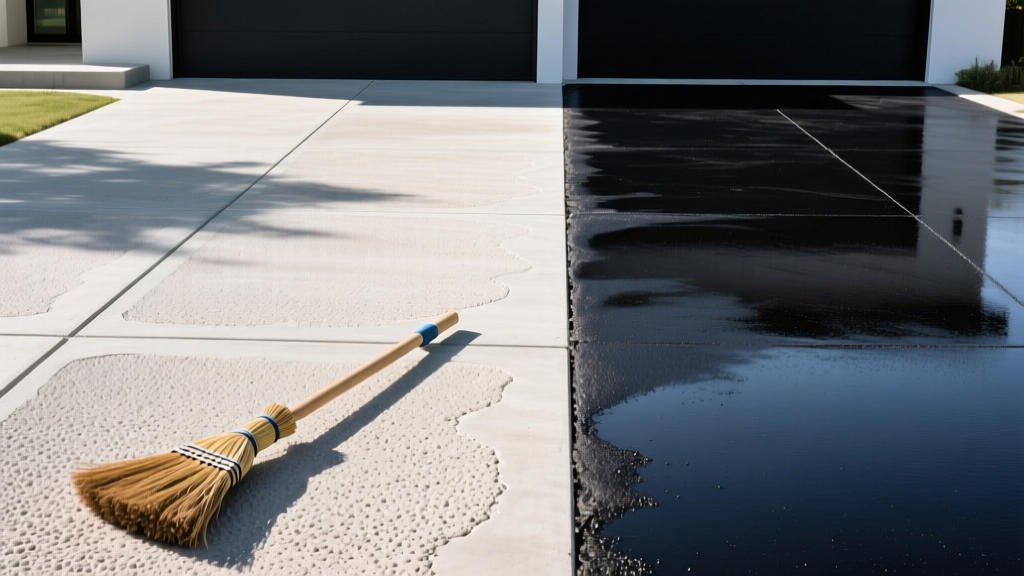
End-of-life considerations are increasingly influencing paving decisions. The Asphalt Pavement Alliance highlights that asphalt is the most recycled material in the United States. When an asphalt driveway reaches the end of its life, it can be milled and 100% reused as Reclaimed Asphalt Pavement (RAP) in new mixes, often reducing the cost of future repaving.
Concrete, while not easily re-melted, is highly recyclable as a base aggregate. Crushed concrete (RCA) is routinely used as a sub-base for new highway construction. However, removing an existing concrete driveway requires heavy machinery (skid steers with hydraulic breakers) and incurs high dump fees due to the material's extreme weight, adding $800 to $1,500 to the demolition phase of a replacement project. Asphalt removal is significantly lighter and cheaper to haul.
Ultimately, the cost of concrete vs asphalt is not a simple comparison of square-foot pricing. It is a calculation of load requirements, climate constraints, and ownership duration. Specify a 4,000 PSI air-entrained concrete mix with #4 rebar for heavy-duty residential applications, or a PG 64-22 asphalt binder over a 6-inch aggregate base for rapid-deployment commercial pads.
Written by
James ThorntonJames Thornton is a construction industry veteran with 25 years of hands-on experience in wood framing, lumber grading, and residential building codes. He started as a framing carpenter in rural Oregon, earned his ICC Residential Building Inspector certification, and eventually became a senior plan reviewer for the City of Portland Bureau of Development Services. James holds a B.S. in Wood Science & Technology from Oregon State University and is a certified lumber grader through the West Coast Lumber Inspection Bureau (WCLIB). He has inspected over 3,000 residential construction sites and authored the city's internal guide on advanced framing techniques (2x6 at 24" O.C.). James lives in Bend, OR, where he builds custom timber-frame cabins and competes in lumberjack sports.
More from James Thornton
View all
Insulation
Best Home Insulation Materials: Complete 2026 Guide
Compare top home insulation materials for 2026. Find R-values, installed costs per square foot, and best uses for fiberglass, spray foam, and mineral wool.
Aug 4, 2026

Sustainable Building
Certify Your Green Building Material for LEED and WELL
Step-by-step guide to certifying a green building material for LEED v5 and WELL v2. Master EPDs, HPDs, and VOC limits for 2026 project specifications.
Aug 4, 2026

Stone & Masonry
Veneer Stacked Stone Panels: Interior Design & Style Showcase
Discover how veneer stacked stone panels transform interiors. Explore modern design profiles, material pairings, and technical installation specs.
Aug 4, 2026