Pouring Procedures for a Carolina Concrete Ready Mix Plant Delivery
Master site prep, mix ordering, and pouring procedures for concrete from a Carolina concrete ready mix plant in high-humidity and clay-soil conditions.
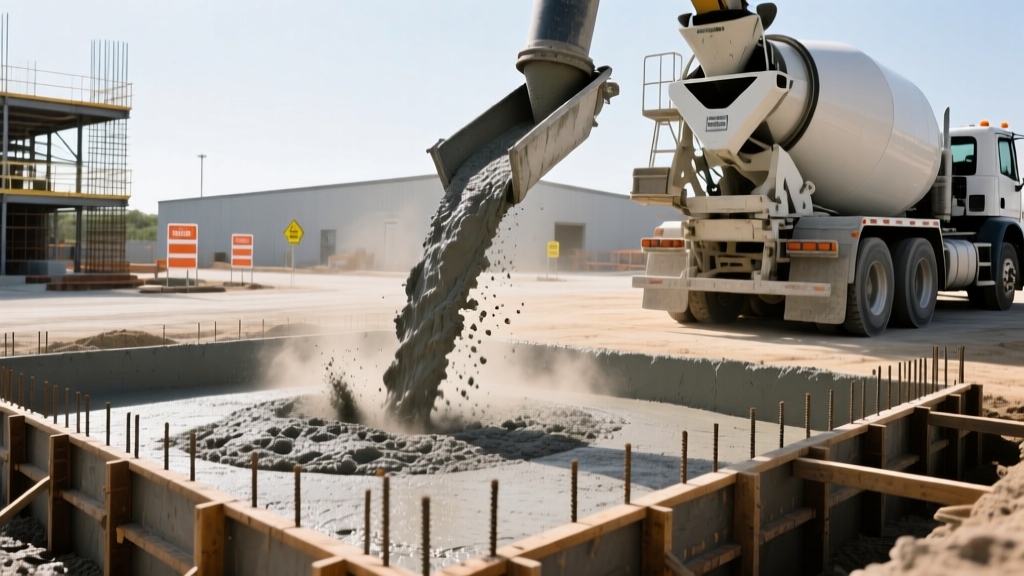
The Carolina Challenge: Climate, Clay, and Concrete
Coordinating a slab pour in the Carolinas requires navigating a unique intersection of environmental variables. High summer humidity, sudden afternoon convective thunderstorms, and highly reactive soils dictate how you must handle ready-mix concrete. When sourcing from a local Carolina concrete ready mix plant, the aggregates are typically regionally mined—often featuring crushed granite or river sand—which influences the mix's water demand and finishing characteristics. Understanding these localized material traits is the first step in executing a flawless placement.
Subgrade Preparation for Expansive Piedmont Soils
The Piedmont region of North and South Carolina is dominated by expansive red clay (Cecil and Pacolet soil series). These soils swell significantly when wet and shrink during droughts, exerting uplift pressures that can easily crack a standard 4-inch residential slab. Proper subgrade preparation is non-negotiable.
Stabilization and Base Course Protocols
- Over-Excavation: Remove 6 to 8 inches of native topsoil and expansive clay down to a stable subgrade.
- Lime Stabilization (If required): For highly plastic clays (Plasticity Index > 25), till in Type S hydrated lime at a rate of 4% to 6% by dry soil weight. Moisture-condition and compact to lock the clay particles.
- Aggregate Base Course (ABC): Install a minimum 4-inch layer of crushed stone (typically #57 or #78 granite sourced from local Carolina quarries). Compact to 95% Standard Proctor density (ASTM D698) using a vibratory plate compactor in 2-inch lifts.
- Vapor Barrier: Lay a 15-mil polyethylene vapor retarder (ASTM E1745) directly over the compacted base before setting forms. This prevents the dry concrete from sucking moisture out of the clay and stops soil gases from migrating into the slab.
Ordering the Right Mix Design from Your Carolina Plant
Ready-mix plants in the Carolinas adjust their batch designs based on seasonal temperature shifts and local aggregate moisture content. When calling in your ticket, you must specify the exact application and environmental conditions. According to the Portland Cement Association, tailoring the mix design to the specific exposure class is critical for long-term durability.
| Mix Application | Target PSI (28-Day) | Slump Range | Required Admixtures & Additions |
|---|---|---|---|
| Interior Slab-on-Grade | 3,000 psi | 4.0 - 5.0 in. | Mid-Range Water Reducer (MRWR), 15% Fly Ash (Class F) |
| Exterior Driveway / Patio | 4,000 psi | 4.0 - 5.0 in. | Air Entrainment (5-7%), MRWR, 6.0 in. max aggregate |
| Coastal Plain Foundation | 4,500 psi | 5.0 - 6.0 in. | Type II/V Cement or 50% Slag Cement (sulfate resistance) |
| Summer Pump Mix (July/Aug) | 4,000 psi | 5.5 - 6.5 in. | Retarder (ASTM C494 Type B), HRWRA, pumpability enhancer |
Note: For coastal plain builds (e.g., Wilmington, Charleston, Myrtle Beach), the high sulfate content in the groundwater requires sulfate-resistant cementitious materials to prevent thaumasite formation and concrete degradation.
Managing the Delivery and 90-Minute Discharge Window
Transit times from a Carolina concrete ready mix plant to your job site can be unpredictable, especially along congested corridors like I-85 or I-26. Under ASTM C94 specifications, concrete must be discharged within 90 minutes of batching, or before the drum has completed 300 revolutions. In high-heat summer conditions, this window shrinks rapidly.
Step-by-Step Discharge Protocol
- Verify the Ticket: Check the batch time, design mix ID, and slump against your order before the truck begins discharging.
- Positioning: Ensure the truck has a stable, level staging area. Carolina red clay turns to grease when wet; lay down steel road plates or crushed stone for the truck's outriggers if using a boom pump.
- Continuous Flow: For slabs larger than 400 square feet, stagger your truck arrivals every 20 to 25 minutes to prevent cold joints. A single plant running standard 9-cubic-yard trucks yields roughly 12 cubic yards every 20 minutes.
Finishing Techniques for High-Humidity Environments
The Carolinas frequently experience ambient humidity levels above 80% during the summer. While high humidity reduces the risk of rapid plastic shrinkage (unlike dry western states), it severely delays the bleeding and setting process. This alters your finishing timeline.
Timing the Float and Trowel
Because the bleed water evaporates slowly in high humidity, attempting to power-trowel the slab too early will trap water beneath the surface crust, leading to blistering, scaling, and a weak top layer. Follow the American Concrete Institute guidelines for hot and humid weather finishing:
- Screeding and Bullfloating: Execute immediately after placement to embed aggregate and seal the surface.
- Wait for Bleed Water: Allow bleed water to rise and fully evaporate. In 85% humidity, this may take 60 to 90 minutes longer than in dry climates.
- The Footprint Test: Step onto the slab. If your footprint is exactly 1/4-inch deep, the concrete is ready for the first power float.
- Hard Troweling: Execute steel troweling only when the surface is hard enough to produce a high-pitched ringing sound under the trowel blade.
Curing Protocols to Prevent Plastic Shrinkage
Even in humid conditions, sudden afternoon Carolina thunderstorms can drop the ambient temperature by 20°F in minutes, altering the evaporation rate and triggering plastic shrinkage cracks. Furthermore, the intense UV index can rapidly dry the surface if wind picks up.
Apply an ASTM C309 compliant membrane-forming curing compound (white-pigmented to reflect solar heat) immediately after final finishing. Alternatively, use continuous wet curing with burlap and soaker hoses for a minimum of 7 days. If wet curing, ensure the water temperature is not more than 20°F cooler than the concrete surface temperature to prevent thermal shock cracking.
Post-Pour Joint Sawing and Protection
Control joints must be saw-cut to a depth of one-quarter the slab thickness (e.g., 1 inch deep for a 4-inch slab). In the humid Carolina summer, the window for early-entry sawing (using dry-cut diamond blades) is typically 2 to 4 hours after placement. Delaying sawing past 12 hours in high-early-strength mixes will result in uncontrolled random cracking as the concrete undergoes initial thermal contraction and drying shrinkage. Protect the freshly poured slab from heavy foot traffic and material staging for a minimum of 48 hours, and restrict heavy vehicle loads for the full 28-day curing cycle.