Cement vs Concrete vs Mortar: Differences and Uses Guide
Master the cement vs concrete vs mortar debate. Explore ASTM mix ratios, PSI strengths, failure modes, and 2026 pricing for your next masonry project.

The Core Distinction: Binder vs. Composite vs. Adhesive
The phrase "cement driveway" is one of the most common misnomers in construction. While the terms cement, concrete, and mortar are frequently used interchangeably by the general public, they represent three entirely distinct materials with unique chemical compositions, structural properties, and building code applications. Confusing them on a job site doesn't just result in terminology errors; it leads to catastrophic structural failures, cracked masonry, and failed foundations.
According to the Portland Cement Association, the simplest way to understand the relationship is through an analogy: cement is to concrete what flour is to cake. Cement is the active binding powder. Concrete is the structural composite material made by combining cement with aggregates. Mortar is a specialized adhesive composite designed specifically to bond masonry units together.
- Cement: The reactive powder (binder). Never used alone.
- Concrete: Cement + Water + Fine Aggregate (Sand) + Coarse Aggregate (Gravel). Used for structural load-bearing.
- Mortar: Cement + Water + Fine Aggregate (Sand) + Hydrated Lime. Used for bonding and sealing masonry.
Portland Cement: The Chemical Activator
Portland cement is not a final building material; it is an ingredient. Manufactured by heating limestone and clay in a kiln to roughly 2,700°F (1,480°C), the resulting "clinker" is ground into a fine powder with a small amount of gypsum to control setting time. When mixed with water, it undergoes hydration—a chemical reaction that forms a rigid crystalline matrix.
ASTM C150 Cement Classifications
Procurement requires specifying the correct ASTM C150 type based on environmental exposure and structural requirements:
| Type | Designation | Primary Application |
|---|---|---|
| Type I | Normal | General construction, sidewalks, standard foundations where no special properties are required. |
| Type II | Moderate Sulfate Resistance | Structures exposed to moderate sulfate soils or groundwater; generates less heat during hydration. |
| Type III | High Early Strength | Cold weather pouring, precast concrete, and projects requiring rapid form removal (finer grind). |
| Type IV | Low Heat of Hydration | Massive structures like dams where heat buildup from curing could cause thermal cracking. |
| Type V | Sulfate Resistant | Severe sulfate environments, such as marine structures or highly alkaline soil foundations. |
Concrete: The Structural Workhorse
Concrete is a composite material designed for high compressive strength. The inclusion of coarse aggregate (typically 3/4-inch crushed stone) creates an interlocking skeletal structure that bears immense loads. The National Ready Mixed Concrete Association notes that modern structural concrete routinely achieves compressive strengths between 3,000 PSI and 5,000 PSI, with high-performance mixes exceeding 10,000 PSI for high-rise columns.
Mix Proportions and the Water-Cement Ratio
The strength of concrete is inversely proportional to the amount of water used. The water-cement (w/c) ratio is the most critical metric in mix design. A standard 4,000 PSI mix typically utilizes a w/c ratio of 0.45. Adding excess water to increase "slump" (workability) permanently weakens the final cure, leading to surface scaling and reduced load capacity.
Never add water to a ready-mix truck drum on-site after the initial batch water has been incorporated. If the concrete is too stiff, use an ASTM C494 compliant mid-range water reducer (plasticizer) instead. Adding 1 gallon of water per cubic yard beyond the design mix can reduce compressive strength by up to 200 PSI.
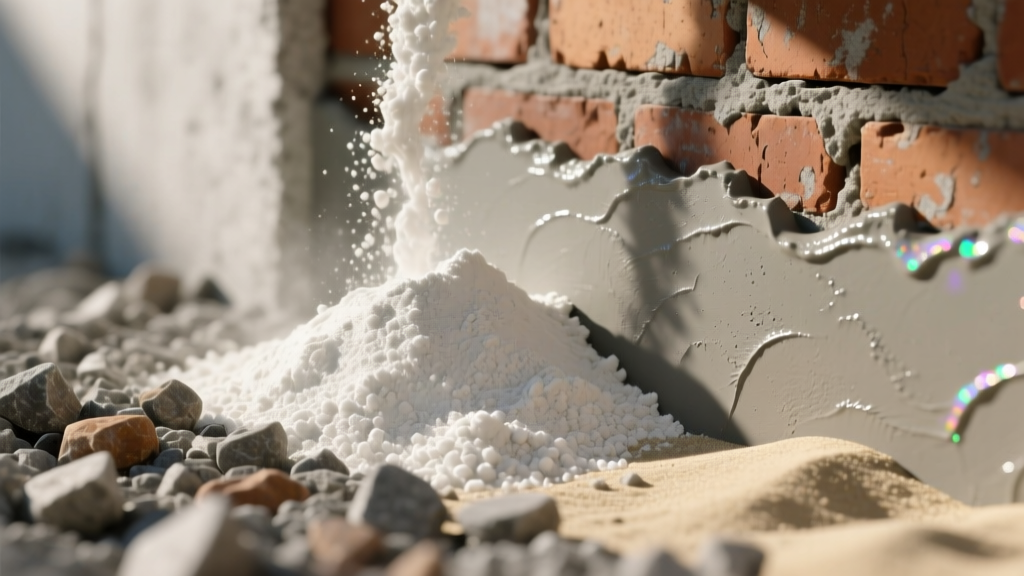
Mortar: The Masonry Adhesive
Unlike concrete, mortar contains no coarse aggregate. It relies on fine masonry sand and, crucially, the addition of hydrated lime (ASTM C207). The lime provides essential workability, water retention, and flexibility. Mortar must be slightly weaker and more permeable than the masonry units (brick or block) it binds. If mortar is harder than the brick, thermal expansion and structural settling will cause the bricks themselves to crack, rather than the sacrificial mortar joints.
ASTM C270 Mortar Types
The International Masonry Institute categorizes mortar into four primary types based on compressive strength and flexibility. Selecting the wrong type is a leading cause of masonry facade failure.
| Mortar Type | Avg. Compressive Strength | Proportion Specification (Cement : Lime : Sand) | Best Use Case |
|---|---|---|---|
| Type M | 2,500 PSI | 3 : 1 : 12 | Below-grade foundations, retaining walls, driveways, and heavy-load bearing masonry. |
| Type S | 1,800 PSI | 2 : 1 : 9 | At or below-grade exterior walls, brick veneers, and structural masonry requiring high bond strength. |
| Type N | 750 PSI | 1 : 1 : 6 | Above-grade exterior walls, chimneys, and soft stone masonry. The standard all-purpose mortar. |
| Type O | 350 PSI | 1 : 2 : 9 | Historic restoration, interior non-load-bearing walls, and tuckpointing soft, antique bricks. |
Real-World Failure Modes: What Happens When You Swap Them?
Substituting these materials on a job site introduces severe failure vectors. Understanding these edge cases prevents costly tear-outs and structural compromises.
- Using Concrete to Lay Brick: Concrete lacks the lime necessary for water retention and board life. It will slump out of the vertical joints, fail to bond to the masonry units, and cure too rigidly. When the wall experiences minor settling or thermal expansion, the rigid concrete will crack the bricks instead of yielding at the joints.
- Using Mortar for a Foundation Footing: Mortar lacks coarse aggregate and has a maximum compressive strength of 2,500 PSI (Type M). A standard residential footing requires a minimum of 2,500 to 3,000 PSI concrete. Under the concentrated point-loads of a structural column, a mortar footing will crush and pulverize, leading to differential settlement and catastrophic structural failure.
- Using Pure Cement as a Surface Topping: Neat cement paste (cement and water only) shrinks massively as it cures. Applied as a floor leveler or surface patch, it will curl, craze, and delaminate within days due to the absence of aggregates to control volumetric shrinkage.
2026 Procurement and Cost Guide
Material costs fluctuate based on regional availability, fuel surcharges for kiln operations, and the integration of Supplementary Cementitious Materials (SCMs) like slag and fly ash to meet modern embodied carbon targets. Below are baseline retail and contractor pricing metrics for standard bagged materials.
Portland Cement
$18.00 - $26.00
Per 94 lb. bag (Type I/II)
Concrete Mix
$6.50 - $8.50
Per 80 lb. bag (4000 PSI)
Mortar Mix
$5.50 - $7.50
Per 60 lb. bag (Type N/S)
Note: For projects exceeding 2 cubic yards, always transition from bagged mixes to ready-mix concrete delivered by transit mixer. The cost per yard drops significantly (typically $140-$180 per yard delivered), and the batch plant guarantees exact w/c ratios and admixture integration that cannot be replicated with bagged goods and a wheelbarrow.
Quick Decision Framework for Site Superintendents
Use this rapid diagnostic tree to specify the correct material for your next scope of work:
- Is the application carrying a structural vertical load or spanning a horizontal gap?
- Yes: Specify Concrete (Minimum 3,000 PSI for flatwork; 4,000+ PSI for structural columns/footings).
- No: Proceed to step 2.
- Are you bonding individual masonry units (brick, CMU block, natural stone) together?
- Yes: Specify Mortar. (Select Type S for below-grade/load-bearing; Type N for above-grade veneers; Type O for historic soft masonry).
- No: Proceed to step 3.
- Are you formulating a custom mix, creating a slurry bond coat, or stabilizing soil?
- Yes: Procure pure Portland Cement and batch it with your own specific aggregates and admixtures according to your engineer's mix design.
Understanding the precise chemical and mechanical boundaries between cement, concrete, and mortar is non-negotiable for durable construction. By specifying materials based on ASTM standards rather than colloquial terminology, contractors eliminate the primary vectors for masonry cracking, foundation settling, and premature concrete spalling.
Written by
Priya KapoorPriya Kapoor is a real estate market analyst and construction economics researcher with expertise in housing affordability, development feasibility, and infrastructure investment. She holds a Master of Regional Planning from Cornell University and previously worked as a senior analyst at CBRE's Investment Properties group, where she modeled returns for $4B in mixed-use development pipelines. Priya now runs an independent research practice advising developers, municipalities, and REITs on construction cost forecasting and market timing. She publishes the quarterly "BuildMat Market Pulse" report tracking material price indices across 12 commodity categories. Based in Austin, TX, Priya serves on the board of Habitat for Humanity Austin and is a marathon runner.
More from Priya Kapoor
View all
Construction Cost
Cost to Build a 1600 Sq Ft Home in 2026: Full Breakdown
Accurate 2026 cost to build a 1600 sq ft home—material, labor, and regional pricing breakdowns included. Plan your budget with real-time estimates.
Aug 11, 2026

Wood & Lumber
Name the Types of Wood for Pressure Treatment and Preservation
Learn how to name the types of wood best suited for pressure treatment. Compare species treatability, chemical retention levels, and 2026 preservation costs.
Aug 4, 2026

Stone & Masonry
Stone Veneer Suppliers Lindenhurst: 2026 Cost Analysis
Analyze 2026 stone veneer costs in Lindenhurst, NY. Compare local supplier pricing, delivery fees, and Suffolk County installation labor rates.
Aug 4, 2026