Cement Glue Taxonomy: Selecting Polymer and Epoxy Concrete Adhesives
Navigate the cement glue taxonomy. Compare polymer, epoxy, and urethane concrete adhesives for structural bonding, overlays, and masonry repairs.
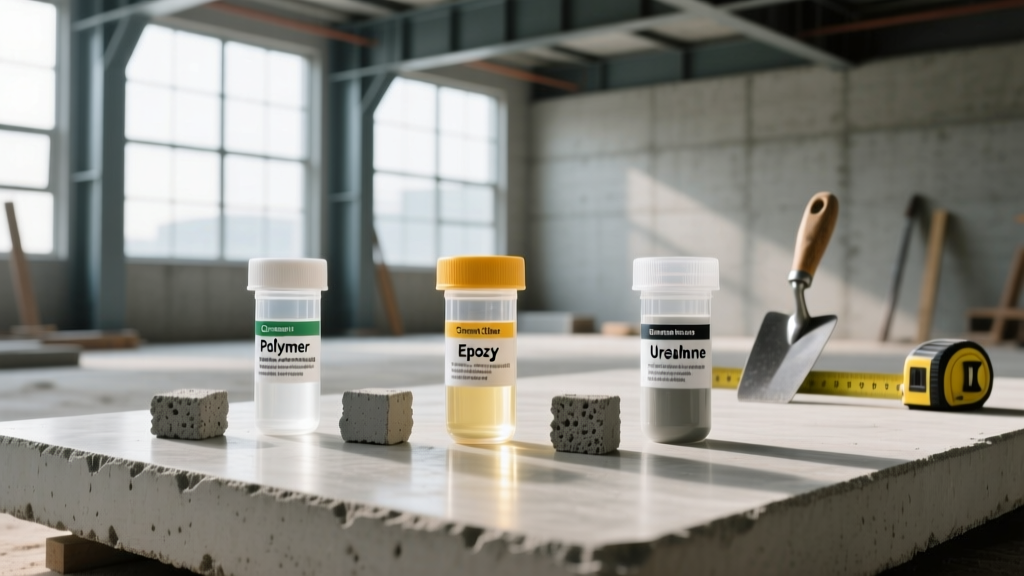
Defining "Cement Glue" in Modern Construction
In professional construction and material science, the colloquial term "cement glue" encompasses a diverse taxonomy of chemical bonding agents, polymer-modified mortars, and structural adhesives designed to bind concrete to concrete, masonry to masonry, or dissimilar overlays to cementitious substrates. Relying on generic construction adhesives for structural concrete repair or heavy-duty overlays leads to catastrophic delamination. Selecting the correct bonding agent requires understanding the chemical mechanisms, substrate preparation standards, and environmental tolerances of each adhesive class.
This guide deconstructs the material taxonomy of concrete bonding agents, providing a framework for contractors and engineers to specify the exact product chemistry required for structural integrity, moisture resistance, and long-term durability in 2026 construction environments.
The Material Taxonomy of Concrete Bonding Agents
Concrete bonding agents are not interchangeable. They are classified by their polymer base, which dictates their tensile strength, alkali resistance, and moisture tolerance. The International Concrete Repair Institute (ICRI) categorizes these materials based on their structural performance and application methodology.
1. Acrylic and Styrene-Butadiene (SBR) Polymers
Acrylic and SBR latex emulsions (e.g., SikaLatex R or Quikrete Concrete Bonding Adhesive) are the most common non-structural bonding agents. They function by forming a continuous, flexible polymer film that bridges the microscopic pores between the old substrate and the new overlay. SBR polymers offer excellent alkali resistance, making them ideal for use directly over fresh Portland cement, which generates high pH levels during hydration. They are typically applied as a liquid primer or mixed directly into the overlay mortar as a fortifier.
2. Polyvinyl Acetate (PVA) Bonding Agents
PVA bonding agents are inexpensive and widely available, but they carry severe limitations. PVA is highly susceptible to re-emulsification when exposed to continuous moisture and breaks down in high-alkalinity environments. Specification Rule: Never specify PVA bonding agents for exterior applications, below-grade structural repairs, or areas subject to hydrostatic pressure. Restrict PVA to interior, non-structural, dry-environment patching.
3. Epoxy-Modified Cementitious Systems
For structural load transfer, doweling, and heavy machinery base plates, two-part epoxy-resin bonding systems are mandatory. Governed by ASTM C881 Standard Specification for Epoxy-Resin-Base Bonding Systems, these adhesives deliver tensile strengths exceeding 2,000 psi. Epoxies are moisture-insensitive during cure and provide a rigid, high-modulus bond that prevents shear slippage under dynamic structural loads. They are available in varying viscosities, from gravity-fed crack injection resins to trowelable structural gels.
4. Polyurethane Concrete Adhesives
Polyurethane adhesives (e.g., Loctite PL Polyurethane) are moisture-curing, elastomeric compounds. Unlike rigid epoxies, polyurethanes maintain flexibility post-cure, accommodating thermal expansion and structural vibration. They are the premier choice for bonding precast concrete panels, securing masonry veneers, and sealing vertical control joints where differential movement is anticipated.
Selection Matrix: Matching Adhesive to Application
Use the following matrix to specify the correct "cement glue" chemistry based on project parameters and 2026 market pricing.
| Adhesive Class | Tensile Strength | Moisture Tolerance | Primary Application | 2026 Avg. Cost |
|---|---|---|---|---|
| SBR / Acrylic Latex | 300 - 600 psi | High (Post-Cure) | Thin overlays, stucco bonding, interior/exterior patching | $35 - $55 / Gallon |
| PVA (Polyvinyl Acetate) | 150 - 300 psi | Very Low (Re-emulsifies) | Interior dry-wall patching, non-structural cosmetic repairs | $15 - $25 / Gallon |
| Epoxy-Resin (ASTM C881) | 2,000 - 4,000 psi | High (Moisture Insensitive) | Structural doweling, column base plates, heavy load transfer | $90 - $140 / Gallon |
| Polyurethane Elastomeric | 400 - 800 psi | High (Moisture-Curing) | Precast panel joints, masonry veneers, vibration zones | $12 - $18 / 10oz Tube |
Substrate Preparation: The ICRI CSP Standard
The most advanced epoxy bonding agent will fail if applied to an improperly profiled substrate. The ICRI utilizes the Concrete Surface Profile (CSP) system, ranging from CSP 1 (smooth) to CSP 9 (heavily roughened). Bonding agents require specific mechanical profiles to achieve micro-mechanical interlock.
- CSP 1 to 3 (Acid Etching / Light Grinding): Suitable for thin acrylic/SBR liquid bonding agents and self-leveling underlayments.
- CSP 3 to 5 (Shot Blasting / Scarifying): Mandatory for structural epoxy adhesives and thick polymer-modified mortars. This profile exposes the coarse aggregate, providing the necessary surface area for epoxy penetration.
- CSP 5 to 9 (Heavy Scarifying / Milling): Reserved for thick structural overlays and heavy-duty industrial traffic toppings.
Always verify the manufacturer's Technical Data Sheet (TDS) for the exact CSP requirement. Applying a high-build epoxy over a CSP 1 substrate guarantees cohesive failure.
Fresh concrete surfaces often develop laitance—a weak, milky layer of cement dust and fine aggregates that rises to the surface during finishing. Laitance has near-zero tensile strength. If a bonding agent is applied over laitance, the adhesive will bond perfectly to the dust, but the dust will detach from the structural slab. Laitance must be removed via mechanical abrasion or high-pressure water blasting prior to adhesive application.
Critical Failure Modes in Concrete Bonding
Understanding why bonds fail is as important as knowing how to create them. Field forensics reveal three primary failure modes in concrete-to-concrete adhesion:
- Hydrostatic Pressure Delamination: Applying non-breathable epoxy or acrylic sealers over below-grade concrete with active hydrostatic pressure traps moisture vapor. The vapor pressure (often exceeding 100 psi) easily overpowers the adhesive's tensile strength, causing blistering and catastrophic delamination. Always perform a Calcium Chloride test (ASTM F1869) or relative humidity probe test (ASTM F2170) before sealing.
- Exothermic Thermal Shock: Thick applications of two-part epoxy generate significant heat during the exothermic curing reaction. If applied in thick lifts (>0.5 inches) in high ambient temperatures, the internal temperature can exceed 200°F, causing the epoxy to become brittle or scorch the surrounding substrate.
- Premature Desiccation: Polymer-modified cementitious bonding mortars require moisture to hydrate the Portland cement component. If applied in direct sunlight or high wind without a curing compound or wet burlap overlay, the mortar flash-dries, halting hydration and resulting in a chalky, friable bond line.
Application Protocol: Structural Concrete-to-Concrete Bonding
For structural repairs utilizing Master Builders Solutions or equivalent structural epoxy systems, adhere to the following protocol:
- Mechanical Profiling: Shot blast the existing substrate to a minimum CSP 4. Remove all dust using industrial HEPA vacuums, followed by an oil-free compressed air blow-down.
- Moisture Verification: Confirm substrate moisture content is below 4% using a Tramex concrete moisture meter. Epoxies are moisture-insensitive, but excess surface water creates a vapor barrier preventing micro-mechanical penetration.
- Primer/Scratch Coat Application: Mix the two-part epoxy and apply a thin, 10-mil scratch coat using a stiff-bristled brush, forcing the resin deep into the substrate pores. Allow it to reach a "tacky" state (typically 45-90 minutes depending on ambient temperature).
- Overlay Placement: Place the new concrete or repair mortar while the epoxy scratch coat is still tacky. If the epoxy has fully cured, it must be mechanically scarified and re-primed to ensure a chemical cross-link.
Yield and Coverage Economics
Accurate material estimation prevents project delays and budget overruns. Coverage rates vary drastically based on substrate porosity and CSP profile.
- Liquid SBR/Acrylic Primers: Yield 200 to 300 square feet per gallon on a dense, trowel-finished slab. On a porous, broom-finished exterior slab, yield drops to 125 square feet per gallon.
- 100% Solids Epoxy Bonding Agents: Yield approximately 160 square feet per gallon at a 10-mil thickness. However, when applied to a CSP 4 shot-blasted surface, the micro-crevices consume up to 30% more material, reducing practical yield to 110 square feet per gallon.
- Polyurethane Tube Adhesives: A standard 10oz tube yields roughly 30 linear feet of adhesive assuming a standard 3/8-inch bead width, sufficient for securing approximately 15 standard concrete masonry units (CMUs) or 12 linear feet of precast coping.
Specifying the correct cement glue taxonomy ensures structural longevity, prevents costly tear-outs, and aligns material performance with the rigorous demands of modern concrete construction.