Crushed Limestone vs Crushed Concrete: Base & Driveway Guide
Compare crushed limestone vs crushed concrete for driveways and base layers. Learn costs, drainage, pH risks, and which aggregate to choose.

Selecting the Right Aggregate: Natural vs. Recycled
Selecting the right aggregate base dictates the lifespan of any driveway, slab, or drainage system. The debate between crushed limestone and crushed concrete—technically known as Recycled Concrete Aggregate (RCA)—centers on a trade-off between geological consistency and economic efficiency. In 2026, with virgin quarrying permits becoming stricter and transport costs rising, RCA has captured significant market share in metropolitan construction. However, substituting natural stone with recycled demolition material introduces specific chemical and structural variables that contractors and homeowners must manage.
- Choose Crushed Limestone if: You are building a French drain, a high-load commercial slab, or a driveway near acid-loving landscaping.
- Choose Crushed Concrete (RCA) if: You are filling deep sub-base voids, building rural access roads, or targeting LEED recycled-content credits on a budget.
Crushed Limestone: The Natural Standard
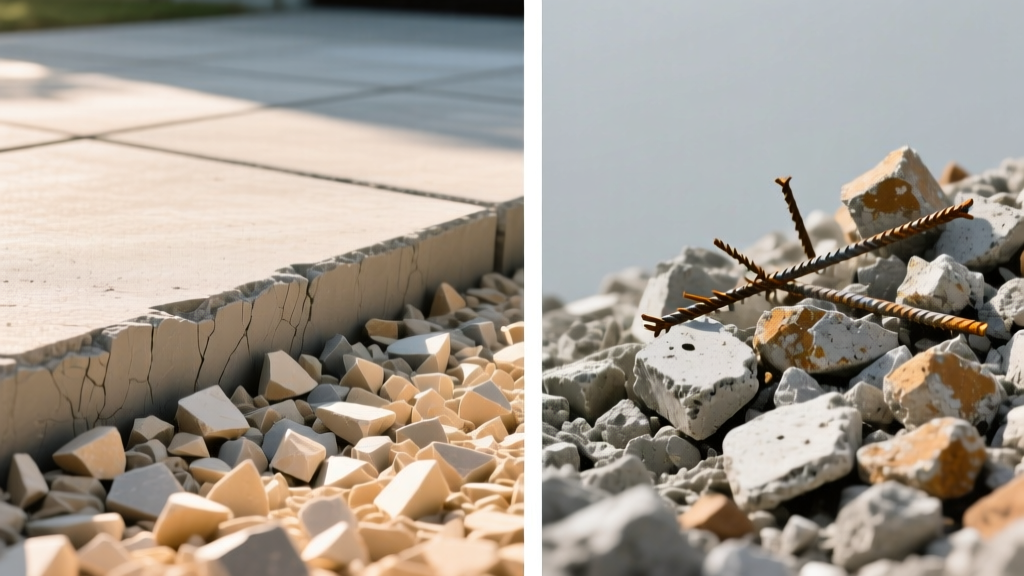
Limestone is a sedimentary rock composed primarily of calcium carbonate. When mechanically crushed, it fractures into highly angular pieces with sharp edges. This angularity is its greatest structural asset; the jagged faces interlock under compaction, creating a dense, nearly impermeable matrix that resists lateral shifting.
Standard Grading and Applications
- #57 Stone (3/4-inch): Washed and free of fines. Used exclusively for drainage applications and as a capillary break beneath concrete slabs.
- 21A / 304 (1-inch down to fines): Contains a precise mix of coarse aggregate and limestone dust. The dust acts as a binder when wetted and compacted, achieving a California Bearing Ratio (CBR) of 80 to 100. This is the premier choice for the top 4 to 6 inches of a driveway base.
Failure Modes and Edge Cases
The primary failure mode for limestone is 'fines migration.' If 21A limestone is used in a high-water-table area without a geotextile fabric separator, the limestone dust will wash out into the subgrade over time, leaving voids that cause surface subsidence. Additionally, limestone is susceptible to chemical weathering in highly acidic soils (pH below 5.5), which can slowly dissolve the aggregate over decades.
Crushed Concrete (RCA): The Recycled Challenger
RCA is produced by crushing demolished concrete structures, screening out rebar, and removing gross contaminants. According to the Federal Highway Administration (FHWA), RCA performs exceptionally well as a subbase material, often matching the structural capacity of virgin aggregate. However, RCA is not just rock; it is rock coated in old, hydrated cement paste.
The Hidden pH and Leaching Problem
This residual cement paste is the most misunderstood aspect of RCA. When exposed to moisture, the old cement reactivates slightly, leaching calcium hydroxide. This creates a highly alkaline environment with a pH frequently between 11 and 12. Real-world impact: If RCA is used as a base for a driveway bordered by acid-loving plants (azaleas, blueberries, hydrangeas), the alkaline runoff will induce severe iron chlorosis, turning the leaves yellow and killing the plants. Furthermore, if used beneath a moisture-sensitive indoor floor without a high-mil poly vapor barrier, the alkaline salts can migrate upward, causing adhesive failure in vinyl and epoxy flooring.
Specific Gravity and Volume Math
Because RCA contains porous old mortar and occasional microscopic air voids, its specific gravity is lower than limestone (approximately 2.4 vs. 2.7). This means RCA is lighter per cubic yard. To achieve the same 6-inch compacted depth over 1,000 square feet, you will need to purchase roughly 10% to 12% more volume of RCA than limestone. This volumetric requirement partially offsets the lower per-ton price of recycled material.
Head-to-Head Performance Matrix
| Feature | Crushed Limestone | Crushed Concrete (RCA) |
|---|---|---|
| Cost per Ton (2026 Avg) | $28 - $45 | $16 - $28 |
| Specific Gravity | 2.6 - 2.8 | 2.3 - 2.5 |
| Drainage (Washed #57) | Excellent | Poor (fines clog) |
| Leachate pH Level | 7.5 - 8.5 (Neutral/Mild) | 11.0 - 12.5 (Highly Alkaline) |
| Compaction Lock | Superior (Angular fractures) | Moderate (Rounded original river rock) |
Application-Specific Protocols
1. Residential Driveways
For a standard residential driveway, the optimal approach is a hybrid system. Use cheaper RCA for the bottom 4 to 8 inches of subbase to build elevation and provide bulk strength. Cap the final 4 inches with 21A crushed limestone. The limestone dust will bind tightly, providing a smooth, impermeable surface that sheds water and prevents the alkaline RCA leachate from reaching the surface or surrounding topsoil.
2. French Drains and Retaining Wall Backfill
Never use RCA in French drains. The Environmental Protection Agency (EPA) notes that C&D materials can contain residual particulates. In a French drain, constant water flow breaks down the old mortar attached to the RCA. This creates a calcium-rich sludge that calcifies inside the perforations of corrugated drain pipes, destroying the drainage system within 3 to 5 years. Always use washed #57 crushed limestone or washed river gravel for subsurface drainage.
3. Concrete Slab Subbases
When pouring a concrete slab, a capillary break is required to prevent ground moisture from wicking into the slab. Washed #57 limestone is the standard. If RCA must be used for cost savings, it must be thoroughly washed (which negates the cost benefit) or sealed beneath a minimum 15-mil polyethylene vapor barrier to prevent the alkaline salts from migrating into the fresh concrete pore water, which can exacerbate Alkali-Silica Reaction (ASR) if the new concrete mix contains reactive aggregates.
Delivery Inspection and Quality Control
When your aggregate delivery arrives, perform a 60-second visual inspection before the truck dumps the load:
- For RCA: Look for 'contaminant flags.' Small snippets of rusted rebar are common and generally harmless, but visible chunks of asphalt, wood, or drywall indicate poor screening at the recycling facility. Asphalt will soften in summer heat and bleed through driveway bases.
- For Limestone: Check for 'clay balls.' Some quarries fail to strip the topsoil layer adequately before blasting. Red or brown clay clumps mixed with the gray limestone will prevent proper compaction and turn to slick mud when wet.
Frequently Asked Questions
Can I lay pavers directly on crushed concrete?
No. The high pH of RCA can cause efflorescence (white, powdery salt deposits) to bloom on the surface of concrete pavers. Always use a 1-inch layer of coarse, washed limestone sand as the bedding layer between the RCA base and the pavers.
Does crushed concrete compact as hard as limestone?
It achieves high density, but it does not 'lock' as rigidly. The original aggregate inside the RCA was often smooth river rock. When the old mortar crushes, you are left with smooth, rounded stones that can roll under heavy, concentrated point-loads (like vehicle jack stands or heavy machinery outriggers).
Written by
Priya KapoorPriya Kapoor is a real estate market analyst and construction economics researcher with expertise in housing affordability, development feasibility, and infrastructure investment. She holds a Master of Regional Planning from Cornell University and previously worked as a senior analyst at CBRE's Investment Properties group, where she modeled returns for $4B in mixed-use development pipelines. Priya now runs an independent research practice advising developers, municipalities, and REITs on construction cost forecasting and market timing. She publishes the quarterly "BuildMat Market Pulse" report tracking material price indices across 12 commodity categories. Based in Austin, TX, Priya serves on the board of Habitat for Humanity Austin and is a marathon runner.
More from Priya Kapoor
View all
Construction Cost
Cost to Build a 1600 Sq Ft Home in 2026: Full Breakdown
Accurate 2026 cost to build a 1600 sq ft home—material, labor, and regional pricing breakdowns included. Plan your budget with real-time estimates.
Aug 11, 2026

Wood & Lumber
Name the Types of Wood for Pressure Treatment and Preservation
Learn how to name the types of wood best suited for pressure treatment. Compare species treatability, chemical retention levels, and 2026 preservation costs.
Aug 4, 2026

Stone & Masonry
Stone Veneer Suppliers Lindenhurst: 2026 Cost Analysis
Analyze 2026 stone veneer costs in Lindenhurst, NY. Compare local supplier pricing, delivery fees, and Suffolk County installation labor rates.
Aug 4, 2026