Choosing the Right Type of Concrete for Driveway: 2026 Costs
Compare the best type of concrete for driveway projects in 2026. Detailed cost breakdown, PSI requirements, and mix designs for lasting durability.

The Anatomy of a Driveway Mix: PSI, Aggregate, and Slump
Selecting the correct type of concrete for driveway applications requires balancing structural integrity, environmental resistance, and budget. Unlike pedestrian sidewalks or interior basement floors, driveways are subjected to dynamic vehicular loads, concentrated point pressures from tire contact patches, and aggressive de-icing chemicals. Because of these factors, the baseline specification for any residential or light-commercial driveway in 2026 is a 4,000 PSI (pounds per square inch) compressive strength mix.
A standard 3,000 PSI mix, often used for flatwork like patios or walkways, lacks the tensile strength and surface density required to resist the shear forces of turning vehicle tires and the freeze-thaw cycling of winter months. To achieve 4,000 PSI, the batch plant must utilize a low water-to-cement (w/c) ratio, typically between 0.40 and 0.45. This lower water content increases the density of the cement paste, drastically reducing the capillary pore structure that allows water and chloride ions to penetrate the slab.
Aggregate Sizing and Slump Tolerances
The coarse aggregate profile is equally critical. A 3/4-inch crushed stone aggregate is the industry standard for driveways. This size provides an optimal interlocking matrix that resists heavy loads while remaining small enough to be easily finished and edged by concrete contractors. Larger aggregates (such as 1-inch stone) can cause issues during the screeding and troweling phases, leading to surface tearing and uneven finishes.
Slump—the measure of concrete workability—should be strictly maintained between 4 and 5 inches. Contractors frequently request high-slump concrete (6 inches or more) because it flows easily and requires less physical labor to screed. However, achieving a high slump by adding water at the job site dilutes the cement paste, drops the final PSI by hundreds of points, and guarantees surface scaling within three to five years. If higher workability is needed, a mid-range water-reducing admixture (plasticizer) must be used instead of water.
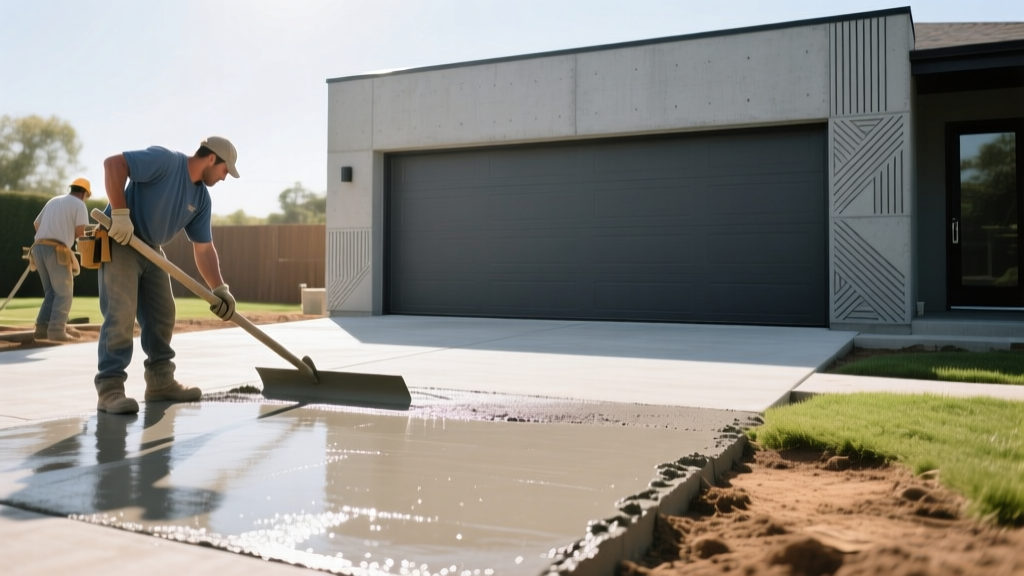
2026 Cost Breakdown by Concrete Type
Material costs for ready-mix concrete have stabilized in 2026 following the supply chain fluctuations of previous years, but regional variations remain significant. The costs below reflect national averages for material delivery and professional installation, assuming a standard 4-inch thick slab with a compacted gravel subgrade.
| Concrete Mix Type | Material Cost (per Cubic Yard) | Installed Cost (per Sq. Ft.) | Best Application |
|---|---|---|---|
| Standard 4,000 PSI (Plain) | $135 - $155 | $8.00 - $11.00 | Mild climates, standard passenger vehicles, tight budgets. |
| Fiber-Reinforced 4,000 PSI | $155 - $180 | $10.00 - $13.50 | Expansive soils, heavy SUVs/trucks, reducing joint spacing. |
| High-Performance (5,000+ PSI) | $180 - $220 | $13.00 - $18.00 | Extreme freeze-thaw zones, heavy RVs, commercial fleet parking. |
| Pervious (Eco-Friendly) | $165 - $195 | $12.00 - $16.50 | Stormwater management zones, eco-conscious developments. |
When calculating total project costs, remember that a standard two-car driveway (approximately 600 square feet) requires roughly 8.5 cubic yards of concrete for a 4-inch pour. At the standard 4,000 PSI rate, the material alone will cost between $1,147 and $1,317, while the total installed cost will range from $4,800 to $6,600.
Hidden Cost Variables: Additives, Finishes, and Logistics
The base price per cubic yard rarely reflects the final batch ticket total. Batch plants charge premiums for specific chemical admixtures and logistical requirements that are mandatory for a durable driveway.
Warning: Air Entrainment is Non-Negotiable in Cold Climates
If your region experiences freezing temperatures, your mix must include an air-entraining admixture (AEA). This creates microscopic, disconnected air bubbles (typically 5% to 7% air content) that give expanding ice a place to swell without cracking the concrete matrix. Skipping AEA to save $8 per cubic yard will result in catastrophic surface spalling and D-cracking within a few winters. For more on freeze-thaw durability, refer to the Portland Cement Association's guidelines on freeze-thaw resistance.
- Air Entrainment: Adds $5 to $12 per cubic yard. Mandatory for any climate where temperatures drop below 32°F.
- Synthetic Fiber Mesh: Adds $15 to $25 per cubic yard. Acts as secondary reinforcement to control plastic shrinkage cracking, though it does not replace structural rebar or wire mesh for load-bearing capacity.
- Accelerators (Calcium Chloride or Non-Chloride): Adds $10 to $20 per cubic yard. Used in cold weather to speed up setting times. Non-chloride accelerators are more expensive but prevent the corrosion of embedded steel rebar.
- Pump Truck Fees: If a ready-mix truck cannot back directly up to the forms, a concrete pump is required. Expect a flat mobilization fee of $800 to $1,200, plus $15 to $25 per cubic yard pumped.
- Short-Load Fees: If your driveway requires less than a full truckload (usually under 8 or 9 cubic yards), batch plants will assess a short-load fee ranging from $150 to $300 to cover the inefficiency of dispatching a partially full truck.
Standard vs. Fiber-Reinforced vs. High-Performance: Decision Matrix
Choosing the right type of concrete for driveway longevity depends heavily on your specific site conditions and usage patterns. Use this decision framework to specify the correct mix to your contractor.
1. Standard 4,000 PSI with Welded Wire Mesh
This is the default choice for 80% of residential driveways. The 4,000 PSI mix handles the compressive loads of daily commuting, while a 6x6 W1.4xW1.4 welded wire mesh (WWM) positioned in the upper third of the slab holds shrinkage cracks tightly together. Choose this if: You live in a temperate climate, have stable, well-draining soil, and primarily park sedans or light crossovers.
2. Fiber-Reinforced 4,000 PSI
Macro-synthetic fibers are dosed directly into the mixer drum at the batch plant. Unlike micro-fibers (which only stop plastic shrinkage), macro-fibers provide structural residual strength and can sometimes eliminate the need for wire mesh, saving labor costs on the job site. Choose this if: Your soil is expansive (heavy clay), you want to reduce the number of saw-cut control joints, or you frequently park heavy diesel trucks or loaded work vans.
3. High-Performance 5,000+ PSI Mix
High-performance concrete (HPC) utilizes supplementary cementitious materials (SCMs) like silica fume or fly ash, combined with high-range water reducers, to achieve extreme density and compressive strength. Choose this if: You are building a driveway for heavy motorhomes (RVs), you live in a severe freeze-thaw climate where heavy magnesium chloride de-icers are used, or you require a highly polished or exposed aggregate finish that demands a dense, abrasion-resistant surface.
Real-World Failure Modes and Prevention
Even the most expensive concrete mix will fail if the subgrade or finishing techniques are flawed. Understanding these common failure modes allows you to audit your contractor's work.
Surface Scaling: The flaking or peeling of the top 1/8-inch of concrete. This is almost always caused by finishing the concrete while bleed water is still on the surface, which traps water and creates a weak, porous top layer. It is also caused by a lack of air entrainment or applying de-icing salts during the first winter before the concrete has fully cured and sealed.
D-Cracking: A series of fine cracks parallel to joints and edges, caused by the freezing and expansion of certain types of porous coarse aggregates (like some limestones or cherts) inside the mix. Prevention requires the batch plant to source high-quality, non-porous, crushed aggregate, which is why specifying a reputable local plant is vital.
Plastic Shrinkage Cracking: Shallow, diagonal cracks that appear within hours of the pour. This occurs when the rate of surface evaporation exceeds the rate of bleed water rising to the surface, typically on hot, windy, or low-humidity days. The application of a liquid evaporation retardant during finishing, or the use of synthetic fiber mesh, mitigates this risk entirely.
Sourcing and Ordering: What to Tell the Batch Plant
When you or your contractor call the local ready-mix dispatcher, vague requests lead to incorrect deliveries. Do not just ask for 'driveway concrete.' Instead, use this exact specification script to ensure you receive the correct type of concrete for driveway durability:
'I need a 4,000 PSI flatwork mix designed for exterior driveway use. Specify 3/4-inch crushed aggregate, a 4-inch slump, and 5.5% to 6.5% air entrainment. Please include a mid-range water-reducer to maintain the low water-cement ratio without sacrificing workability. The target placement is a 4-inch residential slab exposed to freeze-thaw cycling.'
By dictating the exact parameters, you bypass the dispatcher's default 'generic flatwork' mix, which often skimps on air entrainment or relies on excess water for workability. For comprehensive residential flatwork standards, contractors should always reference the American Concrete Institute (ACI) residential concrete guidelines, which outline the precise tolerances for subgrade prep, joint spacing, and curing timelines.
Finally, ensure the contractor applies a high-quality, breathable curing compound or wets the slab continuously for a minimum of 7 days. Proper curing allows the cement to fully hydrate, locking in the 4,000 PSI strength you paid for and ensuring the driveway withstands decades of vehicular traffic and environmental stress.
Written by
Marcus ChenMarcus Chen is a licensed structural engineer (PE) and building materials analyst with over 12 years of experience across residential, commercial, and industrial construction. He holds a Master of Science in Civil Engineering from UC Berkeley and spent six years at Thornton Tomasetti before transitioning to independent consulting and technical writing. Marcus specializes in material selection for seismic-prone regions, concrete reinforcement strategies, and lifecycle cost analysis. His work has been cited by the American Concrete Institute (ACI) and the Structural Engineers Association of California (SEAOC). When he is not on a job site or at his desk, you will find him hiking the Sierra Nevada or restoring a 1920s craftsman bungalow in Oakland, CA.
More from Marcus Chen
View all
Construction Cost
How Much Did the Eiffel Tower Cost to Build?
How much did the Eiffel Tower cost to build in 1889? We adjust for inflation and compare its budget to modern skyscraper construction.
Aug 4, 2026

Fire Resistance
What Is a Fire Resistant Material? Testing & Certification Guide
Discover what is a fire resistant material through ASTM and UL testing. Learn how fire ratings, certifications, and assemblies work in construction.
Aug 4, 2026

Construction Cost
How Much Did the Burj Khalifa Cost to Build?
How much did the Burj Khalifa cost to build? We break down the $1.5B project and extract 5 money-saving strategies for your next build.
Jul 30, 2026