Cement Grinder Cost Calculator: Rental vs Purchase Pricing 2026
Calculate exact cement grinder costs for 2026. Compare rental vs. purchase pricing, diamond tooling wear rates, and OSHA silica compliance overhead.
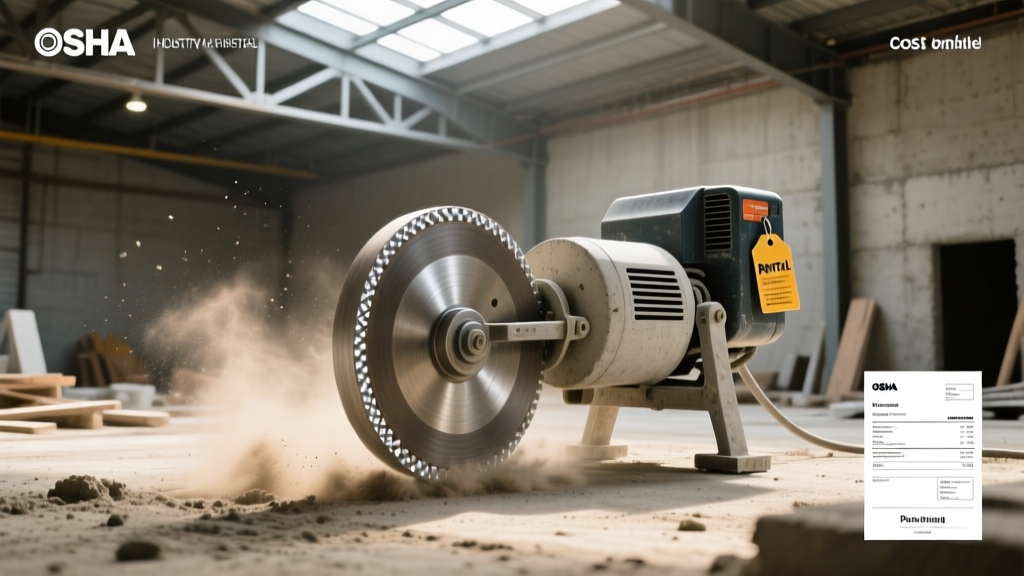
The Economics of Concrete Surface Preparation
Accurately estimating the cost of concrete surface preparation requires looking far beyond the base rental rate of the equipment. A cement grinder is only the engine of the operation; the true financial variables lie in diamond tooling wear rates, silica dust compliance overhead, and labor productivity. Whether you are prepping a 500-square-foot residential garage for epoxy or a 50,000-square-foot commercial warehouse for polished concrete, miscalculating consumable degradation can destroy your profit margins. This guide provides a comprehensive cost estimation framework for cement grinder operations in 2026, breaking down equipment acquisition, tooling economics, and regulatory compliance costs.
Cement Grinder Cost Matrix: Rental vs. Purchase
The decision to rent or buy hinges on your annual square-footage volume and equipment utilization rate. The table below outlines current 2026 market pricing for standard planetary grinders across different production classes.
| Equipment Class | Industry Standard Model | Daily Rental Rate | Purchase Price | Break-Even Point |
|---|---|---|---|---|
| Handheld 5-Inch | Bosch 1773AK / Makita 9565 | $45 - $65 | $220 - $350 | 5 - 7 Days |
| Walk-Behind 20-Inch | Lavina 20X / Husqvarna PG 530 | $180 - $250 | $5,500 - $7,500 | 25 - 35 Days |
| Walk-Behind 25-Inch | Lavina 25X / HTC 650 | $275 - $375 | $8,500 - $12,000 | 30 - 40 Days |
| Ride-On 32-Inch+ | Husqvarna PG 820RC | $650 - $900 | $35,000 - $48,000 | 50 - 65 Days |
Note: Rental rates vary significantly by region and do not include diamond tooling, HEPA vacuums, or freight delivery fees, which typically add 20% to 30% to the final invoice.
The Hidden Variable: Diamond Tooling and Consumables
The most common estimating error in concrete grinding is assuming a flat consumable cost per square foot. Diamond tooling wear is dictated by the Mohs hardness scale of the specific concrete slab. A soft, porous slab (Mohs 3-4) will aggressively tear through hard-bond metal diamonds, while a highly densified, hard slab (Mohs 6-7) will glaze over hard bonds, requiring soft-bond matrices to expose fresh diamonds.
- Coating Removal (PCDs): Polycrystalline Diamond (PCD) segments cost between $90 and $140 per segment. A standard 25-inch grinder requires 9 to 12 segments. Expect to spend $1,000 to $1,500 just to outfit the machine for thick epoxy or mastic removal. PCDs yield approximately 1,500 to 2,500 square feet per set depending on coating thickness.
- Heavy Grinding (Metal Bonds): Standard 16/20 or 30/40 grit metal bond shoes cost $60 to $120 per set of three. On soft concrete, expect a wear rate of $0.15 to $0.25 per square foot. On hard concrete, this drops to $0.04 to $0.08 per square foot.
- Transition and Polishing (Resin Pads): Hybrid transition pads and resin polish pads (100 to 3000 grit) cost $40 to $80 per set. Resin tooling wear is highly predictable, averaging $0.03 to $0.06 per square foot per grit step.
Expert Field Tip: Never bid a large grinding project without performing a Mohs hardness scratch test and a small 4x4 foot test patch. The test patch reveals the concrete's aggregate hardness, the presence of cure-and-seal chemicals, and the exact scratch pattern left by your initial metal bond grit, allowing you to calculate precise tooling degradation rates before signing a contract.
The Silica Dust Compliance Overhead
Operating a cement grinder without integrated dust control is no longer just a health hazard; it is a severe financial liability. Under OSHA's Respirable Crystalline Silica standard for construction, contractors must strictly adhere to Table 1 compliance methods to avoid citations that routinely exceed $15,000 per violation.
OSHA Table 1 Compliance Cost Adder
To legally operate a walk-behind cement grinder indoors, the equipment must be equipped with a fully enclosed shroud connected to a HEPA-filtered vacuum system that provides at least 25 cubic feet per minute (CFM) per inch of grinding wheel diameter. A 25-inch grinder requires a vacuum rated for a minimum of 625 CFM.
- HEPA Vacuum Rental: $75 to $120 per day (e.g., Pullman-Ermator S36 or Husqvarna DC 6000).
- HEPA Vacuum Purchase: $4,500 to $8,500.
- Filter Replacement: HEPA filters clog rapidly when grinding soft concrete or removing coatings. Budget $150 to $300 per week for replacement filters on heavy-use projects.
For comprehensive health protocols regarding silica exposure limits and medical surveillance requirements, contractors should also consult the NIOSH silica guidelines, which inform long-term employee healthcare overhead.
Step-by-Step Cement Grinder Cost Calculator
To generate an accurate bid, use the following formula to calculate your total surface preparation cost. This framework accounts for machine time, consumable degradation, and mandatory safety overhead.
Total Prep Cost = (Machine Cost) + (Area × Tooling Wear Rate) + (Labor Hours × Burdened Rate) + (Dust Control Overhead) + (Disposal Fees)
Applied Scenario: 5,000 Sq. Ft. Commercial Warehouse Prep
Assume you are prepping a 5,000 sq. ft. warehouse floor (Mohs 5 hardness) to remove a thin layer of carpet adhesive and profile the concrete for a metallic epoxy coating. You are using a rented 25-inch walk-behind grinder.
- Machine & Vacuum Rental: 3 days at $350/day (grinder) + $100/day (HEPA vacuum) = $1,350.
- Tooling (PCDs for adhesive): 10 PCD segments at $110 each = $1,100. (PCDs will easily survive the 5,000 sq. ft.).
- Tooling (Metal Bond for profiling): After PCDs, you must run a 30-grit metal bond to remove PCD scratches and open the pores. 5,000 sq. ft. at $0.08/sq. ft. wear rate = $400.
- Labor: A 25-inch grinder in this scenario covers roughly 400 sq. ft. per hour (including vacuum management and cross-grinding passes). 5,000 / 400 = 12.5 machine hours. Add 4 hours for setup, filter cleaning, and tooling changes = 16.5 total labor hours. At a burdened labor rate of $45/hour = $742.50.
- Disposal & Cleanup: Grinding 5,000 sq. ft. generates approximately 400 to 600 lbs of concrete slurry and dust. Budget $150 for heavy-duty bags and landfill tipping fees.
Total Estimated Cost: $1,350 + $1,100 + $400 + $742.50 + $150 = $3,742.50 (or $0.75 per square foot in direct costs). A standard industry markup for overhead and profit (25-35%) would result in a bid price of $4,678 to $5,052 ($0.93 to $1.01 per sq. ft.).
Decision Framework: Rent, Buy, or Subcontract?
Determining the most financially sound approach for your cement grinder needs depends on your business model and project pipeline.
- Rent When: You are a general contractor or flooring installer who encounters concrete prep sporadically (less than 15 days per year). Renting transfers the burden of machine maintenance, belt replacements, and inverter repairs to the rental house. It also allows you to scale machine size exactly to the specific job requirements.
- Purchase When: You are a dedicated concrete polishing or coating contractor running crews more than 40 days a year. Owning your fleet (particularly the 25-inch and 32-inch classes) drastically lowers your cost-per-square-foot, allows for custom tooling configurations, and eliminates the logistical friction of daily rental pickups. Factor in an annual maintenance reserve of 8% of the machine's purchase price for belts, bearings, and electrical servicing.
- Subcontract When: The project requires extreme flatness tolerances (FF/FL numbers), heavy scarification of deeply spalled concrete, or shot-blasting prior to grinding. Subcontracting to a specialized prep crew is often cheaper than burning through thousands of dollars in tooling and risking a failed coating adhesion test due to improper CSP (Concrete Surface Profile) achievement.
Accurate cost estimation in concrete preparation is an exercise in managing friction, hardness, and regulatory compliance. By utilizing this calculator framework and respecting the variables of diamond tooling wear, contractors can eliminate margin-killing surprises and deliver highly profitable, specification-compliant floors.