Concrete Patio Pavers Cost Calculator: 2026 Pricing & Quantity Guide
Calculate exact costs and quantities for concrete patio pavers in 2026. Includes material pricing, base layer formulas, and waste factor adjustments.
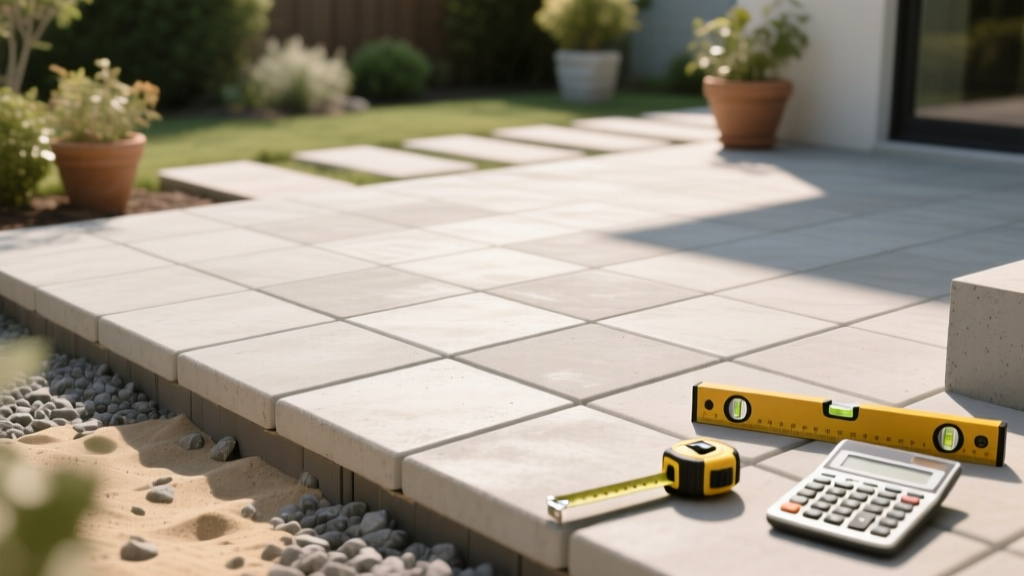
The True Cost of Concrete Patio Pavers in 2026
Estimating the cost of a paver patio requires moving beyond simple square-footage multipliers. In 2026, the national average for professionally installed concrete patio pavers ranges from $18 to $38 per square foot, according to Angi's latest hardscape cost data. However, material-only costs for DIY installations typically fall between $4.50 and $12.00 per square foot, depending heavily on the paver profile, manufacturing process, and regional freight surcharges.
Accurate budgeting demands a granular breakdown of the entire pavement system: the subgrade, base aggregate, bedding sand, the pavers themselves, and jointing compounds. This guide provides the exact formulas and 2026 pricing matrices required to build a precise bill of materials, eliminating the guesswork that leads to mid-project budget overruns.
Step-by-Step Quantity Calculator for Pavers and Base Materials
Most online calculators fail because they assume a flat 5% waste factor and ignore base compaction ratios. Use the following formulas to calculate your exact material requirements.
Formula 1: Paver Count and Pattern Waste
Never order pavers based solely on gross square footage. The cutting waste generated by your chosen laying pattern drastically alters the total unit count. Calculate your gross area (Length × Width), then apply the pattern-specific waste multiplier below to determine your final order volume.
| Laying Pattern | Waste Factor | Multiplier | Cutting Complexity |
|---|---|---|---|
| Running Bond / Stack | 5% - 7% | 1.07 | Low (straight cuts only) |
| Herringbone (45° or 90°) | 10% - 12% | 1.12 | High (diagonal perimeter cuts) |
| Basketweave / I-Pattern | 8% - 10% | 1.10 | Medium |
| Circular / Radial | 15% - 20% | 1.20 | Extreme (tapered cuts required) |
Formula 2: Base Aggregate and Bedding Sand Tonnage
The structural integrity of concrete patio pavers relies entirely on the base. For pedestrian patios, the Interlocking Concrete Pavement Institute (ICPI) standards dictate a minimum of 4 to 6 inches of compacted base material, topped with 1 inch of bedding sand. Refer to Unilock's official installation guidelines for detailed cross-section diagrams.
- Base Aggregate (3/4-inch Minus Crushed Rock): Calculate tonnage using the formula:
(Square Footage × Depth in Inches) / 200 = Tons. For a 400 sq. ft. patio at a 5-inch depth: (400 × 5) / 200 = 10 tons. Note: This formula accounts for the 20% volume loss during mechanical compaction. - Bedding Sand (ASTM C33 Coarse Concrete Sand): Calculate tonnage using:
Square Footage / 100 = Tons. For a 400 sq. ft. patio, you need exactly 4 tons of bedding sand to achieve a uniform 1-inch screeded depth.
Soil Subgrade Adjustments: When to Increase Base Depth
Standard calculator formulas assume a stable, well-draining sandy loam subgrade. If your site features expansive clay or high-plasticity soils, the standard 4-inch base will fail within two seasons due to frost heave and swelling. For clay subgrades, increase the compacted base aggregate depth to 8 inches and mandate the use of a non-woven geotextile separation fabric between the soil and the aggregate. This prevents the clay from migrating upward into the base rock, which would otherwise destroy the base's load-bearing capacity.
2026 Material Price Matrix: Paver Types vs. Budget
Pricing varies significantly based on the manufacturing process. Tumbled and textured pavers require secondary processing, while large-format slabs demand higher-grade molds and longer curing times to prevent warping.
| Paver Category | Thickness | 2026 Material Cost (per sq. ft.) | Best Application |
|---|---|---|---|
| Standard Smooth / Cobble | 60mm (2 3/8") | $2.80 - $4.20 | Standard patios, walkways |
| Tumbled / Antique Finish | 60mm (2 3/8") | $4.50 - $6.80 | Traditional, rustic aesthetics |
| Permeable (Eco-Grid) | 80mm (3 1/8") | $5.50 - $8.50 | Eco-zones, high-runoff areas |
| Large-Format Architectural Slab | 60mm - 80mm | $8.00 - $14.50 | Modern, minimalist designs |
| Porcelain-Concrete Hybrid | 20mm (3/4") | $11.00 - $18.00 | Pedestal systems, luxury roofs |
The Hidden Line Items Most Calculators Miss
Failing to account for perimeter restraints and jointing compounds is the most common reason DIY paver projects stall. Budget for these critical components from day one:
- Edge Restraint: Pavers will creep and separate without rigid perimeter containment. Use heavy-duty polypropylene restraints (like ProFlex or SnapEdge), secured with 10-inch galvanized steel spikes driven every 12 inches. Cost: $2.50 - $3.80 per linear foot.
- Polymeric Sand: Standard masonry sand washes out and invites weed growth. Polymeric sand contains binders that harden when activated with water, locking the pavers in place. A standard 50lb bag covers 80 to 120 square feet, depending on joint width. Cost: $38 - $55 per bag.
- Geotextile Fabric: Essential for clay soils or high-traffic zones to separate the subgrade from the base rock. Cost: $0.45 - $0.80 per square foot.
- Paver Sealer (Optional but Recommended): A wet-look or matte acrylic sealer protects against UV fading and stabilizes polymeric sand joints. Apply 60 days after installation to allow efflorescence to escape. Cost: $0.60 - $1.10 per square foot.
Common Estimation Mistakes That Blow the Budget
- Using Round Gravel: Never use rounded river rock or pea gravel for your base layer. Round stones roll against each other under load and will not compact. You must use angular, crushed aggregate with fines (3/4-inch minus) to create a mechanical lock.
- Skipping the Screed Rails: Attempting to eyeball the 1-inch bedding sand depth without aluminum screed rails results in uneven paver heights, leading to trip hazards and pooling water. Factor in $40 for a set of aluminum screed pipes if you do not own them.
- Ignoring Drainage Slope: Patios must be graded at a minimum 1/8-inch to 1/4-inch drop per linear foot away from structures. Failing to calculate the extra base material needed to build up the high side of the slope will result in water pooling against your home's foundation.
By applying these specific 2026 material costs, pattern-waste multipliers, and base-volume formulas, you can generate a highly accurate bill of materials. For further technical specifications on subgrade preparation and compaction testing, consult the Better Homes & Gardens comprehensive hardscape installation standards. Precision in the estimation phase is the most effective way to protect your profit margins and ensure a structurally sound, long-lasting paver installation.