Types of Joints in Concrete: Installation Cost Breakdown
Analyze the installation and repair costs for different types of joints in concrete. Compare control, expansion, and construction joint pricing.

The Financial Reality of Concrete Cracking
Concrete is a rigid material that shrinks as it cures and expands or contracts with thermal fluctuations. Without engineered weak points, internal tensile stresses will inevitably exceed the concrete's tensile strength, resulting in random, unsightly, and structurally compromising cracks. Installing the correct types of joints in concrete is not merely an aesthetic choice; it is a critical cost-control measure. According to the Portland Cement Association, uncontrolled cracking can reduce a slab's lifespan by decades and lead to moisture intrusion that corrodes subgrades and reinforcing steel.
From a budgeting perspective, the cost of properly specifying and installing concrete joints during the initial pour is a fraction of the cost to repair or replace a failed slab. This analysis breaks down the exact material costs, labor rates, and linear-foot pricing for the primary joint types used in residential and commercial flatwork in 2026.
Cost Matrix: Types of Joints in Concrete
The following matrix provides baseline pricing for joint installation. Labor rates are calculated based on a national average of $75 to $110 per hour for skilled concrete finishers and saw operators.
| Joint Type | Primary Purpose | Material Cost (Lin. Ft.) | Labor Cost (Lin. Ft.) | Total Installed Cost | Typical Spacing |
|---|---|---|---|---|---|
| Contraction (Saw-Cut) | Control shrinkage cracking | $0.15 - $0.30 | $0.60 - $0.95 | $0.75 - $1.25 | 10 to 15 ft |
| Contraction (Tooled) | Control shrinkage (wet) | $0.05 - $0.10 | $0.90 - $1.40 | $0.95 - $1.50 | 10 to 15 ft |
| Expansion (Pre-molded) | Absorb thermal expansion | $0.90 - $1.60 | $1.20 - $2.10 | $2.10 - $3.70 | 40 to 50 ft |
| Isolation (Foam + Sealant) | Separate from fixed objects | $1.60 - $2.80 | $2.20 - $3.80 | $3.80 - $6.60 | Perimeters/Columns |
Deep Dive: Material and Labor Costs by Joint Type
Contraction (Control) Joints
Contraction joints are designed to create a plane of weakness that forces the concrete to crack in a straight, hidden line rather than randomly across the slab surface. The National Ready Mixed Concrete Association (NRMCA) dictates that joint spacing should be 24 to 36 times the slab thickness (e.g., a 4-inch slab requires joints every 10 to 15 feet).
- Saw-Cut Joints: This is the industry standard for commercial and high-end residential work. Contractors use early-entry dry-cut saws (like the Soff-Cut system) within 1 to 4 hours of finishing, or standard wet saws 12 to 24 hours after the pour. A 10-inch diamond Soff-Cut blade costs approximately $55 to $70 and yields about 1,500 linear feet of cutting in standard aggregate. Factoring in blade wear, equipment depreciation, and a two-person crew, saw-cutting costs $0.75 to $1.25 per linear foot.
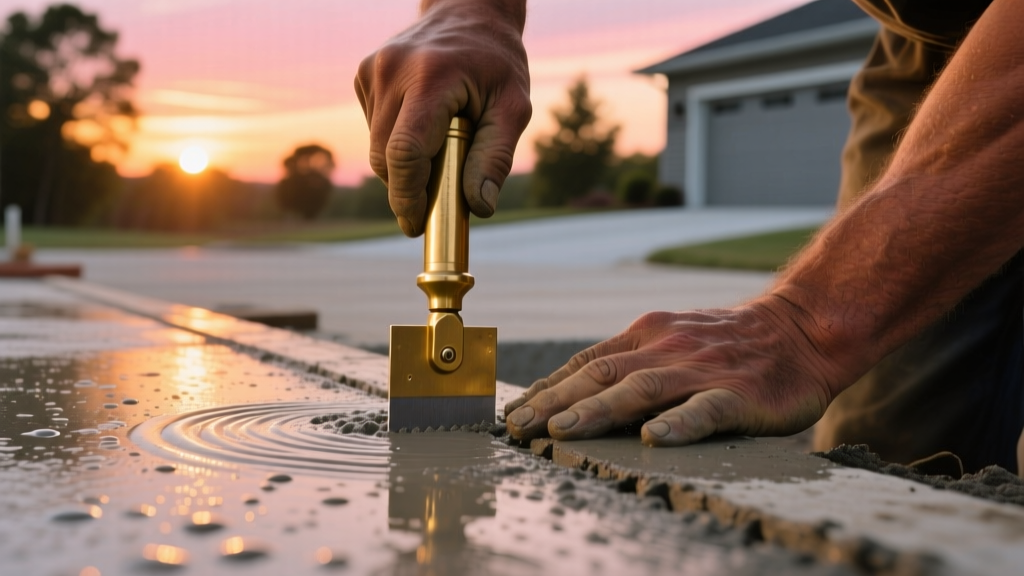
- Tooled Joints: Hand-tooled joints using a brass or magnesium grooving tool are pressed into the concrete while it is still plastic. While the material cost is negligible (the tool costs $40 and lasts for years), the labor intensity is high. Finishers must time the tooling perfectly, resulting in a higher labor cost of $0.95 to $1.50 per linear foot. Tooled joints also leave a slightly rounded edge that is more prone to spalling under heavy wheel traffic than saw-cut joints.
Expansion Joints
Expansion joints are critical for long runs of concrete, such as sidewalks, driveways, and warehouse floors, to prevent compressive stresses from causing blowups or buckling during high-temperature days. These joints require a compressible pre-molded filler, typically 1/2-inch thick bituminous fiberboard or closed-cell polyethylene (e.g., W.R. Meadows FIBERBOARD or Sealtight).
- Material Costs: A standard 1/2" x 4" x 10-foot strip of asphalt-impregnated fiberboard costs between $9.00 and $14.00, equating to $0.90 to $1.40 per linear foot.
- Labor Costs: Setting expansion joint material requires staking it to the subgrade or pinning it to the forms before the pour to prevent it from floating or shifting during concrete placement. This adds $1.20 to $2.10 per linear foot in labor.
Isolation and Construction Joints
Isolation joints completely separate the concrete slab from fixed structures like building foundations, columns, and light poles. Construction joints are bulkheads used to stop a pour at the end of a workday.
Both require a combination of compressible backer material and a high-quality elastomeric sealant to prevent water and incompressible debris (like gravel) from entering the joint space. If debris enters an isolation joint, the concrete will crush against the foundation during thermal expansion.
- Backer Rod & Foam: 1/2-inch closed-cell polyethylene backer rod costs roughly $0.15 per linear foot. For full-depth isolation, 1/2-inch expansion board is used ($1.40/lin. ft.).
- Sealants: Premium polyurethane sealants like Master Builders MasterSeal NP 1 or Sika Sikaflex-1a cost $11 to $14 per 10.1 oz tube. A standard 1/2" wide by 1/2" deep joint requires one tube per 12 linear feet, adding roughly $1.00 per linear foot in sealant material alone.
- Total Installed Cost: Including surface preparation, primer (if required by the sealant manufacturer), backer rod installation, and caulking labor, isolation joints run $3.80 to $6.60 per linear foot.
Scenario Analysis: 1,000 Sq. Ft. Driveway Jointing Budget
To contextualize these unit costs, consider a standard 20 ft. x 50 ft. residential driveway (1,000 sq. ft.) poured at a 4-inch thickness.
Driveway Jointing Calculation
- Perimeter Isolation Joints: 140 linear feet (separating driveway from garage floor and sidewalk). At $5.20/lin. ft. = $728.00
- Internal Contraction Joints: Spaced at 10 ft. intervals requires 4 transverse cuts across the 20 ft. width (80 linear feet total). Saw-cut at $1.00/lin. ft. = $80.00
- Total Jointing Cost: $808.00
Note: On a typical $12,000 to $15,000 driveway installation, $808 represents roughly 5% to 6% of the total project cost, yet it dictates the long-term structural integrity of the entire slab.
Critical Failure Modes and Hidden Repair Costs
Specifying the right joint is only half the battle; execution errors lead to catastrophic failures that void warranties and require expensive routing and sealing repairs.
⚠️ Warning: The Saw-Cut Timing Window
The most common cause of random cracking is delayed saw-cutting. Conventional wet saws must cut the joint to a depth of 1/4 the slab thickness (1 inch for a 4-inch slab). If the contractor waits longer than 24 hours, internal shrinkage stresses will initiate micro-fractures before the saw blade creates the relief plane. Conversely, cutting too early with a standard saw causes 'raveling'—the tearing of coarse aggregate at the joint edge, which compromises the joint's load-transfer ability and costs $4.00 to $7.00 per linear foot to rout out and patch with epoxy mortar.
Another frequent failure occurs in expansion joints when contractors omit the backer rod. Without a backer rod to create an hourglass shape, the sealant bonds to the bottom of the joint (three-sided adhesion). When the joint expands, the sealant is stretched in three directions simultaneously, leading to cohesive tearing within 12 to 18 months. The Federal Highway Administration (FHWA) emphasizes that proper joint geometry and backer rod placement are non-negotiable for long-term sealant performance in both highway and commercial applications.
ROI Calculation: Jointing vs. Slab Replacement
When value-engineering a project, developers sometimes attempt to reduce jointing costs by increasing spacing or switching from saw-cut to tooled joints. This is a false economy.
Proactive Jointing
Initial Cost: $800 - $1,200
10-Year Maintenance: $150 (re-caulking isolation joints)
Total 10-Year Cost: $950 - $1,350
Reactive Slab Repair
Initial Cost: $0 (omitted joints)
10-Year Maintenance: $3,500+ (stitching cracks, mudjacking, or full panel replacement due to water-induced subgrade failure)
Total 10-Year Cost: $3,500+
Ultimately, understanding the specific types of joints in concrete and their associated costs allows project managers and homeowners to allocate budgets accurately. Paying a premium for early-entry saw-cutting and high-modulus polyurethane sealants during the initial construction phase guarantees a predictable, straight-line cracking pattern and protects the subgrade from moisture infiltration, securing the slab's structural ROI for decades.
Written by
Sarah WhitfieldSarah Whitfield is a chartered quantity surveyor (MRICS) and construction cost analyst with 15 years of experience in material pricing, procurement strategy, and project budgeting. She earned her degree in Construction Management from the University of Reading (UK) and has worked on projects ranging from $2M custom homes to $180M mixed-use developments across North America and Europe. Sarah currently leads cost estimating for BuildMat Insight, maintaining a proprietary database of 4,000+ material price points updated quarterly. She is a frequent contributor to RSMeans cost data panels and has presented at the International Cost Engineering Council (ICEC) congress. Based in Denver, CO, Sarah is an avid trail runner and volunteer mentor for Women in Construction.
More from Sarah Whitfield
View all
Wood & Lumber
What Are the Different Types of Wood? A Builder's Guide
Compare structural softwoods, finish hardwoods, and engineered lumber. Analyze Janka ratings, MOE values, and 2026 pricing for construction.
Aug 4, 2026

Walls & Panels
Steel Framing vs Wood Framing: Corrosion and Moisture Defense
Compare steel framing vs wood framing for moisture resistance. Learn about galvanized coatings, condensation risks, and corrosion protection strategies.
Jul 21, 2026

Stone & Masonry
How to Cut Stone Veneer: Wet Saw vs Grinder Comparison
Compare the best tools for cutting stone veneer. We review wet saws, angle grinders, and chop saws to help you achieve clean, chip-free cuts.
Jul 21, 2026