Brick or Concrete Pavers: Technical Specs & ASTM Standards
Compare technical specifications for brick or concrete pavers. Review ASTM C936 and C902 standards, load ratings, and 2026 material costs.

Core Material Composition and Manufacturing
When evaluating brick or concrete pavers for structural paving applications, understanding the fundamental manufacturing differences is critical for predicting long-term performance. Concrete pavers are produced using a zero-slump concrete mix (cement, graded aggregates, water, and integral pigments) that is vibratory-compacted in steel molds and cured in controlled environments. This process yields a dense, high-strength unit with a consistent surface texture.
Clay brick pavers are manufactured from natural shale and clay, extruded or dry-pressed into molds, and fired in kilns at temperatures exceeding 2,000°F (1,093°C). This vitrification process creates a ceramic-like structure that is inherently UV-stable and highly resistant to chemical degradation. While concrete pavers rely on cementitious hydration for strength, clay pavers derive their structural integrity from the ceramic bond formed during firing.
ASTM and CSA Technical Standards Matrix
Engineers and architects must specify pavers according to rigorous industry standards. In North America, concrete pavers are governed by ASTM C936 (Standard Specification for Solid Concrete Interlocking Paving Units), while clay pavers are regulated by ASTM C902 (Standard Specification for Pedestrian and Light Traffic Paving Brick). Below is a direct comparison of the minimum technical thresholds required for severe weathering applications.
| Technical Property | Concrete Pavers (ASTM C936) | Clay Brick Pavers (ASTM C902 Class SX) |
|---|---|---|
| Minimum Compressive Strength | 8,000 psi (55 MPa) | 10,000 psi (69 MPa) |
| Maximum Water Absorption | 5.0% by weight | 7.0% by weight |
| Freeze-Thaw Durability (50 Cycles) | Max 1.0% weight loss | Max 0.5% weight loss |
| Minimum Thickness (Vehicular) | 3 1/8 in. (80 mm) | 2 1/4 in. (57 mm) for standard; 3 in. for heavy |
| Abrasion Resistance | Max 0.5 cm³ volume loss (ASTM C418) | Not explicitly rated (inherent ceramic hardness) |
According to the Brick Industry Association (BIA), specifying Class SX (Severe Weathering) is mandatory for any exterior horizontal application exposed to freezing temperatures and moisture. The Interlocking Concrete Pavement Institute (ICPI) similarly mandates strict adherence to C936 for all interlocking concrete pavement (ICP) projects to prevent surface spalling.
Compressive Strength and Load-Bearing Capacities
Pedestrian and Light-Duty Applications
For walkways, patios, and residential driveways, 2 3/8-inch (60 mm) thick concrete pavers or standard 2 1/4-inch clay pavers are structurally adequate. These thicknesses distribute point loads effectively across a properly compacted ASTM D2940 aggregate base. The 8,000 psi baseline strength of concrete pavers is more than sufficient to handle the 3,000 to 4,000 lb axle loads of standard passenger vehicles without fracturing.
Heavy Vehicular and Industrial Applications
When designing for fire lanes, commercial loading docks, or port facilities, thickness and base preparation must scale. Concrete pavers must be upgraded to 3 1/8-inch (80 mm) or even 4-inch (100 mm) units. For extreme industrial loads, such as reach stackers in shipping ports, specialized concrete pavers exceeding 10,000 psi and 5 inches in thickness are required. Clay pavers are rarely used in heavy industrial vehicular applications due to the cost and logistical challenges of manufacturing 4-inch solid clay units.
Dimensional Tolerances and Jointing Specifications
Precise dimensional tolerances are what allow pavers to interlock and transfer shear loads to adjacent units. The jointing sand acts as a flexible mortar, accommodating minor thermal expansion while maintaining structural rigidity.
- Concrete Paver Tolerances: ASTM C936 permits a dimensional variation of ±1/16 inch (1.6 mm) in length and width. This tight tolerance allows for narrow 1/16 to 1/8-inch joints, which are ideal for mechanized installation and optimal load transfer.
- Clay Paver Tolerances: Due to the natural shrinking and warping that occurs during kiln firing, ASTM C902 allows a wider tolerance of ±3/32 inch (2.4 mm). Consequently, clay pavers typically require wider 3/16 to 1/4-inch joints to accommodate size variations.
- Chamfer and Edge Design: Concrete pavers frequently feature a 1/8-inch chamfer to prevent edge spalling under vehicular turning forces. Clay pavers typically feature square edges, which provide a tighter visual joint but are more susceptible to chipping if the base settles unevenly.
Bedding and Jointing Sand Specifications
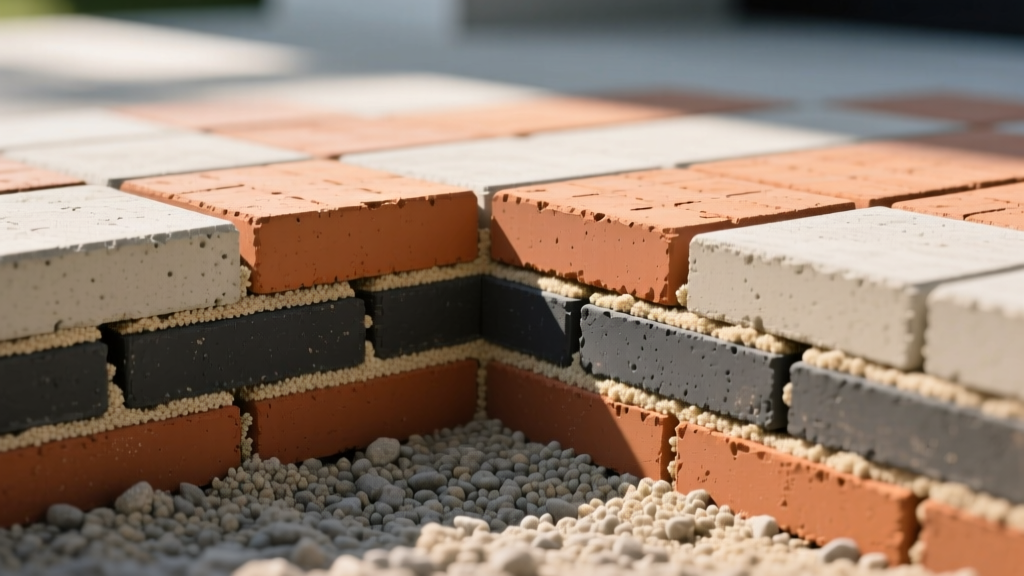
The structural interlock of brick or concrete pavers relies entirely on the friction generated by jointing sand. Using the wrong sand grade is a primary cause of pavement failure.
- Bedding Sand: Must conform to ASTM C33 (Concrete Sand). It should be coarse, washed, and angular. Rounded sand particles (like mason sand) will compact and cause the pavers to settle unevenly under load.
- Jointing Sand: Must conform to ASTM C144 (Masonry Sand) but specifically graded so that 100% passes a #8 sieve and less than 10% passes a #50 sieve. This specific gradation allows the sand to vibrate deeply into the 1/8-inch joints without bridging at the surface.
- Polymeric Sand: For areas prone to heavy surface water runoff or aggressive weed growth, polymer-modified jointing sands are recommended. These bind upon water activation, achieving a compressive strength of up to 3,500 psi within the joint itself, effectively locking the pavers in place.
Permeability and Freeze-Thaw Durability Metrics
Standard pavers are impervious, meaning water infiltrates through the joints (typically 5% to 10% of the total surface area). However, for stormwater management, Permeable Interlocking Concrete Pavers (PICP) governed by ASTM C1781 are required.
Concrete Pavers (Freeze-Thaw)
Concrete relies on air-entrainment and low water-cement ratios to survive freeze-thaw cycles. If absorption exceeds 5%, trapped water expands upon freezing, causing micro-cracking and surface scaling. High-quality 2026 concrete mixes utilize supplementary cementitious materials (SCMs) like fly ash to reduce permeability and boost long-term durability.
Clay Brick Pavers (Freeze-Thaw)
Clay pavers manage freeze-thaw cycles through their inherent porosity. The vitrified ceramic matrix contains microscopic voids that act as expansion chambers for freezing water. Class SX brick pavers routinely survive 50+ freeze-thaw cycles with less than 0.5% weight loss, often outlasting the concrete base they are installed upon.
Real-World Cost and Specification Selection Framework
Material costs fluctuate based on regional manufacturing capacity and freight. As of early 2026, the baseline material costs (excluding base prep and labor) are:
- Standard Concrete Pavers: $3.50 to $6.50 per square foot.
- Premium/Tumbled Concrete Pavers: $5.50 to $8.50 per square foot.
- Standard Clay Brick Pavers: $5.50 to $9.00 per square foot.
- Permeable Concrete Pavers (PICP): $6.00 to $10.00 per square foot (requires deeper, more expensive open-graded base stone).
Decision Tree: Selecting the Right Paver
Use this framework to finalize your specification:
- Is the application subject to heavy vehicular traffic (delivery trucks, fire engines)?
Yes: Specify 3 1/8-inch (80mm) ASTM C936 concrete pavers over a 12-inch ASTM D2940 aggregate base.
No: Proceed to step 2. - Is color permanence and UV stability the highest architectural priority?
Yes: Specify ASTM C902 Class SX clay brick pavers. The fired ceramic color will not fade over 50 years, whereas concrete pigments will slowly degrade under UV exposure.
No: Proceed to step 3. - Does the project require LEED credits for stormwater management?
Yes: Specify ASTM C1781 Permeable Interlocking Concrete Pavers (PICP) with an open-graded crushed stone base.
No: Specify standard 2 3/8-inch ASTM C936 concrete pavers for the most cost-effective, high-strength solution.
Frequently Asked Technical Questions
Can brick or concrete pavers be installed over existing concrete?
Yes, this is known as an overlay application. However, the existing concrete slab must be structurally sound, free of heaving, and sloped a minimum of 1.5% for drainage. A 1-inch layer of coarse ASTM C33 bedding sand must be placed over the concrete, and the perimeter must be secured with a structural concrete bond beam to prevent the sand bed from washing out. Do not install permeable pavers over an impervious concrete slab.
What causes efflorescence on concrete pavers and how is it prevented?
Efflorescence is a white, powdery deposit of calcium carbonate that occurs when water-soluble salts from the Portland cement migrate to the surface and react with atmospheric carbon dioxide. While it does not affect structural integrity, it is an aesthetic nuisance. Modern manufacturers mitigate this by adding efflorescence-control admixtures during production. Post-installation, it can be removed using specialized, non-acidic efflorescence cleaners; using muriatic acid will etch the concrete surface and degrade the pigments.
Written by
Priya KapoorPriya Kapoor is a real estate market analyst and construction economics researcher with expertise in housing affordability, development feasibility, and infrastructure investment. She holds a Master of Regional Planning from Cornell University and previously worked as a senior analyst at CBRE's Investment Properties group, where she modeled returns for $4B in mixed-use development pipelines. Priya now runs an independent research practice advising developers, municipalities, and REITs on construction cost forecasting and market timing. She publishes the quarterly "BuildMat Market Pulse" report tracking material price indices across 12 commodity categories. Based in Austin, TX, Priya serves on the board of Habitat for Humanity Austin and is a marathon runner.
More from Priya Kapoor
View all
Construction Cost
Cost to Build a 1600 Sq Ft Home in 2026: Full Breakdown
Accurate 2026 cost to build a 1600 sq ft home—material, labor, and regional pricing breakdowns included. Plan your budget with real-time estimates.
Aug 11, 2026

Wood & Lumber
Name the Types of Wood for Pressure Treatment and Preservation
Learn how to name the types of wood best suited for pressure treatment. Compare species treatability, chemical retention levels, and 2026 preservation costs.
Aug 4, 2026

Stone & Masonry
Stone Veneer Suppliers Lindenhurst: 2026 Cost Analysis
Analyze 2026 stone veneer costs in Lindenhurst, NY. Compare local supplier pricing, delivery fees, and Suffolk County installation labor rates.
Aug 4, 2026