Concrete Slab vs Crawl Space Cost: Foundation Repair Guide
Compare the concrete slab vs crawl space cost for foundation repairs. Expert troubleshooting, 2026 pricing, and failure mode analysis for both systems.

The True Cost of Foundation Troubleshooting: Slab vs. Crawl Space
When evaluating the concrete slab vs crawl space cost, most homeowners and builders focus strictly on initial construction expenses. However, the true financial divergence between these two foundation systems emerges decades later during troubleshooting and repair. A concrete slab-on-grade foundation and a raised crawl space foundation fail in fundamentally different ways, dictated by soil mechanics, hydrostatic pressure, and material degradation. Understanding these distinct failure modes is critical for accurate repair budgeting and structural triage.
2026 National Repair Cost Snapshot
- Average Slab Foundation Repair: $4,500 – $25,000 (Highly dependent on plumbing access)
- Average Crawl Space Repair: $2,000 – $15,000 (Driven by moisture mitigation and wood replacement)
- Worst-Case Slab Scenario: $40,000+ (Severe differential settlement requiring interior piering and concrete demolition)
- Worst-Case Crawl Scenario: $25,000+ (Complete sill plate rot, bowing block walls, and full encapsulation)
Concrete Slab Foundations: Troubleshooting & Repair Costs
Slab-on-grade foundations transfer structural loads directly to the underlying soil. Because the concrete is in direct contact with the earth, they are highly susceptible to expansive soil movement and sub-slab plumbing failures. According to guidelines from the American Concrete Institute (ACI), controlling the water-to-cement ratio and proper subgrade compaction are vital, but existing older slabs often lack modern post-tensioning or rigorous moisture barriers, leading to predictable failure modes.
Common Slab Failure Modes & Repair Pricing
| Failure Symptom | Root Cause | Repair Method | 2026 Cost Range |
|---|---|---|---|
| Sloping floors, sticking doors | Differential settlement (clay soil shrinkage) | Polyurethane foam jacking (e.g., Alchemy-Spetec Deep Lift) | $5 – $15 per sq. ft. |
| Severe structural cracking, wall separation | Deep load-bearing strata failure | Steel push piers or helical piers (e.g., Chance Helical Piers) | $1,200 – $3,000 per pier |
| Wet spots on floor, unexplained water bill spikes | Sub-slab copper or PVC plumbing leak | Concrete saw-cutting, trenching, pipe repair, and patching | $2,500 – $6,000+ per leak |
| Hairline map-cracking (non-structural) | Plastic shrinkage or curing errors | Epoxy injection (e.g., Sikadur-52) or polyurethane sealant | $300 – $800 per project |
Crawl Space Foundations: Troubleshooting & Repair Costs
Raised crawl spaces elevate the living area above the ground, relying on a perimeter stem wall (usually CMU block or poured concrete) and interior piers to support wooden floor joists. While they avoid the sub-slab plumbing nightmare, crawl spaces introduce a new vector for foundation failure: environmental degradation. The U.S. Department of Energy notes that unvented, unconditioned crawl spaces are primary sources of structural moisture, leading to wood rot and mold.
Common Crawl Space Failure Modes & Repair Pricing
- Bowing or Stepping CMU Block Walls: Caused by lateral hydrostatic pressure from poor exterior grading. Repair requires interior carbon fiber straps ($400–$800 per strap) or exterior excavation and waterproofing ($100–$150 per linear foot).
- Sagging Floor Joists & Sill Plate Rot: Caused by standing water and high relative humidity (>70%). Repair involves sistering new pressure-treated joists ($150–$300 per joist) and replacing rotted sill plates ($50–$100 per linear foot).
- Interior Pier Settlement: The shallow concrete footings supporting the center beam often sink in expansive soils. Repair requires installing adjustable lally columns or helical piers beneath the central girder ($800–$1,500 per pier).
- Efflorescence and Spalling: White, powdery mineral deposits on block walls indicate active water migration through the porous concrete. Repair requires applying a crystalline waterproofing slurry like Xypex ($3–$5 per sq. ft.).
Decision Matrix: Which Foundation Fails Faster in Your Soil Type?
The concrete slab vs crawl space cost debate over a 50-year lifecycle is heavily dictated by regional geology. Use this matrix to anticipate long-term troubleshooting expenses based on your site's soil profile.
Expansive Clay Soils (e.g., Texas, Colorado)
Higher Risk: Concrete Slab
Why: Clay swells significantly when wet and shrinks when dry. Slabs move as a single monolithic unit, leading to severe differential cracking and drywall tears. Crawl spaces allow for easier adjustment of interior shims and piers without destroying the floor system.
High Water Table / Coastal (e.g., Florida, Carolinas)
Higher Risk: Crawl Space
Why: Constant hydrostatic pressure and capillary action will wick moisture into crawl space block walls and wooden joists, causing rapid rot and efflorescence. Slabs, when poured with proper capillary breaks and vapor barriers, resist groundwater intrusion far more effectively.
Hidden Cost Multipliers in Foundation Repair
When budgeting for foundation troubleshooting, contractors often quote the structural repair but omit the ancillary costs required to restore the home to a finished state. Factor these into your financial models:
- Interior Finish Restoration (Slab): If a slab must be saw-cut for plumbing or interior piering, expect to pay $15–$30 per square foot to replace tile, hardwood, or carpet that was destroyed during access.
- Exterior Hardscape Destruction (Both): Installing exterior helical piers requires heavy machinery. If your home has concrete patios, driveways, or mature landscaping abutting the foundation, demolition and replacement of these features can add $3,000–$8,000 to the project.
- Crawl Space Encapsulation (Crawl): Repairing a rotted sill plate is a temporary fix if the environment isn't corrected. A full 20-mil polyethylene vapor barrier encapsulation, complete with a commercial-grade dehumidifier (e.g., AprilAire E100) and sump pump, adds $5,000–$12,000 to the initial repair invoice but prevents secondary failures.
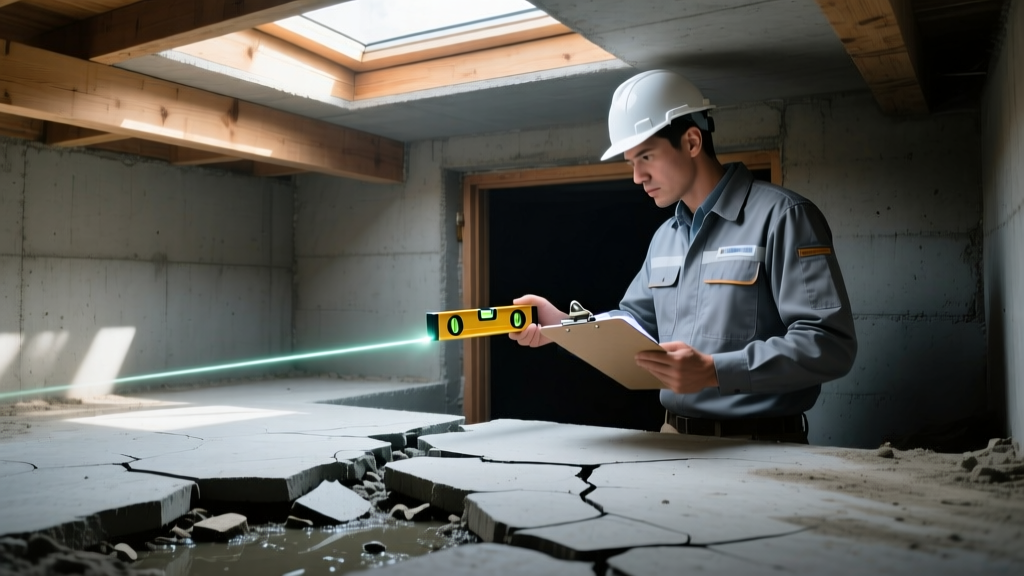
Step-by-Step Triage: Diagnosing Your Foundation Issue
Before soliciting repair bids, perform this systematic triage to accurately identify whether you are dealing with a slab or crawl space structural failure, or merely cosmetic settling.
Step 1: The String Line Test
Stretch a mason's string line tightly across the longest interior wall, securing it at the baseboards on both ends. Measure the gap between the string and the baseboard at the center. A gap exceeding 1/2 inch over a 20-foot span indicates active differential settlement requiring professional underpinning.
Step 2: The Door Frame Plumb Check
Place a 48-inch digital level against the hinge side of an interior door frame. If the frame is out of plumb by more than 1/4 inch, the foundation has rotated. In slab homes, this usually points to a dropped corner. In crawl spaces, it often points to a failed interior girder post.
Step 3: The Moisture Meter Audit (Crawl Spaces Only)
Access the crawl space and use a pin-type moisture meter (e.g., Wagner Meters MMC220) on the wooden joists and sill plates. Readings above 19% indicate active fungal decay. If the wood is soft to the touch with a screwdriver, structural sistering is mandatory before any foundation jacking occurs.
Step 4: The Plumbing Isolation Test (Slabs Only)
Turn off all water fixtures and check the water meter. If the dial is still moving, you have a sub-slab leak. Call a leak detection specialist using acoustic or thermal imaging equipment before calling a foundation repair company.
Ultimately, analyzing the concrete slab vs crawl space cost requires looking past the initial pour and examining the lifecycle maintenance. Slabs offer superior resistance to moisture and wind but carry catastrophic financial risks if sub-grade plumbing fails or expansive soils fracture the monolith. Crawl spaces provide unparalleled access for mechanical and structural troubleshooting but demand rigorous, ongoing environmental control to prevent the biological decay of their load-bearing timber components. Accurate diagnosis and targeted repair methodologies are the only ways to protect your capital investment in either system.
Written by
David NakamuraDavid Nakamura is a licensed architect (AIA) and construction technology writer focused on sustainable building methods, mass timber engineering, and high-performance building envelopes. He holds a Master of Architecture from the University of Washington and is a certified Passive House Consultant (CPHC). David spent eight years at the Seattle firm Mithun, where he led the design of three LEED Platinum projects, before founding his own practice specializing in net-zero residential design. He serves on the editorial advisory board of GreenBuilder Magazine and has authored peer-reviewed papers on cross-laminated timber (CLT) connections for the Journal of Structural Engineering. In his spare time, David teaches woodworking at Pratt Fine Arts Center and kayaks the Puget Sound.
More from David Nakamura
View all
Construction Cost
Labor Cost to Build a Deck Per Sq Ft: 2026 Installation Guide
Discover the exact labor cost to build a deck per sq ft in 2026. This installation guide breaks down contractor rates, complexity factors, and hidden fees.
Aug 4, 2026

Construction Cost
How Much Does It Cost to Build a 3 Bedroom House? Financing Guide
Learn exactly how much it costs to build a 3 bedroom house and explore 2026 financing options, construction loan types, and budget frameworks for your build.
Aug 4, 2026

Construction Cost
Cost to Build a Tennis Court: 2026 Guide
How much does it cost to build a tennis court in 2026? Breakdowns for asphalt, concrete, and synthetic surfaces plus fencing and lighting.
Jul 30, 2026