Pavers vs Concrete Cost: Application Pricing & ROI Guide
Compare pavers vs concrete cost across driveways, patios, and pool decks. Explore 2026 pricing, installation specs, and long-term maintenance ROI.

The Core Economics: Pavers vs Concrete Cost per Square Foot
When evaluating hardscape materials, the initial quote rarely tells the full financial story. The true cost of poured concrete versus interlocking pavers fluctuates wildly based on the specific application, load-bearing requirements, and regional material availability. In 2026, supply chain stabilization has normalized cement prices, but specialized paver manufacturing and skilled labor rates continue to drive premium costs for modular systems.
2026 National Average Cost Snapshot
- Standard Poured Concrete (Broom Finish): $8.00 – $12.00 per sq. ft.
- Stamped/Decorative Concrete: $15.00 – $25.00 per sq. ft.
- Concrete Pavers (Standard 60mm): $12.00 – $18.00 per sq. ft.
- Premium Pavers (Clay/Natural Stone/80mm): $20.00 – $35.00+ per sq. ft.
Note: Prices include standard subgrade preparation, materials, and professional installation. Complex grading or retaining walls will increase costs.
According to data from the National Ready Mixed Concrete Association (NRMCA), ready-mix concrete prices have stabilized, but the labor required for forming, pouring, and finishing remains a significant cost driver. Conversely, the Interlocking Concrete Pavement Institute (ICPI) notes that while paver material costs are higher, the lack of curing time and modular installation can sometimes offset labor expenses on smaller, complex-shaped projects.
Application Showcase: Where Each Material Wins
The financial and structural calculus changes depending on where the material is being installed. A material that offers the best ROI for a pedestrian patio may fail catastrophically under the weight of a daily-driven truck.
Scenario 1: The Heavy-Duty Driveway
Driveways demand high compressive strength and deep subgrade support. For poured concrete, a driveway requires a minimum 4,000 PSI mix, poured at a 5-to-6-inch thickness, reinforced with welded wire mesh or #4 rebar on a 2-foot grid. Control joints must be cut every 10 feet to manage shrinkage cracking. The cost for a standard 600-square-foot broom-finished driveway typically lands between $4,800 and $7,200.
For pavers, vehicular traffic mandates the use of 80mm (3-1/8 inch) thick units, rather than the standard 60mm pedestrian pavers. The base preparation is also more rigorous: ICPI standards require a 6-to-8-inch compacted Class II road base, topped with a 1-inch layer of coarse, sharp concrete sand. While the initial pavers vs concrete cost heavily favors poured concrete for large, rectangular driveways, pavers offer a distinct advantage in regions with severe freeze-thaw cycles. When a concrete slab heaves or cracks due to frost, the entire panel must be mud-jacked or replaced. When a paver driveway shifts, individual units can be lifted, the base re-tamped, and the pavers reset for a fraction of the cost.
Scenario 2: The Backyard Patio & Entertainment Space
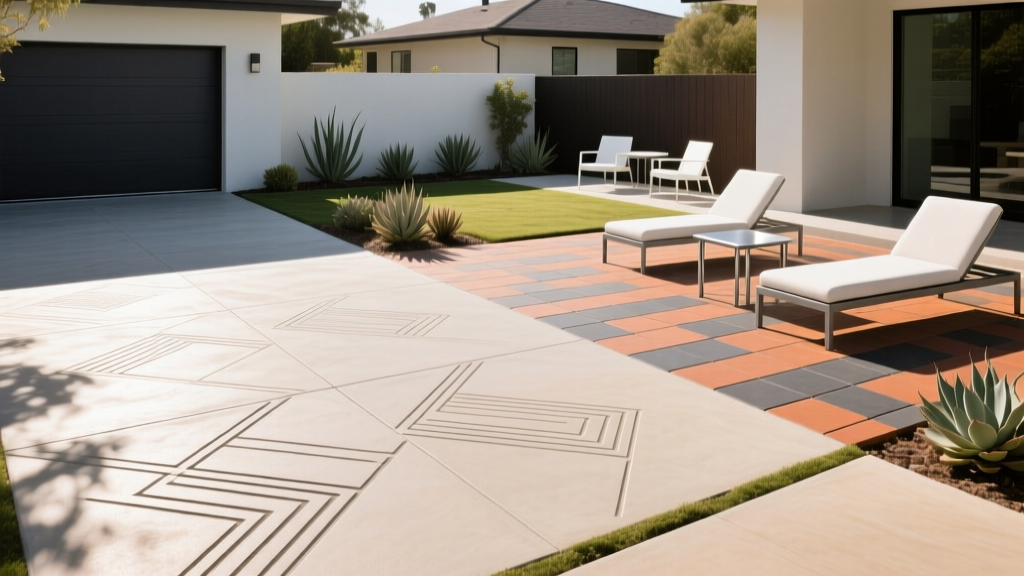
Patios prioritize aesthetics, drainage, and integration with landscaping. Here, the cost gap narrows, especially when comparing stamped concrete to mid-tier pavers. Stamped concrete requires a 3,000 PSI mix, coloring agents, release powders, and specialized stamping mats, pushing the price to $18–$22 per square foot. However, stamped concrete requires resealing every 2 to 3 years to protect the UV-sensitive color hardeners from fading, adding $1.50 to $2.50 per square foot in recurring maintenance.
Concrete pavers, particularly tumbled or multi-piece modular systems, offer a similar high-end aesthetic without the mandatory resealing. The color in concrete pavers is integral or applied via highly durable face-mix technology. Furthermore, patios often feature curves, cutouts for trees, or intricate drainage slopes. Cutting and forming poured concrete for curved edges is labor-intensive and expensive, whereas pavers are easily cut with a gas-powered wet saw and laid into complex geometric patterns with minimal waste.
Scenario 3: The Pool Deck
Pool decks introduce two critical variables: slip resistance and thermal retention (heat absorption). Dark-colored stamped concrete absorbs immense heat, making it unbearable to walk on barefoot in direct summer sun. It also becomes incredibly slippery when wet, unless a specialized anti-slip additive is mixed into the sealer.
Light-colored concrete pavers, particularly those with a high Solar Reflectance Index (SRI), remain significantly cooler. Tumbled pavers also provide natural slip resistance due to their textured, porous surfaces. While the upfront cost of a premium pool deck using light-colored pavers may be 20% higher than basic poured concrete, the elimination of resealing and the superior barefoot comfort make pavers the undisputed champion for poolside applications.
Hidden Costs and Long-Term Maintenance Matrix
To accurately evaluate the pavers vs concrete cost, you must project the 10-year lifecycle expenses. Poured concrete is often marketed as "maintenance-free," but this is a misconception. Concrete is porous, susceptible to staining, and vulnerable to de-icing salts, which cause surface spalling and scaling.
| Maintenance Task | Poured Concrete (Stamped) | Interlocking Pavers |
|---|---|---|
| Routine Cleaning | Power washing (Annual) | Power washing (Annual) |
| Sealing / Coating | Required every 2-3 years ($1.50-$2.50/sq ft) | Optional (for color enhancement) |
| Joint Maintenance | Fill control joints with backer rod/sealant | Top-up polymeric sand every 3-5 years |
| Crack / Shift Repair | Epoxy injection or slab replacement ($$$) | Lift, re-tamp base, reset ($) |
| Stain Removal | Difficult; oil stains often permanent | Replace individual stained pavers |
As illustrated by industry cost trackers like HomeGuide's hardscape pricing data, the 10-year maintenance cost of a stamped concrete patio can easily add 30% to its initial installation price, whereas paver maintenance remains largely limited to inexpensive polymeric sand replenishment.
Failure Modes: Why Installations Actually Fail
Understanding how these materials fail is crucial for making an informed purchasing decision. Both materials are only as good as their subgrade, but their failure mechanisms differ drastically.
⚠️ Critical Paver Failure: Edge Restraint Blowout
The most common cause of paver failure is inadequate edge restraint. Without a rigid perimeter, the pavers will slowly migrate outward under traffic and freeze-thaw cycles, causing the polymeric sand joints to unzip. The Fix: Never rely on standard landscape spikes. Professional installations must use a poured concrete curb (hidden beneath the soil) or heavy-duty commercial-grade plastic restraints secured with 12-inch galvanized steel spikes driven at a 45-degree angle every 12 inches.
💧 Critical Concrete Failure: Subgrade Washout & Shrinkage
Concrete does not crack because it is weak; it cracks because it shrinks as it cures and because the earth beneath it moves. If the contractor fails to install a 6-mil polyethylene vapor barrier beneath the slab, moisture from the soil will wick up, causing efflorescence and potential interior flooring failures if the slab is attached to a home. Furthermore, if control joints are not cut within 12 hours of pouring (or tooled during the finishing process), the concrete will create its own random, unsightly cracks to relieve internal tension.
"The single biggest mistake homeowners make in hardscaping is underestimating the base. Whether you are pouring a 6-inch slab or laying 80mm pavers, 70% of your budget should conceptually go into the dirt work. A flawless finish on a poorly compacted subgrade is just a delayed failure." — Senior Geotechnical Engineer, Regional Hardscape Assessment Report
The Final Decision Framework
Use this matrix to determine which material aligns with your specific project parameters, budget, and maintenance tolerance.
Choose Poured Concrete If:
- Budget is the primary constraint: You need a large, functional surface area (like a long driveway or a massive RV pad) and want the lowest initial cost per square foot.
- You prefer a seamless look: You want a minimalist, modern aesthetic without the visual interruption of joint lines.
- Heavy, static loads are expected: You are parking heavy machinery, RVs, or commercial vehicles in one spot for extended periods (pavers can dent or settle under extreme, stationary point-loads if the base isn't engineered for it).
Choose Interlocking Pavers If:
- You live in a freeze-thaw climate: The modular nature of pavers allows them to flex and shift with frost heave, and individual units can be reset without leaving ugly patch marks.
- Utility access is required: You are building over main water lines, sewer cleanouts, or irrigation manifolds. Pavers can be unzipped to access underground utilities and reinstalled seamlessly.
- You want zero curing downtime: A paver patio or driveway can be driven on or furnished the exact minute the installer finishes sweeping the joint sand. Concrete requires a minimum 7-day cure time before vehicular traffic.
- Complex shapes and curves are involved: The cost of forming and stamping curved concrete is prohibitive; pavers handle radii and organic shapes effortlessly.
Ultimately, the pavers vs concrete cost debate is not just about the initial invoice. It is a choice between the monolithic, lower-upfront-cost rigidity of poured concrete and the modular, higher-upfront-cost flexibility of pavers. By matching the material's structural properties to the specific demands of your driveway, patio, or pool deck, you ensure that your hardscape investment delivers both aesthetic appeal and long-term financial ROI.
Written by
Priya KapoorPriya Kapoor is a real estate market analyst and construction economics researcher with expertise in housing affordability, development feasibility, and infrastructure investment. She holds a Master of Regional Planning from Cornell University and previously worked as a senior analyst at CBRE's Investment Properties group, where she modeled returns for $4B in mixed-use development pipelines. Priya now runs an independent research practice advising developers, municipalities, and REITs on construction cost forecasting and market timing. She publishes the quarterly "BuildMat Market Pulse" report tracking material price indices across 12 commodity categories. Based in Austin, TX, Priya serves on the board of Habitat for Humanity Austin and is a marathon runner.
More from Priya Kapoor
View all
Construction Cost
Cost to Build a 1600 Sq Ft Home in 2026: Full Breakdown
Accurate 2026 cost to build a 1600 sq ft home—material, labor, and regional pricing breakdowns included. Plan your budget with real-time estimates.
Aug 11, 2026

Wood & Lumber
Name the Types of Wood for Pressure Treatment and Preservation
Learn how to name the types of wood best suited for pressure treatment. Compare species treatability, chemical retention levels, and 2026 preservation costs.
Aug 4, 2026

Stone & Masonry
Stone Veneer Suppliers Lindenhurst: 2026 Cost Analysis
Analyze 2026 stone veneer costs in Lindenhurst, NY. Compare local supplier pricing, delivery fees, and Suffolk County installation labor rates.
Aug 4, 2026