Concrete Drill Bit Lifespan: Durability Analysis and Wear Rates
Analyze concrete drill bit durability, comparing carbide and diamond lifespans. Learn thermal wear metrics, failure modes, and cost-per-hole data.
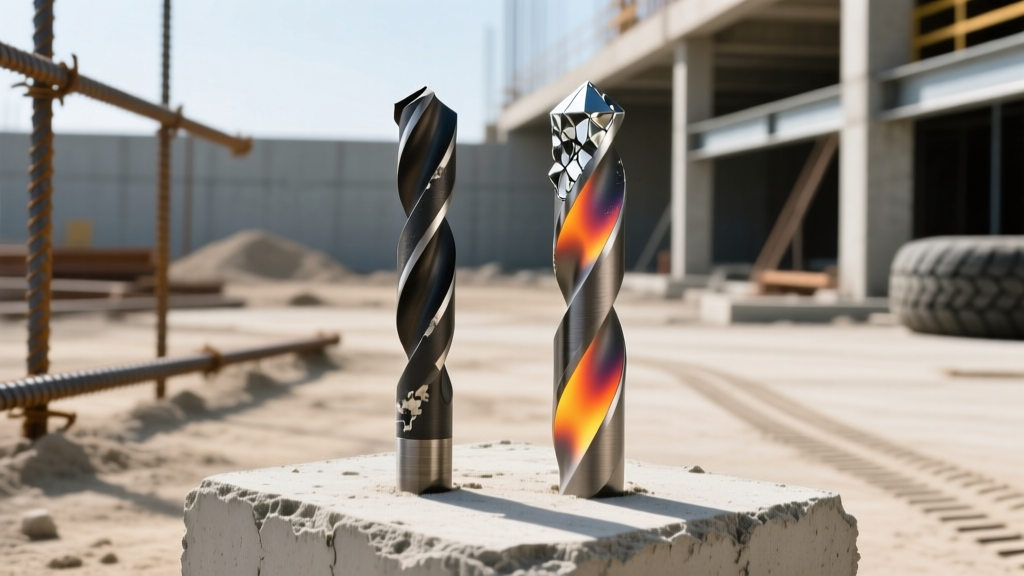
The Metallurgy of Abrasion: Why Concrete Destroys Drill Bits
When evaluating the durability of a concrete drill setup, it is critical to separate the rotary hammer (the tool) from the concrete drill bit (the consumable). The lifespan of the bit is dictated by a brutal metallurgical battle between the cutting edge and the concrete matrix. While the Portland cement paste is relatively soft, the aggregate suspended within it—often quartz and silica—ranks at a 7 on the Mohs hardness scale.
Tungsten carbide, the standard material for masonry bits, ranks between 9 and 9.5. However, drilling is not merely a scratching process; it is a high-impact, high-compression event. The rotary hammer delivers up to 50,000 blows per minute (BPM). Each impact causes micro-fractures in the concrete, but simultaneously induces impact fatigue in the carbide tip. Over time, the binder (cobalt or nickel) holding the tungsten carbide grains together degrades, leading to grain pull-out and rapid edge rounding.
Lifespan Metrics by Bit Category
To provide actionable data for contractors and DIYers, we must quantify durability in terms of 'holes per bit' under standardized conditions. The following matrix assumes 4,000 PSI cured concrete with standard siliceous aggregate, using an SDS-Plus rotary hammer at optimal feed pressure.
| Bit Category | Material & Geometry | Expected Lifespan (1/2' Dia, 4' Depth) | Avg. Cost Per Hole | Primary Failure Mode |
|---|---|---|---|---|
| Standard Masonry | 2-Flute, Brazed Carbide Tip | 40 - 80 holes | $0.12 - $0.20 | Tips shearing off due to braze failure |
| Premium SDS-Plus | 4-Flute, Full-Head Carbide | 350 - 500 holes | $0.04 - $0.06 | Flute erosion and edge rounding |
| Diamond Core (Wet) | Steel Tube, Diamond Segments | 150 - 300 linear inches | $0.08 - $0.15 | Segment wear, core binding/snagging |
| Diamond Core (Dry) | Steel Tube, Laser-Welded Segments | 50 - 100 linear inches | $0.25 - $0.40 | Thermal degradation of diamond matrix |
Thermal Fatigue: The Hidden Lifespan Killer
Impact fatigue is only half of the durability equation; thermal degradation is the other. Friction at the cutting edge generates immense localized heat. In standard 2-flute bits, the carbide tip is brazed to a steel shaft using a silver-based alloy. This brazing material begins to soften and lose shear strength at temperatures exceeding 600°C (1,112°F).
When a user applies excessive feed pressure without frequently withdrawing the bit to clear dust, the trapped silica dust acts as an insulator. The temperature at the tip spikes, the braze softens, and the rotational torque snaps the carbide tip clean off the shaft. This is known as 'braze failure' and accounts for nearly 40% of premature bit deaths in field conditions.
The 4-Flute Advantage in Thermal Management
Premium full-head carbide bits (such as the Milwaukee MX4 or Bosch HCFC series) utilize a 4-flute design. The primary cutting flutes remove the bulk of the material, while the secondary, wider flutes act as high-volume dust extraction channels. By clearing the hole 30% faster than a 2-flute design, the 4-flute geometry drastically reduces friction-induced heat, extending the bit's functional lifespan by a factor of four to six.
The Rebar Factor: Impact Spalling and Shear Failure
Standard concrete drill bits are designed for the brittle fracture of stone and cement. They are entirely unequipped for the ductile shear strength of steel reinforcement. When a standard 2-flute bit encounters a #5 (5/8-inch) rebar, the asymmetric cutting edges catch on the steel. The resulting torsional twist frequently snaps the bit shaft or shatters the carbide tip.
Full-head 4-flute bits feature a symmetrical cutting geometry that can 'chew' through rebar, but this comes at a severe durability cost. Cutting rebar dulls the carbide edge exponentially faster than cutting aggregate. If your core sampling or anchor placement requires frequent rebar penetration, switching to a diamond core bit with a wet-drilling rig is the only mathematically sound decision. According to safety and material handling guidelines from OSHA's respirable crystalline silica standards, wet drilling also suppresses hazardous silica dust, making diamond core drilling a dual-purpose solution for tool longevity and operator health.
Rotary Hammer Tool Durability: Beyond the Bit
While bits are consumables, the rotary hammer itself is a capital investment. The durability of the tool hinges on two primary systems: the brushless motor and the pneumatic hammer mechanism.
- Brushless Motors: Modern brushless SDS-Max and SDS-Plus rotary hammers eliminate carbon brush wear, pushing the motor lifespan past 10,000 hours of active trigger time. The primary point of failure is no longer the motor, but the electronic speed controller (ESC) overheating during continuous, high-load drilling.
- Pneumatic Hammer Mechanism: The piston and striker assembly relies on a precise film of lubricant to transfer kinetic energy. Using standard lithium grease instead of manufacturer-specified molybdenum disulfide (MoS2) grease causes the grease to liquefy under high-frequency vibration, leading to metal-on-metal scoring and catastrophic mechanism failure within 500 hours.
Routine maintenance is non-negotiable. The tool nose and bit shank must be cleaned and re-greased with MoS2 paste before every single shift. Furthermore, the internal pneumatic chamber requires a complete teardown, flush, and re-grease by a certified service center every 1,000 hours of operation to maintain the 50,000 BPM impact energy rating.
Cost-Benefit Framework: Selecting Your Drill Technology
Durability must be weighed against project scope. Use this decision matrix to optimize your concrete drill expenditure:
- Low Volume (< 50 holes): Standard 2-flute SDS-Plus bits. The low initial capital outlay ($4-$8 per bit) justifies the higher cost-per-hole and shorter lifespan. Keep a spare bit on hand to account for potential braze failure.
- Medium Volume (50 - 500 holes): Full-head 4-flute SDS-Plus bits. The $15-$25 upfront cost is amortized over hundreds of holes, dropping the cost-per-hole to under $0.05. The symmetrical head also ensures the hole remains perfectly round, which is critical for epoxy anchor pull-out strength.
- High Volume / Large Diameter (> 500 holes or > 1-inch diameter): Wet diamond core drilling. The initial rig and bit cost is high ($500+), but the lifespan is measured in linear feet, not individual holes. As noted by the NIOSH guidelines on silica exposure, the water feed required for this method inherently solves the thermal degradation problem while keeping the job site compliant with health regulations.
Ultimately, maximizing the lifespan of your concrete drill setup requires matching the bit metallurgy to the specific compressive strength and aggregate profile of the concrete, while strictly adhering to thermal management and pneumatic maintenance protocols.