Cinder vs Concrete Block Cost Breakdown & Comparison 2026
Compare cinder vs concrete block costs in 2026. Detailed breakdown of material, labor, and lifecycle pricing for CMU construction projects.

The Material Cost Matrix: Block-by-Block Pricing
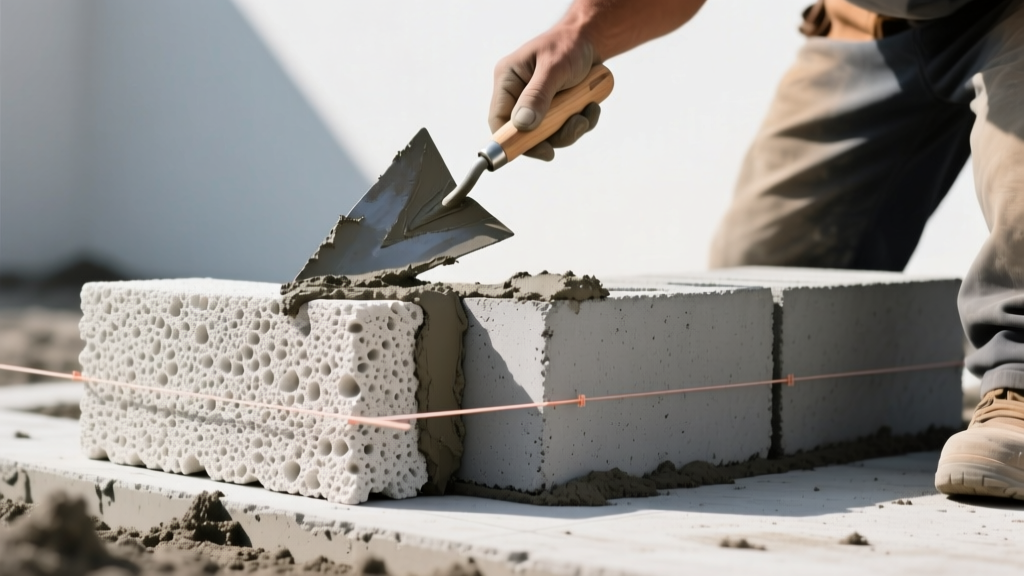
The foundational cost difference between lightweight 'cinder' blocks and standard concrete blocks stems from the aggregate used in the mix. Standard blocks use dense sand and crushed stone, while lightweight blocks use expanded shale, slate, or pumice. These engineered lightweight aggregates require specialized kiln-firing processes, which increases the upfront manufacturing cost per unit.
| CMU Type (8x8x16 Nominal) | Avg. Weight | Compressive Strength | Unit Cost (2026) | Pallet Cost (90 units) |
|---|---|---|---|---|
| Standard Weight Concrete | 38 - 42 lbs | 2,000 - 2,800 psi | $1.85 - $2.40 | $166 - $216 |
| Lightweight 'Cinder' (Pumice) | 24 - 28 lbs | 1,500 - 2,000 psi | $2.15 - $2.85 | $193 - $256 |
| Medium Weight (Hybrid Blend) | 30 - 35 lbs | 1,800 - 2,200 psi | $1.95 - $2.55 | $175 - $229 |
While the lightweight option carries a 15% to 25% material premium per block, evaluating the total project cost requires analyzing labor efficiency, structural reinforcement requirements, and long-term thermal performance. According to the ASTM C90 Standard Specification for Loadbearing Concrete Masonry Units, both block types can meet structural code requirements, but their application dictates the true cost of ownership.
Labor Economics: How Weight Impacts Mason Productivity
The most frequently overlooked variable in CMU cost estimation is mason fatigue. Laying an 8x8x16 wall requires repetitive lifting, twisting, and placing. Over an 8-hour shift, the cumulative weight lifted by a mason drastically impacts their hourly output rate.
- Standard Concrete Block (40 lbs): A skilled mason typically lays 90 to 110 blocks per day. The heavier weight accelerates muscle fatigue, requiring more frequent micro-breaks and slowing the pace during the final two hours of the shift.
- Lightweight 'Cinder' Block (26 lbs): Masons can lay 120 to 140 blocks per day. The 35% reduction in weight allows for sustained momentum and faster mortar bed preparation.
The Labor Calculation: If a masonry crew charges $85 per hour and lays 12% more lightweight blocks per day, the labor savings per square foot of wall ranges from $0.90 to $1.40. In many commercial projects, this labor savings entirely absorbs the $0.30 to $0.45 per-block material premium, making lightweight CMUs the more cost-effective choice for above-grade, non-load-bearing partition walls.
Hidden Lifecycle Costs: Mortar, Grout, and Moisture Dynamics
Lightweight aggregates are highly porous. This porosity creates a hidden cost center during the laying and grouting phases that estimators must account for in their 2026 budgets.
Furthermore, when filling cells with structural grout, lightweight blocks absorb water from the grout mix. If the grout slump is not strictly maintained between 8 and 11 inches as mandated by TMS 402/602 Code and Specifications, the grout will stiffen prematurely in the cells, creating voids that compromise structural integrity and require costly core-drilling and re-grouting.
Structural Reinforcement and Insulation Cost Variables
The decision between standard and lightweight blocks heavily influences secondary material costs, specifically rebar placement and thermal insulation.
Rebar and Grout Consumption
Standard weight concrete blocks provide superior confinement for vertical and horizontal rebar. Because the webs (the solid cross-sections) of standard blocks are denser, they handle the shear forces of fully grouted cells better. For high-seismic zones or retaining walls, engineers will specify standard weight blocks to avoid the need for tighter rebar spacing. Using lightweight blocks in high-load scenarios often requires adding more vertical rebar (e.g., dropping from #4 bars at 48 inches on-center to 32 inches on-center) to achieve the same shear capacity, increasing steel costs by $1.15 to $1.80 per square foot.
Thermal Envelope and HVAC Sizing
Lightweight 'cinder' blocks inherently possess a higher R-value than dense concrete. An uninsulated 8-inch standard concrete block wall yields an R-value of roughly 2.5. An equivalent lightweight pumice block wall yields an R-value of 3.9 to 4.2. While neither meets modern IECC energy codes without added insulation, the lightweight block reduces the thermal bridging effect. When paired with rigid foam inserts or closed-cell spray foam in the cells, lightweight CMU walls can achieve R-14 to R-16, potentially allowing for a 3% to 5% reduction in the building's required HVAC tonnage, saving thousands in upfront mechanical equipment costs.
Total Project Cost Scenario: 1,000 Sq Ft Commercial Partition Wall
To illustrate the true cost divergence, here is a breakdown for a 1,000 square foot above-grade, non-load-bearing exterior partition wall (approx. 890 blocks required, accounting for 5% waste).
| Cost Category | Standard Weight Concrete | Lightweight 'Cinder' CMU |
|---|---|---|
| Block Material (890 units) | $1,867 | $2,269 |
| Mortar, Sand, & Admixtures | $410 | $465 (higher retention mix) |
| Masonry Labor (Installation) | $9,500 | $8,450 (faster lay rate) |
| Scaffolding & Equipment Rental | $800 | $750 (shorter rental period) |
| Total Estimated Cost | $12,577 | $11,934 |
| Cost Per Square Foot | $12.57 / sq ft | $11.93 / sq ft |
As demonstrated, the lightweight option yields a net savings of $643 on this specific wall assembly, driven entirely by labor velocity and equipment rental reductions, despite the higher unit cost of the blocks themselves.
Decision Framework: When to Specify Which Block
Do not default to standard concrete blocks simply because they are cheaper at the supply yard. Use this framework to optimize your 2026 construction budget based on structural and architectural requirements, referencing guidelines from the National Concrete Masonry Association (NCMA).
- Specify Standard Weight Concrete Blocks When: You are pouring below-grade foundation walls, building retaining walls subjected to lateral earth pressure, constructing shear walls in high-seismic zones, or building fire-rated shaft enclosures where the dense mass provides superior acoustic dampening and fire-resistance ratings without additional coatings.
- Specify Lightweight 'Cinder' CMUs When: You are constructing above-grade partition walls, multi-story exterior walls where reducing the dead load on the structural steel frame yields savings in beam sizing, or interior demising walls where the lighter weight reduces the required structural support and the porous nature aids in acoustic absorption when left unpainted.
Accurate cost estimation in masonry requires looking past the unit price of the block. By factoring in labor fatigue, mortar chemistry adjustments, and structural reinforcement densities, project managers can accurately identify which CMU type offers the lowest total installed cost for their specific application.
Written by
Priya KapoorPriya Kapoor is a real estate market analyst and construction economics researcher with expertise in housing affordability, development feasibility, and infrastructure investment. She holds a Master of Regional Planning from Cornell University and previously worked as a senior analyst at CBRE's Investment Properties group, where she modeled returns for $4B in mixed-use development pipelines. Priya now runs an independent research practice advising developers, municipalities, and REITs on construction cost forecasting and market timing. She publishes the quarterly "BuildMat Market Pulse" report tracking material price indices across 12 commodity categories. Based in Austin, TX, Priya serves on the board of Habitat for Humanity Austin and is a marathon runner.
More from Priya Kapoor
View all
Construction Cost
Cost to Build a 1600 Sq Ft Home in 2026: Full Breakdown
Accurate 2026 cost to build a 1600 sq ft home—material, labor, and regional pricing breakdowns included. Plan your budget with real-time estimates.
Aug 11, 2026

Wood & Lumber
Name the Types of Wood for Pressure Treatment and Preservation
Learn how to name the types of wood best suited for pressure treatment. Compare species treatability, chemical retention levels, and 2026 preservation costs.
Aug 4, 2026

Stone & Masonry
Stone Veneer Suppliers Lindenhurst: 2026 Cost Analysis
Analyze 2026 stone veneer costs in Lindenhurst, NY. Compare local supplier pricing, delivery fees, and Suffolk County installation labor rates.
Aug 4, 2026